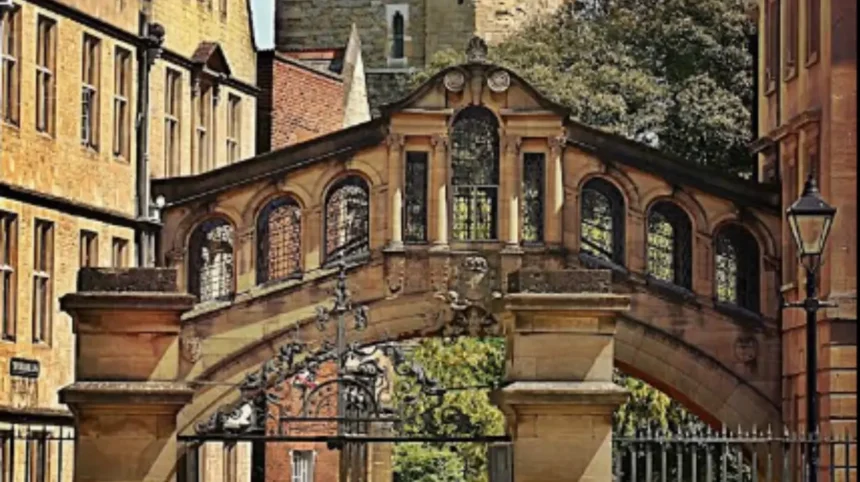
The Bridge of Sighs in Oxford, officially named Hertford Bridge, is a covered stone skyway that spans New College Lane to connect two quadrangles of Hertford College within the University of Oxford. Built in 1914 by architect Sir Thomas Graham Jackson, the Neo-Baroque structure serves as a safe pedestrian corridor while acting as one of the most recognizable historic architectural landmarks in England.
- Why Was the Bridge of Sighs Built in Oxford?
- Who Designed the Bridge of Sighs Oxford?
- How Did the Bridge Get Its Popular Name?
- Can the Public Walk Across the Bridge of Sighs?
- What Architectural Style Is the Bridge of Sighs Oxford?
- How Does the Oxford Bridge Compare to Cambridge and Venice?
- What is the exact address of the Bridge of Sighs in Oxford?
- Is the Bridge of Sighs Oxford free to view from the outside?
- Can you see the Bridge of Sighs on an Oxford walking tour?
- Why is the Oxford Bridge of Sighs famous in movies and television?
- How far is the Bridge of Sighs from the Radcliffe Camera?
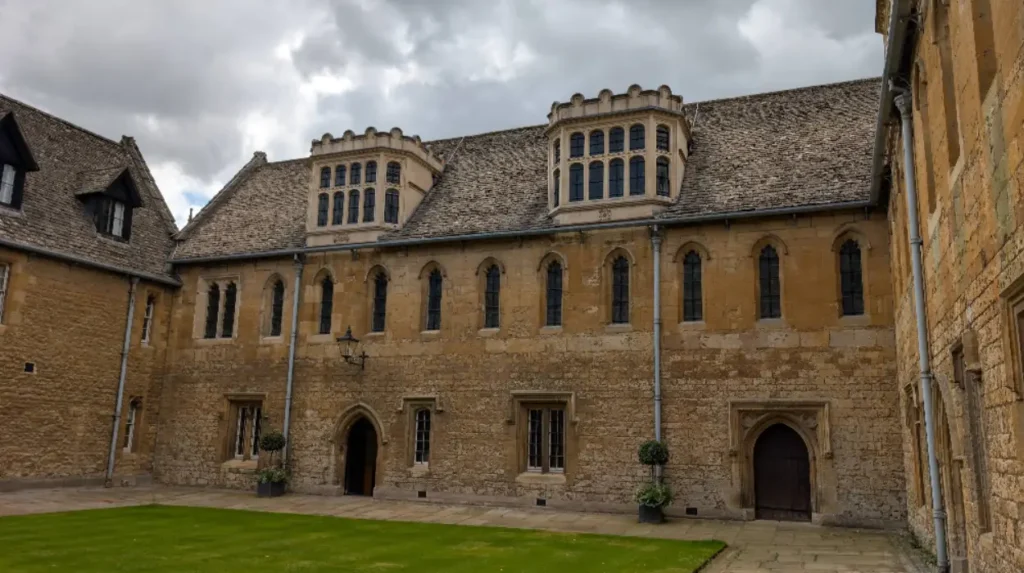
Hertford College consists of two distinct areas known as the Old Quadrangle and the New Quadrangle. Before the bridge was constructed, students and staff had to cross New College Lane at street level to travel between accommodation blocks, dining rooms, and administrative offices. This street-level commute presented safety hazards during bad weather and late hours, prompting college administrators to commission an elevated pedestrian crossway.
Architect Sir Thomas Graham Jackson designed the bridge using traditional Clipsham limestone, matching the historic stone fabric of surrounding academic buildings. The skyway features an elegant stone arch, detailed window openings, decorative carvings, and the official Hertford College coat of arms carved directly into the central stonework.
Although the landmark is universally referred to as the Bridge of Sighs, its architectural design does not replicate the famous Bridge of Sighs in Venice, Italy. Instead, its central arch design closely resembles the historic Rialto Bridge in Venice. The structure remains fully operational today, providing functional access for members of Hertford College while serving as a central visual attraction for tourists visiting Oxford.
Why Was the Bridge of Sighs Built in Oxford?
The Bridge of Sighs was built to solve practical logistics and space constraints at Hertford College during the late nineteenth and early twentieth centuries. Rapid student enrollment growth forced the college to acquire land on the north side of New College Lane, creating two physically separated college sites that required a secure, direct overhead physical connection.
In 1874, Hertford College was re-established on the historical site of Hart Hall, located on the south side of New College Lane. As student numbers expanded rapidly over subsequent decades, the college purchased additional property directly across the narrow street to build student accommodation. This geographic division forced students to exit security gates and walk outside to move between residential rooms and academic halls.
College administrators sought permission to construct an enclosed overhead walkway that would join the second-floor levels of both quadrangle buildings. Local civic authorities initial raised objections regarding public sightlines and historical preservation along New College Lane. Approval was eventually granted after architect Thomas Graham Jackson presented a refined Neo-Baroque plan that complemented neighboring structures like the Bodleian Library and the Sheldonian Theatre.
Construction began in 1913 and reached full completion in 1914. The physical skyway immediately improved college operations by creating a climate-controlled thoroughfare. Today, this structure stands as an exceptional example of early twentieth-century academic infrastructure integration, blending utilitarian traffic management with classical architectural elegance.
Who Designed the Bridge of Sighs Oxford?
Sir Thomas Graham Jackson designed the Bridge of Sighs in Oxford as part of his extensive architectural transformations across the University of Oxford. Jackson was one of the most prominent Victorian and Edwardian architects in Great Britain, renowned for shaping the visual character of the university through his distinct Anglo-Jackson revivalist architectural style.
Jackson was commissioned by Hertford College due to his extensive experience designing academic structures throughout Oxford. His earlier local portfolio included the Examination Schools on High Street, key residential wings at Brasenose College, and major structural additions at Trinity College. His deep familiarity with local stone materials made him the ideal choice for integrating modern skyways into medieval urban landscapes.
For Hertford Bridge, Jackson chose an English Neo-Baroque structural framework featuring symmetry, expressive stonework, and rhythmic window placing. He incorporated small leaded windows to flood the interior corridor with natural daylight while preserving exterior privacy. He personally supervised the selection of local limestone to ensure identical aging characteristics with the adjoining hall walls.
The completion of the bridge in 1914 marked one of Jackson’s final major contributions to the University of Oxford. Knighthood was conferred upon him for his services to British architecture. His legacy endures through this iconic skyway, which continues to demonstrate how functional structural additions can achieve timeless artistic alignment with surrounding medieval streetscapes.
How Did the Bridge Get Its Popular Name?
The Bridge of Sighs in Oxford acquired its popular nickname through student folklore and visual association with Venetian architecture, despite structural design differences. Officially named Hertford Bridge, the popular moniker emerged during the early twentieth century as students compared their academic stress with historical tales associated with the original Bridge of Sighs in Venice.
The original Venetian Bridge of Sighs was constructed in 1600 to connect the Doge’s Palace with the state prison. According to local legend, condemned prisoners sighed as they caught their final view of Venice through window grilles before entering confinement. Oxford students adopted the phrase, claiming that undergraduates let out heavy sighs as they crossed the bridge toward administrative offices for academic discipline or exam results.
A secondary origin story relates to student health assessments conducted on college grounds. Local myths claim that college administrators periodically monitored student fitness metrics as undergraduates traversed the elevated corridor, leading to sighs of exhaustion. While these folklore tales lack primary historical documentation, the catchy nickname quickly eclipsed the official title of Hertford Bridge in travel literature and popular culture.
Architecturally, the Oxford structure bears greater resemblance to Venice’s Rialto Bridge due to its single dramatic arch, side window sequences, and decorative roof molding. Nevertheless, the name Bridge of Sighs stuck permanently. It remains a global example of how university culture and popular mythology can permanently redefine civic geographic nomenclature.
Can the Public Walk Across the Bridge of Sighs?
Public access across the interior of the Bridge of Sighs in Oxford is strictly restricted to current students, university fellows, staff, and authorized guests of Hertford College. General visitors and tourists are prohibited from entering the skyway interior to preserve campus security, student privacy, and structural integrity across the active academic facility.
The interior of Hertford Bridge functions as a private residential and administrative corridor within the college perimeter. Security access control systems are installed at both entry doors leading from the Old Quadrangle and New Quadrangle buildings. These security measures prevent unauthorized entry into private student accommodations and administrative spaces connected by the skyway.
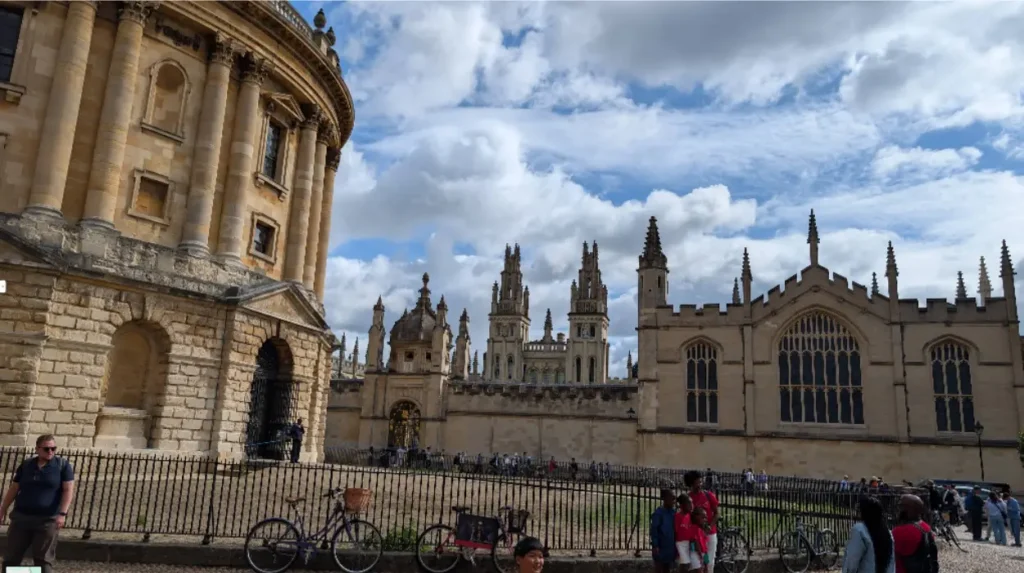
While interior access remains restricted, the exterior of the bridge is fully visible to the public 24 hours a day from street level along New College Lane. Millions of global travelers gather on the public pavement beneath the arch annually to view the stone carvings, taking photographs from the open vantage points near Catte Street and the Radcliffe Camera.
Hertford College occasionally opens its interior grounds, including historical access corridors, during public heritage events such as Oxford Open Doors. During these special civic programs, ticketed visitors may receive guided access through historic quadrangle spaces. Outside of these sanctioned heritage events, public appreciation of the landmark remains focused entirely on its exterior elevation.
What Architectural Style Is the Bridge of Sighs Oxford?
The Bridge of Sighs in Oxford represents the English Neo-Baroque style, characterized by monumental symmetry, rich surface ornamentation, carved stone coat of arms, and classic arched windows. Built in 1914, the design showcases late Edwardian architectural craft, which sought to revive classic seventeenth-century classical proportions across British institutional buildings.
Sir Thomas Graham Jackson incorporated multiple distinctive elements into the skyway structure. The base features a smooth segmental stone arch that spans New College Lane without requiring center supporting pillars in the roadway below. The main elevation contains divided light windows set within carved stone frames, allowing light entry while maintaining structural strength.
The central exterior section displays the official coat of arms of Hertford College, carved directly into the high-grade limestone paneling. Decorative scrollwork, molded cornices, and carved stone balustrades run along the roofline and lower base, creating textural variation that reacts dramatically to changing ambient sunlight throughout the day.
The interior features vaulted plaster ceiling panels, wood paneled wainscoting, polished hardwood flooring, and concealed electrical fittings. By utilizing regional Clipsham limestone, Jackson ensured that the early twentieth-century structure harmonized naturally with surrounding medieval and Renaissance buildings. This design balance makes the bridge a masterclass in historic architectural integration.
How Does the Oxford Bridge Compare to Cambridge and Venice?
The Oxford Bridge of Sighs differs significantly from its famous namesakes in Venice and Cambridge in terms of construction date, architectural style, structural purpose, and geographic setting. Comparing these three famous structures highlights the unique engineering and social role that Hertford Bridge fills within the British academic landscape.
The original Bridge of Sighs in Venice, Italy, was constructed in 1600 out of white limestone by architect Antonio Contino. Designed in the Italian Renaissance style, it features fully enclosed stone walls with narrow marble lattice grilles, serving originally as a secure transit canal bridge connecting prison cells to interrogation rooms inside the Doge’s Palace.
The Cambridge Bridge of Sighs was built in 1831 at St John’s College, designed by architect Henry Hutchinson in the Gothic Revival style. Unlike the Oxford bridge, the Cambridge structure spans a natural waterway, the River Cam, connecting two college courts. It features dramatic Gothic window tracery, pointed arches, and exterior stone battlements along its roofline.
What is the exact address of the Bridge of Sighs in Oxford?
The Bridge of Sighs is located on New College Lane, Oxford OX1 3BL, United Kingdom. It connects the main quadrangles of Hertford College, positioned directly opposite the entrance to the Bodleian Library and steps away from Radcliffe Square.
Is the Bridge of Sighs Oxford free to view from the outside?
Yes, viewing the exterior of the Bridge of Sighs from street level on New College Lane is completely free and accessible 24 hours a day. Visitors can walk underneath the archway and take photos without purchasing tickets or booking reservations.
Can you see the Bridge of Sighs on an Oxford walking tour?
Yes, almost all guided city and university walking tours in Oxford stop directly beneath the Bridge of Sighs. Professional tour guides highlight its construction history, student myths, and connections to neighboring landmarks like the Sheldonian Theatre.
Why is the Oxford Bridge of Sighs famous in movies and television?
The Bridge of Sighs is world-famous due to its frequent appearances in popular media, including Inspector Morse, Lewis, Endeavour, and various historical drama productions. Its distinctive stone arch provides an iconic visual backdrop representing classic Oxford academic life.
How far is the Bridge of Sighs from the Radcliffe Camera?
The Bridge of Sighs is located approximately 100 meters north of the Radcliffe Camera, representing a short 1-minute walk along Catte Street. Both iconic sites sit within the central historic pedestrian zone of Oxford University.