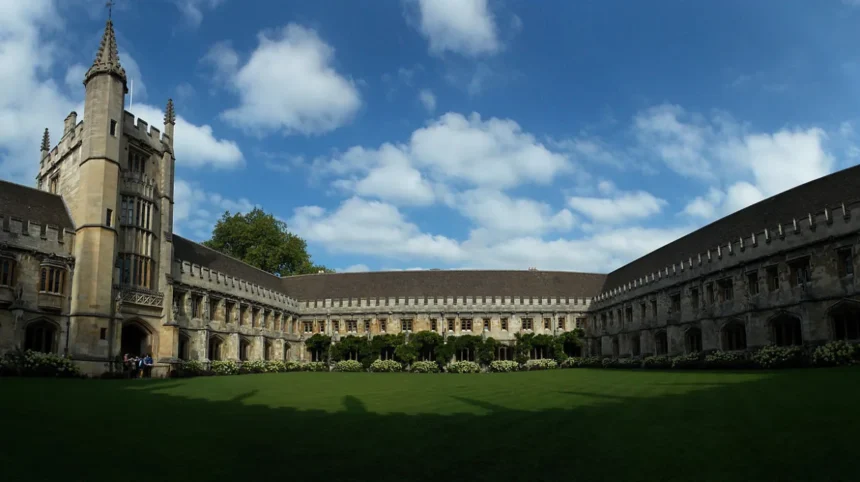
Oscar Wilde (1854-1900) entered Magdalen College, Oxford, in October 1874 and graduated in 1878. His four years at Oxford were not merely academic. They were the intellectual crucible in which his philosophy of aestheticism, his wit, and his public persona were formed. Oxford gave Wilde two prestigious prizes, two defining mentors, and one enduring worldview.
- What Did Oscar Wilde Study at Oxford University?
- How Did Oscar Wilde Arrive at Oxford and What Was His Background Before Enrolling?
- Who Were Oscar Wilde’s Most Important Mentors at Oxford?
- What Prizes and Academic Honors Did Oscar Wilde Win at Oxford?
- How Did Oxford Shape Oscar Wilde’s Philosophy of Aestheticism?
- What Was Oscar Wilde’s Social Life Like During His Oxford Years?
- What Long-Term Impact Did Oscar Wilde’s Oxford Years Have on His Literary Career?
What Did Oscar Wilde Study at Oxford University?
Oscar Wilde studied Literae Humaniores, commonly known as “Greats,” at Magdalen College, Oxford. This classical degree covered ancient Greek and Latin literature, philosophy, and history. Wilde earned a Double First, the highest academic distinction available, in 1878.
Literae Humaniores at Oxford in the 1870s was a rigorous program centered on original Greek and Latin texts. Students engaged directly with Plato, Thucydides, Aristotle, Virgil, and Cicero. The curriculum demanded close reading, philosophical analysis, and written composition in classical languages. Wilde excelled in every component. His command of Greek was described by examiners as exceptional.
He read Plato in the original and developed a deep admiration for Greek aesthetic thought, which later influenced his critical essays and dialogues, including “The Decay of Lying” (1889) and “The Critic as Artist” (1891). The Oxford examination system at the time required candidates to sit for written and oral examinations at the end of their degree. Wilde’s Double First placed him among the top graduates of his year and confirmed his standing as one of the most academically gifted students of his generation at the university.
How Did Oscar Wilde Arrive at Oxford and What Was His Background Before Enrolling?
Oscar Wilde arrived at Oxford after completing his undergraduate studies at Trinity College Dublin, where he had already won the Berkeley Gold Medal for Greek in 1874. He entered Magdalen College, Oxford, on a Demyship, a form of scholarship worth 95 pounds per year.
Wilde was born on 16 October 1854 in Dublin, Ireland. His father was Sir William Wilde, a prominent ophthalmologist and antiquarian. His mother, Jane Francesca Wilde, wrote nationalist poetry under the pen name “Speranza” and hosted one of Dublin’s most celebrated literary salons. This background gave Wilde early exposure to intellectual culture, poetry, and public performance.
At Trinity College Dublin, Wilde studied from 1871 to 1874 under the classical scholar John Pentland Mahaffy, who introduced him to Greek culture and took him on an influential tour of Greece and Italy in 1877. Mahaffy’s influence on Wilde’s appreciation for Hellenic thought was considerable. The Demyship at Magdalen College was a competitive award. It required Wilde to demonstrate strong academic potential in classics. His success in securing this scholarship confirmed his abilities before he even arrived in Oxford and placed him in an institution that produced some of Britain’s leading public intellectuals.
Who Were Oscar Wilde’s Most Important Mentors at Oxford?
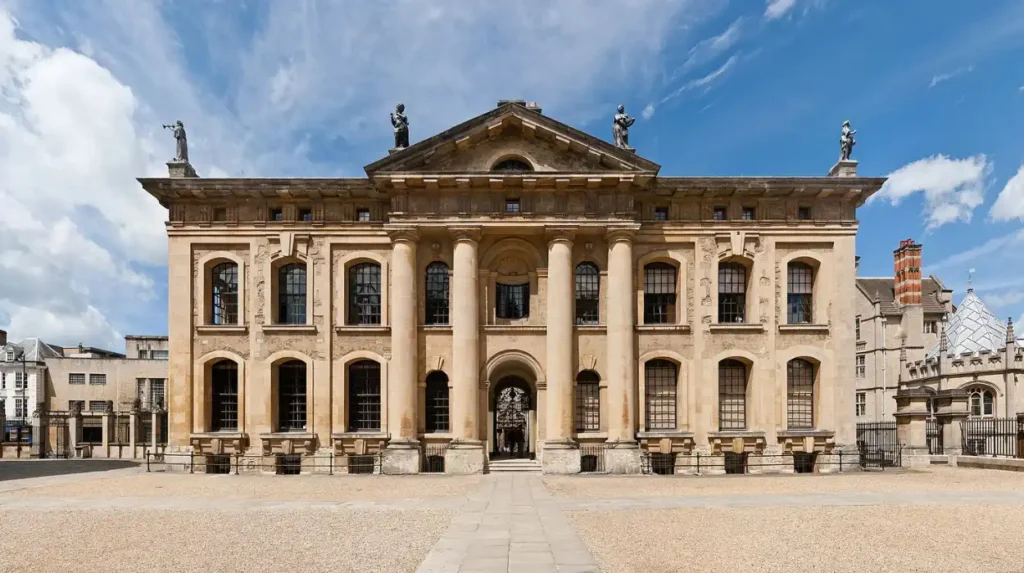
The two most important mentors during Oscar Wilde’s Oxford student days were John Ruskin (1819-1900), the art critic and social thinker, and Walter Pater (1839-1894), the essayist and aesthete. These two figures represented opposing but equally formative intellectual influences on Wilde.
John Ruskin was Slade Professor of Fine Art at Oxford when Wilde arrived. Ruskin believed art carried moral responsibilities and that beauty was inseparable from ethical purpose. He organized a famous road-building project in the village of Ferry Hinksey, near Oxford, in which he invited undergraduates to participate as a demonstration of the dignity of manual labor and social responsibility. Wilde was among the students who took part in 1874 and 1875.
The project had little practical success as a road, but it brought Wilde into direct personal contact with Ruskin and exposed him to the idea that aesthetic sensibility could be connected to civic life. Walter Pater offered a contrasting vision. His collection of essays, “Studies in the History of the Renaissance” (1873), contained the famous conclusion urging readers to burn with a hard gemlike flame, to live intensely for the sake of experience and sensation.
Pater argued that art existed for its own sake, independent of moral utility. This principle of “art for art’s sake” became the foundation of the aesthetic movement that Wilde would later champion publicly. Wilde read Pater’s “Renaissance” shortly after arriving at Oxford and described it as his golden book. He attended Pater’s lectures and sought personal tutorials with him. The tension between Ruskin’s ethical aestheticism and Pater’s pure aestheticism remained visible throughout Wilde’s mature work, where beauty and morality frequently compete.
What Prizes and Academic Honors Did Oscar Wilde Win at Oxford?
During Oscar Wilde’s Oxford student days, he won the Newdigate Prize for Poetry in 1878 and graduated with a Double First in Literae Humaniores the same year. These two achievements represent the peak of undergraduate academic recognition at Oxford in his era.
The Newdigate Prize, established in 1806 through an endowment by Sir Roger Newdigate, is awarded annually for the best composition in English verse by an Oxford undergraduate. The subject for the 1878 competition was Ravenna, the Italian city famous for its Byzantine mosaics. Wilde submitted a poem of 262 lines that drew on his own travels through Italy in 1877, made possible by a loan from his Trinity College tutor John Mahaffy. The poem describes the historical significance of Ravenna, its role in the decline of the Roman Empire, its Byzantine art, and its connection to the poet Dante, who died in the city in 1321. Wilde’s poem was selected from a competitive field.
He read it publicly at the Sheldonian Theatre in Oxford on 26 June 1878, a ceremony attended by university dignitaries and the public. The reading was well received and established Wilde’s name beyond his immediate circle. The Double First, awarded in the same year, combined with the Newdigate Prize to give Wilde two simultaneous public victories at the close of his Oxford career. His tutor at Magdalen, John Wordsworth, wrote that the result was the most brilliant he had ever known in the Final Classical Schools.
How Did Oxford Shape Oscar Wilde’s Philosophy of Aestheticism?
Oxford provided Oscar Wilde with the philosophical vocabulary, the intellectual community, and the personal encounters necessary to develop his philosophy of aestheticism. Aestheticism holds that art is the highest form of human achievement and that beauty is a value independent of moral, political, or social function.
Wilde encountered the foundational texts of aestheticism directly at Oxford. Walter Pater’s “Studies in the History of the Renaissance” provided the theoretical core. The Pre-Raphaelite Brotherhood, a group of mid-Victorian painters including Dante Gabriel Rossetti and Edward Burne-Jones, had already popularized the idea that painting should prioritize beauty and sensory richness over narrative or moral instruction. Burne-Jones was personally known to several figures in the Oxford academic community. John Ruskin, despite his moral framework, had trained an entire generation to take visual art seriously as a subject worthy of sustained intellectual attention.
Wilde absorbed all of these influences simultaneously. He began decorating his rooms at Magdalen College with blue china, peacock feathers, sunflowers, and Japanese fans, objects that signaled aesthetic sensibility and that became associated with the broader aesthetic movement of the 1870s and 1880s. He cultivated the persona of the aesthete deliberately and openly.
Fellow students noticed and commented on his affectations. Wilde’s Oxford persona was a direct rehearsal for the public role he would perform in London and, from 1882, during his lecture tour of the United States and Canada. The aesthetic philosophy he developed at Oxford informed his 1890 novel “The Picture of Dorian Gray,” his 1891 essays in “Intentions,” and his lecture “The English Renaissance of Art,” delivered in New York on 9 January 1882.
What Was Oscar Wilde’s Social Life Like During His Oxford Years?
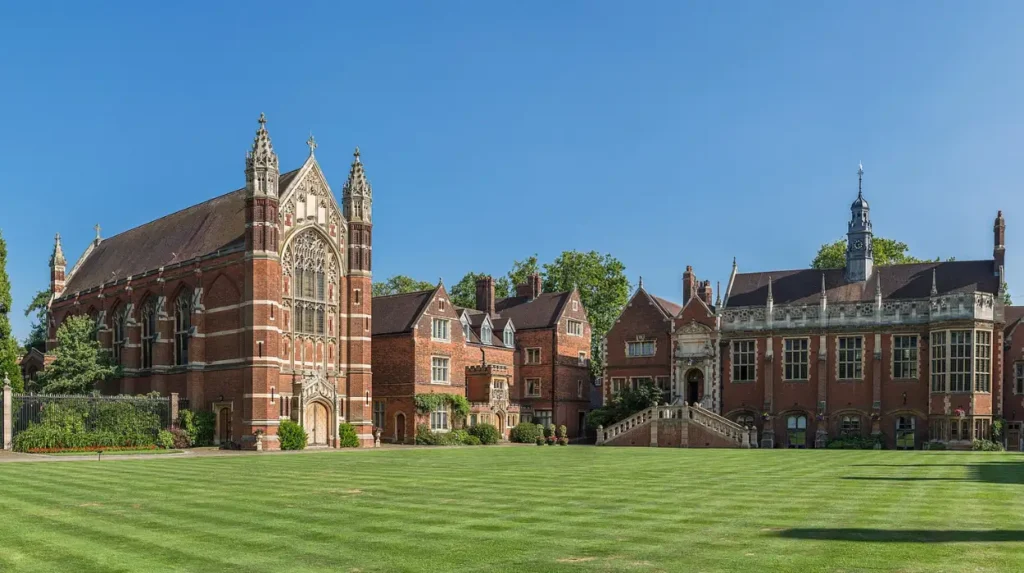
Oscar Wilde’s social life during his Oxford student days was active, visible, and deliberately cultivated. He joined the Apollo Lodge of Freemasons in 1875, attended artistic and intellectual gatherings, traveled to Italy and Greece, and built friendships that extended his network beyond Oxford into London artistic circles.
Wilde joined the Apollo University Lodge, a Freemasons lodge affiliated with Oxford University, on 23 February 1875. He later joined the University College Lodge and rose to the rank of Master Mason. His involvement with Freemasonry introduced him to a network of influential figures at a formative stage of his career. In 1877, Wilde traveled to Greece and Rome with John Mahaffy and two other students. The trip, which caused him to arrive late for the start of the summer term, resulted in Wilde being rusticated, meaning temporarily suspended, by the college authorities. He was also fined 47 pounds and 10 shillings.
Despite these penalties, Wilde considered the journey transformative. He visited the ruins of Olympia, Mycenae, and the Acropolis in Athens, experiences that deepened his engagement with classical Greek culture. Within Oxford, Wilde was known as a conversationalist of unusual ability. He cultivated an image of effortless brilliance and performed his wit consciously. Contemporaries recalled his ability to hold rooms of students with extended monologues on art, beauty, and classical civilization. This performative dimension of his social presence at Oxford was foundational to his later career as a lecturer, playwright, and celebrity personality in Victorian London.
What Long-Term Impact Did Oscar Wilde’s Oxford Years Have on His Literary Career?
Oscar Wilde’s Oxford student days established the philosophical, literary, and social foundations that defined his entire subsequent career. The aestheticism he developed there shaped every major work he produced, from his poetry collections of the 1880s to his plays of the 1890s.
Wilde’s first published collection, “Poems” (1881), drew directly on the themes and forms he had explored at Oxford. The Newdigate Prize poem “Ravenna” appeared in the collection. Several other poems in the volume reflected his engagement with Italian art, Greek mythology, and the aesthetic philosophy of Pater.
His 1882 American lecture tour, which covered 260 venues across the United States and Canada, was built around the aesthetic ideas he had formed at Oxford. He spoke on topics including “The English Renaissance of Art,” “The House Beautiful,” and “The Decorative Arts.” His lectures reached an audience of tens of thousands and established his international reputation before he had published any major prose or drama. “The Picture of Dorian Gray” (1890) dramatizes the conflict between Pater’s pure aestheticism and the moral consequences of living solely for sensation, a conflict Wilde had first encountered intellectually through the competing influences of Ruskin and Pater at Oxford.
His four major society comedies, including “Lady Windermere’s Fan” (1892) and “The Importance of Being Earnest” (1895), deploy the wit and verbal performance that Wilde first developed in Oxford common rooms and lecture halls. His critical essays, particularly those in “Intentions” (1891), engage directly with the philosophical debates about art, criticism, and truth that he had encountered during his studies under Pater and in the classical curriculum of Literae Humaniores. Oxford did not merely educate Oscar Wilde. It produced the conditions in which his distinctive voice, intellect, and public identity could emerge.
What is the famous story of Oscar Wilde?
Oscar Wilde’s most famous story is “The Happy Prince” (1888), in which a golden statue asks a swallow to distribute his jewels and gold leaf to the city’s poor. The story reflects Wilde’s themes of sacrifice, beauty, and compassion. It remains one of the most widely read pieces of children’s literature in the English language.
What caused Oscar Wilde’s death?
Oscar Wilde died on 30 November 1900 in Paris at the age of 46 from cerebral meningitis, likely caused by an ear infection he had suffered since his time in prison. His health deteriorated severely during his two years of hard labor at Reading Gaol between 1895 and 1897. He died in a modest hotel room on the Left Bank under the name Sebastian Melmoth.
What is Oscar Wilde’s writing style?
Oscar Wilde’s writing style is characterized by wit, paradox, and epigram delivered through elegant and precise prose. He consistently inverted conventional moral expectations to expose social hypocrisy, a technique visible across his plays, essays, and fiction. His style draws heavily on the aesthetic philosophy he developed during his Oxford student days under Walter Pater.
What is Oscar Wilde’s most famous quote?
Oscar Wilde’s most cited quote is “I can resist everything except temptation,” which appears in his 1892 play “Lady Windermere’s Fan.” The line encapsulates his signature technique of using apparent contradiction to expose human weakness. It remains one of the most recognized epigrams in English literary history.
What are the four comedies of Oscar Wilde?
Oscar Wilde’s four society comedies are “Lady Windermere’s Fan” (1892), “A Woman of No Importance” (1893), “An Ideal Husband” (1895), and “The Importance of Being Earnest” (1895). Each play uses drawing-room settings and sharp dialogue to satirize Victorian aristocratic morality and social convention. “The Importance of Being Earnest” is widely considered his comic masterpiece.