Philip Pullman’s His Dark Materials is a trilogy of fantasy novels first published between 1995 and 2000. The series includes Northern Lights (1995), The Subtle Knife (1997), and The Amber Spyglass (2000). Pullman set his narrative across multiple parallel worlds, grounding the story in real geographic locations, particularly in Oxford, England, and the Arctic region of Svalbard.
- Where Did Philip Pullman Set His Dark Materials?
- What Is Jordan College Based On in Real Oxford?
- Which Real Oxford Locations Appear in His Dark Materials?
- Where Was the His Dark Materials TV Series Filmed?
- What Is the Real-World Significance of Svalbard in His Dark Materials?
- How Did Philip Pullman’s Time in Oxford Shape the Geography of His Dark Materials?
- What Locations Feature in The Subtle Knife and The Amber Spyglass?
- How Can Visitors Explore Philip Pullman’s His Dark Materials Locations Today?
- Why Do Philip Pullman’s His Dark Materials Sites Matter for Literary and Cultural Heritage?
The BBC and HBO television adaptation, which aired from 2019 to 2022, brought many of these locations to a global audience. Understanding where Pullman drew his inspiration and where the production filmed provides a deeper relationship with the story’s world-building and geographic foundation.
Where Did Philip Pullman Set His Dark Materials?
Philip Pullman’s His Dark Materials is primarily set in an alternate version of Oxford, England, where the Magisterium controls society and every human has an animal companion called a daemon. The story expands across the Arctic, London, and multiple parallel universes.
Oxford serves as the central anchor of the entire trilogy. Pullman lived and worked in Oxford for many years, and the city’s architecture, institutions, and atmosphere directly shaped the fictional world he constructed. In the novels, Oxford exists in a parallel dimension where technology and social order differ from the real world, but the physical geography mirrors genuine Oxford landmarks with precision. The fictional Jordan College, where protagonist Lyra Belacqua grows up, draws directly from the architecture and collegiate structure of real Oxford University colleges.
Pullman described the streets, riverbanks, and rooftops of his alternate Oxford with enough specificity that readers familiar with the real city recognize the source material immediately. The Thames, called the Isis in Oxford, runs through both the real and fictional settings. Pullman also extended the geography northward to the Arctic archipelago of Svalbard, Norway, which serves as the territory of the armored bears in the novels.
What Is Jordan College Based On in Real Oxford?
Jordan College, the fictional institution at the heart of Northern Lights, is based on a combination of real Oxford colleges, primarily Exeter College and Christ Church. Pullman studied at Exeter College and drew heavily from its physical structure.
Exeter College, founded in 1314, sits on Turl Street in central Oxford. Its library, hall, and chapel provided Pullman with the interior geography that became Jordan College in his imagination. The college’s Gothic Revival chapel, designed by George Gilbert Scott and completed in 1859, closely matches descriptions of Jordan College’s chapel in the novels. Christ Church, Oxford’s largest and most architecturally distinctive college, contributed its grand hall and quadrangle to the composite image of Jordan College.
The Bodleian Library, one of the oldest libraries in Europe with origins dating to 1602, also appears in the mythology of Jordan College as an institution of forbidden knowledge. Pullman acknowledged Exeter College explicitly as the primary model for Jordan College in multiple interviews and public statements. The college’s gardens, which back onto Broad Street and New College Lane, gave Pullman the enclosed green spaces that Lyra explores in the opening chapters of Northern Lights.
Which Real Oxford Locations Appear in His Dark Materials?
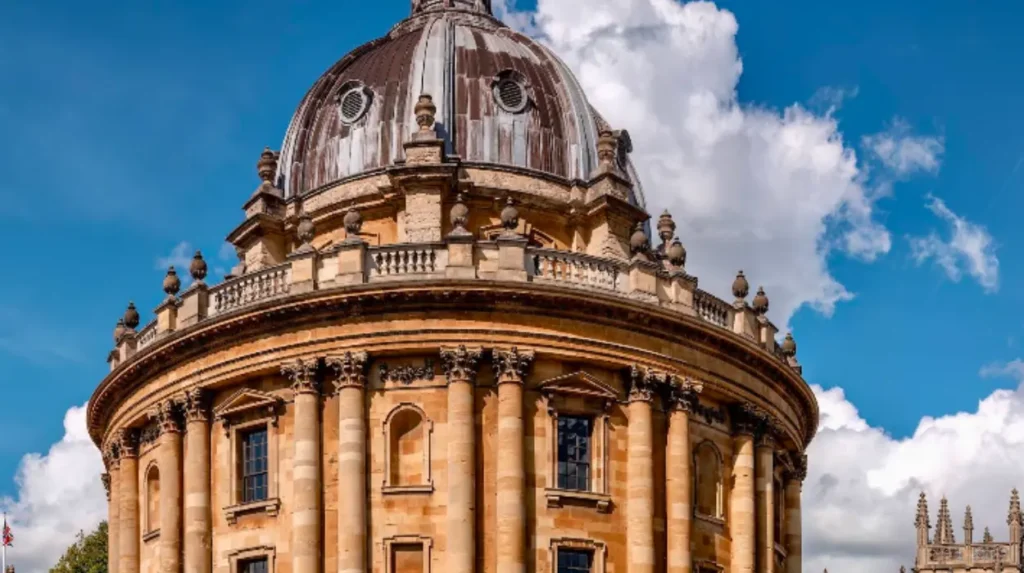
Philip Pullman’s Oxford includes direct references to real streets, buildings, and waterways that fans can visit today. The Covered Market, Radcliffe Camera, and the Oxford Canal are among the most directly referenced real locations.
The Radcliffe Camera, a circular library building completed in 1749 and designed by James Gibbs, appears in both the novels and the television adaptation as a background landmark of Lyra’s Oxford. The Oxford Covered Market, which has operated continuously since 1774, features in scenes depicting the commercial life of the city. Duke Humfrey’s Library inside the Bodleian complex, dating to the 15th century, provided the visual and atmospheric model for the Jordan College library where Lyra discovers hidden truths about Dust.
The Oxford Canal, constructed between 1769 and 1790, runs along the western edge of Oxford and corresponds to the waterway routes used by the Gyptians in Northern Lights. Port Meadow, a large flat flood meadow beside the River Thames northwest of the city center, is the open space where Lyra and her friends play in the early sections of the novel. The meadow has been common land since before the Norman Conquest and remains publicly accessible today.
Where Was the His Dark Materials TV Series Filmed?
The BBC and HBO television adaptation of Philip Pullman’s His Dark Materials filmed primarily at Wolf Studios Wales in Cardiff, with location shoots across Oxford, the United Kingdom, and parts of Eastern Europe.
Wolf Studios Wales, located in the Roath Lock development in Cardiff Bay, served as the main production base for all three seasons broadcast between 2019 and 2022. The studio constructed large-scale sets representing Jordan College interiors, the Magisterium headquarters, and various parallel world environments. Oxford provided essential exterior footage, with the Bodleian Library, Radcliffe Square, and Exeter College quadrangle all appearing in the production. Blenheim Palace, a Baroque country house in Woodstock, Oxfordshire, built between 1705 and 1722, stood in for several grand institutional buildings. Chatsworth House in Derbyshire, one of England’s largest stately homes dating to the 16th century, contributed additional architectural backdrops. For Arctic sequences representing Svalbard, the production filmed in Iceland, particularly around the Vatnajokull glacier and the volcanic landscapes of the south coast. The Trolltunga region of Norway also provided aerial and exterior footage for the armored bear territory. Brno in the Czech Republic doubled for parts of the Magisterium’s Geneva in season two and three filming.
What Is the Real-World Significance of Svalbard in His Dark Materials?
Svalbard is a Norwegian Arctic archipelago located between 74 and 81 degrees north latitude, approximately 650 kilometers north of mainland Norway. In Philip Pullman’s trilogy, it is the kingdom of the Panserbjorne, the armored bears led by Iorek Byrnison.
The real Svalbard archipelago covers approximately 61,022 square kilometers and has a permanent population of around 2,600 people, centered in the settlement of Longyearbyen. The archipelago is governed under the 1920 Svalbard Treaty, which grants Norway sovereignty while allowing citizens of signatory nations to conduct commercial activities.
Svalbard’s landscape features permanent ice caps, Arctic tundra, and dramatic fjords that match the hostile, frozen terrain Pullman describes in Northern Lights. The archipelago hosts polar bears, which number around 3,000 in the wider Barents Sea region, making the choice of Svalbard as bear territory geographically logical. Pullman transformed the real political structure of Svalbard into a medieval bear kingdom governed by tradition and combat. The islands’ permanent darkness in winter months, a real meteorological phenomenon where the sun does not rise between late October and mid-February, contributes directly to the atmospheric tone of the Arctic sequences in the novel.
How Did Philip Pullman’s Time in Oxford Shape the Geography of His Dark Materials?
Philip Pullman was born in Norwich in 1946 and moved to Oxford after studying at Exeter College, where he later worked as a middle school teacher. His 30-year residence in Oxford produced the deep geographic familiarity evident throughout the trilogy.
Pullman taught at Bishop Kirk Middle School in Oxford from 1970 to 1986, during which period he began developing the ideas and settings that became His Dark Materials. His daily familiarity with Oxford’s streets, parks, and institutional buildings gave him precise knowledge of spatial relationships within the city that he then transposed into his alternate world. Pullman has described walking the same routes Lyra walks and mentally mapping her movements against real Oxford geography. The rooftops Lyra crosses in the novel correspond to actual Oxford college rooflines.
The river route the Gyptians travel mirrors the Thames and canal network Pullman would have known from his years in the city. Pullman moved to a village near Oxford after leaving teaching to write full-time, maintaining his connection to the region throughout his career. The Oxford skyline, famously described as the city of dreaming spires in a phrase coined by poet Matthew Arnold in 1865, appears repeatedly in the atmospheric descriptions of Lyra’s city.
What Locations Feature in The Subtle Knife and The Amber Spyglass?
The second and third novels of Philip Pullman’s His Dark Materials trilogy introduce Cittàgazze, a city in a third parallel world, and a series of locations drawn from the geography of the Himalayas, the land of the dead, and the physical world of the mulefa.
Cittàgazze, the spectral city introduced in The Subtle Knife, is described as a Mediterranean coastal city resembling parts of southern Italy and the Ligurian coast of northwest Italy. The city is inhabited by Spectres that consume adult souls, leaving only children safe. Pullman drew its architecture from Italian and Spanish coastal towns characterized by narrow streets, arcades, and harbor fronts. For the television adaptation, Cittàgazze was filmed on location in Genoa, Italy, and in set constructions at Wolf Studios Wales.
The Himalayas appear in The Amber Spyglass as the location of the cave where Mrs. Coulter hides Lyra, a setting based on the high-altitude mountain geography of Nepal and Tibet, with peaks exceeding 8,000 meters. The land of the dead, a central location in The Amber Spyglass, has no geographic real-world equivalent but draws conceptually from mythological underworld traditions found in ancient Greek and Norse cosmology. The mulefa world, where Mary Malone observes the creatures with wheeled limbs and seed pods, is described as an open savanna landscape with no specific real-world geographic model.
How Can Visitors Explore Philip Pullman’s His Dark Materials Locations Today?
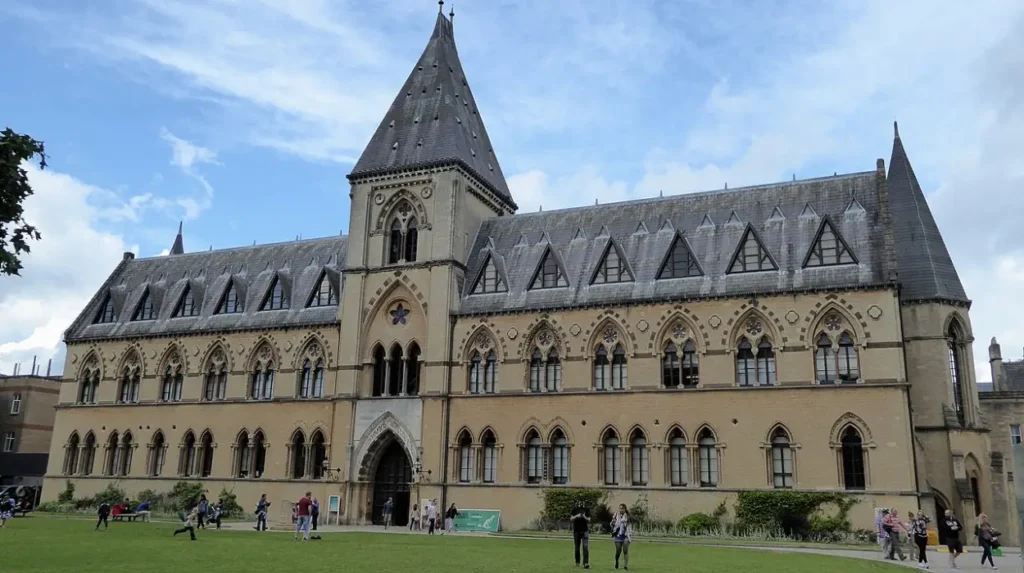
Philip Pullman’s His Dark Materials locations in Oxford are publicly accessible through a combination of college visits, university library tours, and self-guided walking routes. Oxford tourism infrastructure supports dedicated literary and film location tourism.
Exeter College admits visitors to its public areas, including the chapel, hall, and gardens, on most days when the college schedule permits. Advance booking is recommended during peak tourist seasons from June through September. The Bodleian Library offers daily guided tours of Duke Humfrey’s Library, the Divinity School, and the Radcliffe Camera, all of which connect directly to the visual world of Jordan College. The Oxford University Museum of Natural History, opened in 1860 and located on Parks Road, features in later sections of the television adaptation and is freely accessible to the public.
Port Meadow is open access land with no admission charge, accessible from the Walton Well Road entrance near Jericho. The Oxford Tourist Information Centre, operated by the Experience Oxfordshire organization, distributes self-guided literary walking maps that include Philip Pullman locations as part of broader Oxford literary heritage trails. Cardiff, the filming base for the television series, does not offer public access to Wolf Studios Wales, but the surrounding Cardiff Bay area where the studio is located is a publicly accessible waterfront development.
Why Do Philip Pullman’s His Dark Materials Sites Matter for Literary and Cultural Heritage?
Philip Pullman’s His Dark Materials sites represent a significant point in the intersection of modern literary fiction and physical geography. The trilogy has sold over 25 million copies worldwide and is taught in secondary school curricula in the United Kingdom and internationally.
The Oxford locations associated with Pullman’s trilogy carry formal recognition within the UK’s literary tourism sector. The British Council includes His Dark Materials in its list of significant British literary works for international cultural promotion. Oxford City Council has acknowledged the economic contribution of literary tourism, which alongside film tourism generates an estimated 750 million pounds annually for the UK economy according to VisitBritain research published in 2019. The physical preservation of Oxford’s medieval and early modern architecture means that the sites Pullman used as models remain largely unchanged from the period when he was writing the trilogy in the 1980s and 1990s.
Exeter College, the Bodleian Library, and the Oxford canal network all maintain their historic character under heritage protection legislation, including the Planning (Listed Buildings and Conservation Areas) Act 1990. The continuation of the His Dark Materials universe through Pullman’s Book of Dust trilogy, beginning with La Belle Sauvage in 2017 and The Secret Commonwealth in 2019, has extended the geographic and narrative world and introduced new Oxford-based locations that sustain ongoing visitor interest in the real sites.
Where do they film His Dark Materials?
His Dark Materials was filmed primarily at Wolf Studios Wales in Cardiff. Additional location shoots took place in Oxford, Iceland, and the Czech Republic for Arctic and alternate world sequences.
Which Pakistani studied in Oxford?
Several notable Pakistanis studied at Oxford University, including former Prime Minister Benazir Bhutto, who attended Lady Margaret Hall, and Imran Khan, who studied at Keble College in the 1970s.
How many Muslims live in Oxford?
Several notable Pakistanis studied at Oxford University, including former Prime Minister Benazir Bhutto, who attended Lady Margaret Hall, and Imran Khan, who studied at Keble College in the 1970s.
How many Muslims live in Oxford?
According to the 2021 UK Census, approximately 12,000 Muslims live in Oxford, representing around 6.5 percent of the city’s total population of roughly 152,000 residents.
Did Mohammed Hijab go to Oxford University?
Mohammed Hijab, the British Muslim author and debater, has stated he studied at the University of London. No confirmed academic record places him as a student at Oxford University.