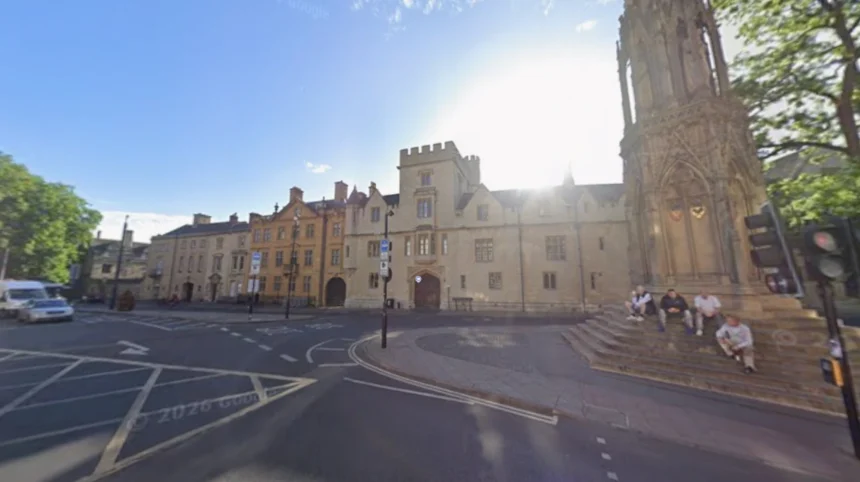
What is the Martyrs Memorial Oxford? The Martyrs Memorial Oxford is a prominent Victorian Gothic stone monument situated at the intersection of St Giles, Magdalen Street, and Beaumont Street in Oxford, England. Sir George Gilbert Scott designed the memorial between 1841 and 1843 to commemorate three 16th-century Anglican bishops burned at the stake.
- Why Was the Martyrs Memorial Built in Oxford?
- Who Were the Three Oxford Martyrs Commemorated at the Site?
- What Is the Architectural Design of the Martyrs Memorial?
- Where Is the Exact Execution Site of the Oxford Martyrs?
- How Has the Monument Been Restored and Preserved Over Time?
- What is the difference between the Martyrs Memorial and the execution cross?
- Can visitors go inside the Martyrs Memorial Oxford?
- Why are the statues on the memorial made from a different stone?
- What famous quote was said at the Oxford Martyrs execution?
- Is there an admission fee to view the Martyrs Memorial in Oxford?
The monument stands directly to the west of Balliol College and south of St Giles Church. The Oxford Martyrs Memorial Committee commissioned the stone structure to honor Thomas Cranmer, Nicholas Ridley, and Hugh Latimer. Queen Mary I ordered the execution of these three Protestant leaders during the English Reformation Marian persecutions.
Architect George Gilbert Scott modeled the monument after the 13th-century Eleanor Crosses erected by King Edward I. Sculptor Henry Weekes carved the three distinct statues of the martyrs out of imported Caen stone. The main body of the monument utilizes durable Magnesian limestone to create an intricate, spire-like exterior.
The Oxford Preservation Trust completed a major restoration project on the structure in 2003 to repair weathered stonework. Today, the landmark serves as an educational historical point, an architectural focal point, and a public gathering space. Visitors access the site via public footpaths in central Oxford near the Ashmolean Museum.
Why Was the Martyrs Memorial Built in Oxford?
The Martyrs Memorial was built in Oxford between 1841 and 1843 to commemorate the 16th-century executions of Protestant bishops Thomas Cranmer, Nicholas Ridley, and Hugh Latimer, while simultaneously counteracting the 19th-century Anglo-Catholic Oxford Movement led by John Henry Newman.
Anglican clergymen led by Charles Pourtales Golightly established the Martyrs Memorial Committee in November 1838. The committee raised public subscriptions to build a permanent monument asserting the Protestant identity of the Church of England. This initiative reacted directly against the Oxford Movement, also known as the Tractarian Movement.
The Oxford Movement advocated for the restoration of traditional Catholic liturgy, theology, and ritual within the Anglican Church. Evangelical Anglicans viewed these theological shifts as a dangerous alignment with the Church of Rome. The committee chose to honor the three bishops executed in Oxford during the reign of Queen Mary I to remind the public of the Reformation sacrifices.
The public fundraising appeal targeted national donors, university academics, and local residents across the United Kingdom. The project funded both the erection of the external memorial monument and the structural rebuilding of the nearby St Mary Magdalen Church aisle. Construction finalized in 1843, establishing an anti-Tractarian symbol in central Oxford.
Who Were the Three Oxford Martyrs Commemorated at the Site?
The three Oxford Martyrs commemorated at the site were Thomas Cranmer, the Archbishop of Canterbury; Nicholas Ridley, the Bishop of London; and Hugh Latimer, the Bishop of Worcester, who were all executed for heresy between 1555 and 1556.
Thomas Cranmer served as the first Protestant Archbishop of Canterbury under King Henry VIII and King Edward VI. Cranmer authored and compiled the Book of Common Prayer, establishing foundational liturgical texts for the Church of England. Authorities imprisoned Cranmer in the Tower of London before transferring him to Bocardo Prison in Oxford.
Nicholas Ridley served as the Master of Pembroke College, Cambridge, and later became the Bishop of Rochester and Bishop of London. Ridley actively promoted Protestant theology, removing traditional stone altars from churches to install simple wooden communion tables. Hugh Latimer served as the Bishop of Worcester and held a reputation as a influential royal preacher.
Queen Mary I reinstated Roman Catholicism following her accession to the English throne in 1553. Royal officials arrested the three churchmen for refusing to affirm Catholic doctrines regarding transubstantiation and papal authority. Heresy trials took place at the University Church of St Mary the Virgin in Oxford during 1554 and 1555.
What Is the Architectural Design of the Martyrs Memorial?
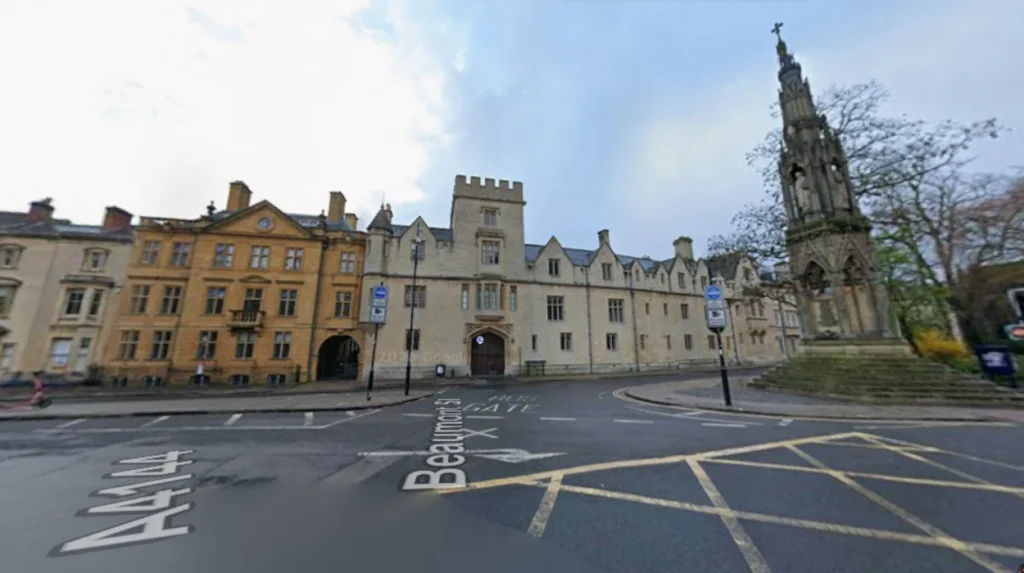
Sir George Gilbert Scott designed the Martyrs Memorial in the Victorian Gothic Revival style, basing its multi-tiered hexagonal layout on the medieval Eleanor Crosses built by King Edward I between 1290 and 1294.
The architectural design resembles an ornate, freestanding church spire rising three main levels above a stepped stone base. Scott selected the 13th-century Eleanor Cross at Waltham Cross as the primary geometric model for the structure. The structure features pointed arches, decorative crockets, carved pinnacles, and heraldic shields detailing regional coats of arms.
The main body of the monument utilizes Magnesian limestone, whereas sculptor Henry Weekes carved the three life-sized statues out of softer Caen stone imported from Normandy. Weekes positioned each figure in open niches facing distinct directions. Hugh Latimer faces west with his arms folded across his chest.
Nicholas Ridley faces east while holding a closed holy Bible. Thomas Cranmer faces north toward St Giles, holding a open scroll representing his written recantations and ultimate Protestant affirmation. The contrast between the cream Caen stone figures and the darker Magnesian limestone structure highlights the individual statues.
Where Is the Exact Execution Site of the Oxford Martyrs?
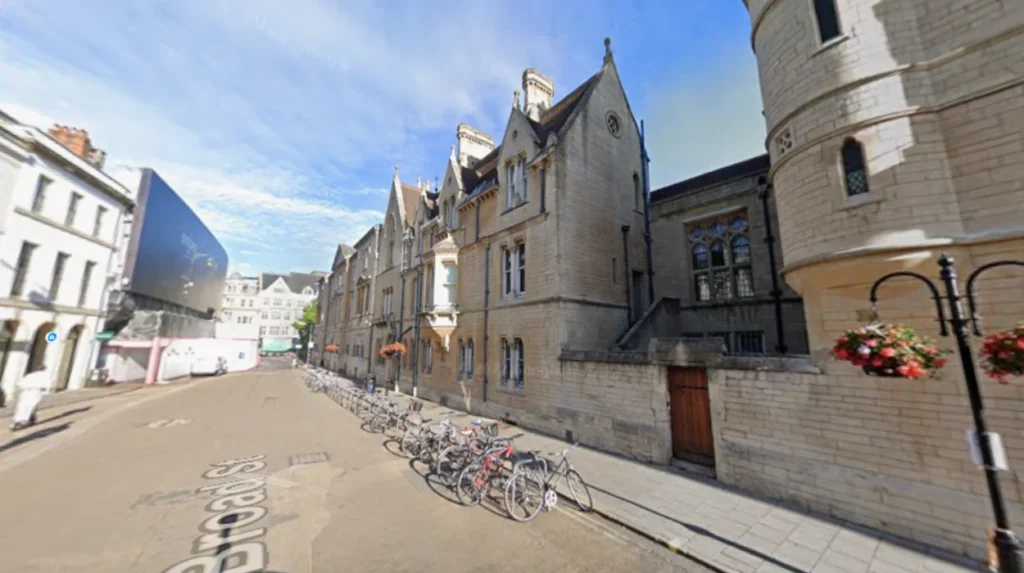
The exact execution site of the Oxford Martyrs is located on Broad Street, approximately 100 meters southeast of the Martyrs Memorial, outside the front entrance of Balliol College.
An iron cross embedded directly into the paved roadway marks the precise location where the burnings at the stake occurred. During the 16th century, this area formed a dry city ditch positioned just outside the northern medieval boundary wall of Oxford. Executioners erected wooden stakes, iron chains, and gorse pyres in this ditch.
Executioners burned Nicholas Ridley and Hugh Latimer together at the stake on October 16, 1555. Historical records state that Latimer encouraged Ridley by declaring that their deaths would light an unquenchable spiritual candle in England. Officials forced Thomas Cranmer to view their executions from the window of Bocardo Prison at Northgate.
Cranmer was executed five months later at the same Broad Street location on March 21, 1556. Before his death, Cranmer held his right hand into the flames first because that hand had previously signed recantations of his Protestant faith. Heavy scorching from the execution pyres remains visible on preserved wooden doors inside Balliol College.
How Has the Monument Been Restored and Preserved Over Time?
The Oxford Preservation Trust and the Oxford City Council completed comprehensive structural restorations of the Martyrs Memorial in 2003 after environmental pollution and cement repairs damaged the stone.
By the late 20th century, sulfur dioxide pollution, acid rain, and freeze-thaw cycles caused severe exfoliation of the Magnesian limestone and Caen stone. Inappropriate 20th-century repairs using impermeable Portland cement trapped moisture within the soft Victorian stone. The monument entered the national Buildings at Risk register in the late 1990s due to falling masonry risks.
The Oxford Preservation Trust launched a 75th-anniversary public fundraising campaign in April 2001 to secure restoration capital. Specialist conservators removed accumulated atmospheric soot using low-pressure micro-abrasive cleaning systems and gentle water mists. Craftsmen carved replacement stone indents and stabilized damaged features using ceramic T-pegs and lime-based mortars.
Conservators recarved missing sculpted details on the figures of Cranmer, Ridley, and Latimer. Painters reinstated authentic historical pigments across the heraldic shields and decorative religious symbols decorating the base. The site officially reopened to the public in January 2003, featuring restored stone steps and protective street bollards.
What is the difference between the Martyrs Memorial and the execution cross?
The Martyrs Memorial is an 1843 Victorian Gothic stone monument located at the junction of St Giles and Beaumont Street. The execution cross is a small iron marker set into the pavement on Broad Street that indicates the precise spot where the burnings occurred.
Can visitors go inside the Martyrs Memorial Oxford?
Visitors cannot enter the Martyrs Memorial because it is a solid stone structure designed as an outdoor public monument rather than a hollow building. Public access is limited to viewing the exterior statues and sitting along the outer stone steps.
Why are the statues on the memorial made from a different stone?
Architect George Gilbert Scott selected white Caen stone from Normandy for the statues to contrast against the darker Magnesian limestone body. This material choice highlighted the sculpted figures of Cranmer, Ridley, and Latimer within their architectural niches.
What famous quote was said at the Oxford Martyrs execution?
Bishop Hugh Latimer famously told Nicholas Ridley at the stake to play the man because their execution would light an unquenchable candle in England. This statement referred to their belief that their Protestant martyrdom would secure the future of the English Reformation.
Is there an admission fee to view the Martyrs Memorial in Oxford?
The Martyrs Memorial stands in an open public space at the intersection of St Giles and Magdalen Street, making it free to view 24 hours a day. No tickets or reservations are required to examine the monument or visit the nearby Broad Street cross.