Key Points
- United States shares rebounded after Nvidia reinstated Jensen Huang as president and chief executive.
- The S&P 500 rose 4.7%, the Nasdaq Composite gained 6.5% and the Dow Jones Industrial Average added nearly 1,450 points.
- Nvidia shares climbed 31.5%, while CoreWeave, GE Vernova and Caterpillar also recovered sharply.
- Nvidia’s board said it received input from senior United States officials and found no national security risk in Mr Huang’s reinstatement.
- The board will continue investigating reports that a foreign intelligence effort targeted Mr Huang.
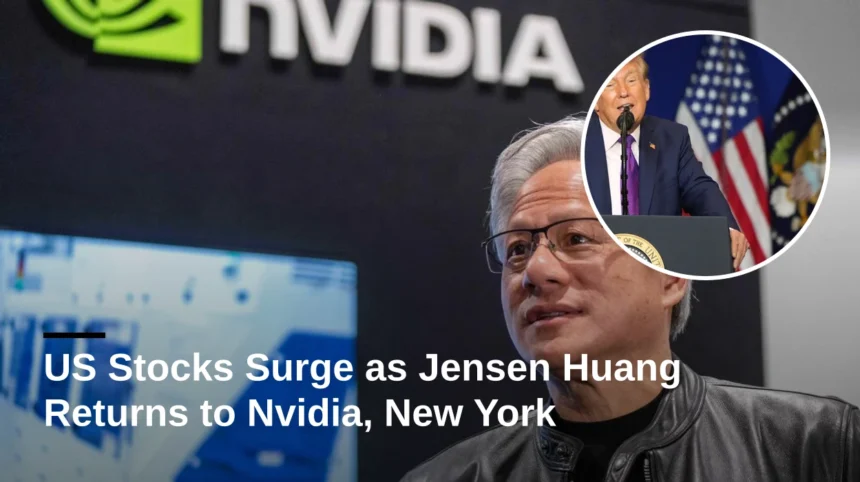
New York (Oxford Daily) November 23, 2026 – US stocks surged after Nvidia reinstated Jensen Huang as president and chief executive, reversing part of the previous week’s sell-off. The S&P 500 rose 4.7%, the Nasdaq Composite advanced 6.5% and the Dow Jones Industrial Average gained nearly 1,450 points as investors returned to artificial-intelligence shares. Nvidia closed 31.5% higher after the board restored Mr Huang with immediate effect, according to the Associated Press report by Stan Choe.[1]
- Key Points
- Why did US stocks surge after Jensen Huang returned as Nvidia’s chief executive?
- Which companies benefited from the Nvidia-led market rebound?
- What investigation is Nvidia continuing?
- What could the rebound mean for US stocks and artificial-intelligence investors?
- What is the background to Jensen Huang’s reinstatement?
- How could the development affect US stocks after Jensen Huang’s return?
Why did US stocks surge after Jensen Huang returned as Nvidia’s chief executive?
The rally followed Nvidia’s announcement that Mr Huang had returned to lead the company less than two weeks after his resignation. The company said the board had received input from senior levels of the United States government and was confident that his reinstatement posed no national security risk.[4]
Associated Press reporting said President Donald Trump claimed his intervention had helped persuade Nvidia’s board to reinstate its co-founder. Mr Trump also said his administration had assured Nvidia that there were no national security concerns regarding Mr Huang’s return.[1]
Nvidia shares rose close to their strongest daily performance since 2000. The move helped the company recover from a fall of nearly 23% during the previous week, although the shares remained below their pre-scandal level, according to the Associated Press.[1]
Which companies benefited from the Nvidia-led market rebound?
CoreWeave, which buys Nvidia chips and rents computing access through the cloud, rose 22.3%. GE Vernova, which supplies equipment connected with powering artificial-intelligence data centres, gained 8.2%, while Caterpillar climbed 7.2% after both companies had suffered substantial losses the previous week.[1]
The BBC reported that Nvidia’s market value increased by nearly $1 trillion during the rally, while its shares gained more than 31% and the Nasdaq rose 6.5%.[5] Reuters reported that Nvidia shares had risen as much as 36% before closing about 31% higher, lifting semiconductor and technology stocks across Wall Street.[6]
What investigation is Nvidia continuing?
Nvidia said an independent-director committee would continue investigating reports that Mr Huang had been targeted by a foreign intelligence effort. The company said the committee had retained independent counsel, while Mr Huang supported the investigation and would co-operate with it.[4]
Other reporting said the company still faced scrutiny involving national security and potential federal and state inquiries. Nvidia was also beginning a search for a new chief compliance officer, according to Reuters.[9]
What could the rebound mean for US stocks and artificial-intelligence investors?
The rally showed how strongly major US indexes remain linked to a small group of artificial-intelligence companies. The Associated Press reported that the S&P 500 had recovered more than half of the previous week’s decline, while the market remained vulnerable to renewed losses because of high valuations, possible regulation and elevated borrowing costs.[1]
FactSet data cited by the Associated Press indicated that S&P 500 companies were on course to report nearly 33% growth in earnings per share for the summer compared with a year earlier. Barclays analysts Ajay Rajadhyaksha and Amrut Nashikkar said the risks could slow and narrow artificial-intelligence investment rather than stop it.[1]
What is the background to Jensen Huang’s reinstatement?
Jensen Huang co-founded Nvidia and had been serving as its chief executive before the board reinstated him on November 23, 2026. His return followed reports that he had resigned amid scrutiny over an alleged relationship and claims that a foreign intelligence operation may have targeted him.[4][8]
Nvidia’s board said the reinstatement was effective immediately and that Mr Huang would also return as a board director.[4]
The board’s conclusion on national security concerns was based partly on input from senior United States government officials, but the company said its investigation would continue.[4]
Government officials did not publicly confirm that all investigations or reviews involving Mr Huang and Nvidia had ended.[9][10]
How could the development affect US stocks after Jensen Huang’s return?
For investors focused on US stocks surge after Jensen Huang returns as Nvidia’s chief executive, the immediate effect was a sharp recovery in technology and artificial-intelligence shares. Nvidia’s leadership change reduced one source of uncertainty and encouraged buying in companies linked to chips, cloud computing, data-centre construction and power infrastructure.
The rebound may support broader gains if Nvidia maintains earnings growth and demand for artificial-intelligence infrastructure. However, high valuations, possible regulation, expensive borrowing and the continuing investigation could limit the advance or trigger renewed volatility. Barclays analysts said the underlying investment cycle appeared intact, while acknowledging that the risks remained real.[1]