Following the UK government announcement of a new plan to turn an old, empty military base (near Bicester) into a large housing centre for asylum seekers, mixed opinions have stirred the community.
An asylum seeker can be defined as someone who seeks protection under another country in the light of its own home country not being able to offer a safe environment for the individual in question.
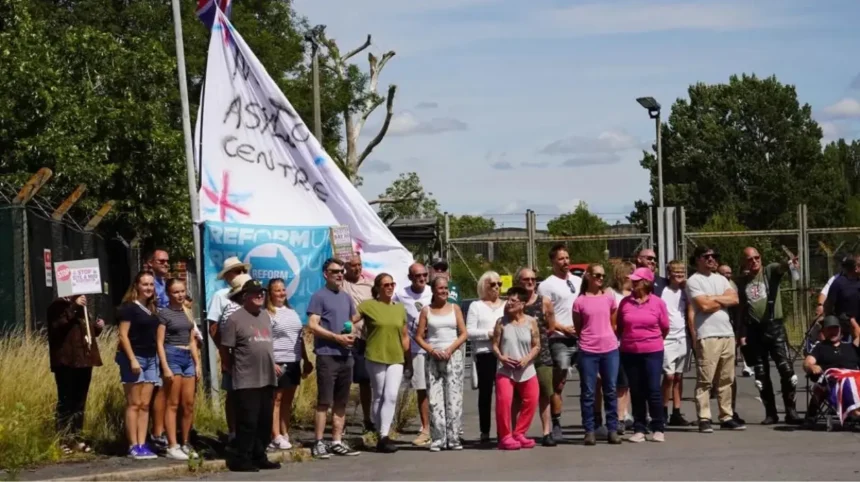
On Sunday – the 5th of July 2026 – protests unfolded, essentially focusing on three main local community concerns in regard to the government’s arrangements:
- The lack of the locals’ opinion on the matter – many locals expressed frustrations over the government making a decision before consulting formally the public. The local council leaders, the police commissioners and that area’s Member of Parliament (MP) have all stated that none of them received any proper warning or chance to discuss how the camp would affect the area and the local services there.
- The highly possible resource incapability and strain of the area – the base is essentially located in the countryside between two small villages (Piddington and Upper Arncott) with limited infrastructure capacity. The locals argue that the available infrastructure would not be able to sustain up to 1250 new residents. Facilities concerned by this issue are bus routes, medical services and proper sewage systems to handle such a major population increase.
- The dangers brought by the chosen location to the wildlife around – the local volunteers and residents pointed out that the chosen military base, Site A of the Bicester Garrison sits on a floodplain for the River Ray and borders the Upper Ray Meadows (a protected nature reserve). Therefore, protesters are rather worried about the impact of such a large camp on the local environment and its wildlife.
Moreover, the debate is consumed by mostly the government and the Oxfordshire local leaders. The government maintains however that restoring and using the old military sites is a necessary and highly cost-effective choice in comparison to local hotels (which ultimately cost taxpayers significantly more money).
This debate is still ongoing as the government moves forward with seeking final planning permissions, with an agenda structured on a two-step timeline – firstly to open the site by late 2026 to 270 beds for the first group of individuals and secondly to open it later and progressively to its full capacity of 1250 people.
The site is aimed to house single adult men aged 18 to 65 while they wait for the government’s decision on whether they can remain in the UK or not. The government’s plan is to keep this site in use for at least 10 years.