The University of Oxford organizes its academic year around three distinctive terms, a structure that dates back to the medieval era. For students, faculty, and residents tracking the schedule via Oxford Daily, understanding these periods is essential for navigating the academic, administrative, and cultural rhythms of the city.
- What Are the Three Term Names and Meanings at Oxford University?
- How Long Is an Oxford Term and What Is Full Term?
- The Structure of Full Term
- The Significance of Week 0 and Week 9
- Residency Requirements and Statutory Dates
- Why Does Oxford University Use the Numerical Week Calendar System?
- Decentralization and the Need for Synchronization
- Standardized Tutorial and Essay Cycles
- Impact on University Administrative Operations
- What Are the Precise Dates for Oxford Term Times Across Academic Years?
- Term Dates for the 2025–2026 Academic Year
- Term Dates for the 2026–2027 Academic Year
- Long Vacations and Interim Periods
- How Do Oxford Term Times Compare to Cambridge and Other UK Universities?
- What Historical Events Shaped the Development of Oxford Term Times?
- Monastic Origins and the Ecclesiastical Calendar
- Agricultural Demands and Black Death Disruptions
- The Oxford University Act of 1854 and Modern Standardization
- How Does the 8-Week Term System Impact Student Workloads and Mental Health?
- The Phenomena of the Fifth-Week Blues
- Academic Acceleration and Information Retention
- Institutional Support Mechanisms
- What Are the Key Traditions and Events Linked to Specific Weeks of Term?
- How Do Term Times Affect Local Oxford Businesses and the City Economy?
- What Are the Administrative Requirements for Staff During Vacation Periods?
What Are the Three Term Names and Meanings at Oxford University?
The academic year at the University of Oxford consists of three specific eight-week periods called Michaelmas term, Hilary term, and Trinity term. These terms align with historic religious festivals and legal calendars in England, dictating the schedule for all university operations.
Michaelmas Term
Michaelmas term is the first term of the academic year, beginning in October and ending in December. The term derives its name from the Feast of St. Michael and All Angels, an ancient Christian festival celebrated on September 29. Historically, Michaelmas marked the beginning of the financial and legal year in England, a tradition the university maintained to structure its autumn admissions and initial lecture series.
Hilary Term
Hilary term serves as the second period of the academic year, commencing in January and concluding in March. The university names this winter term after St. Hilary of Poitiers, a fourth-century Christian theologian whose feast day falls on January 14. This term bridges the mid-winter period and the early spring, focusing heavily on core academic tutorials, laboratory research sequences, and mid-year examinations.
Trinity Term
Trinity term constitutes the third and final term of the academic year, running from April through June. The name originates from Trinity Sunday, which occurs eight weeks after Easter Sunday to honor the Christian doctrine of the Trinity. Trinity term represents the peak of the academic calendar, hosting the majority of final honor school examinations, university encaenia celebrations, and outdoor athletic regattas.
How Long Is an Oxford Term and What Is Full Term?
An official Oxford term spans exactly eight weeks of formal instruction, a period administratively designated as Full Term. The university utilizes a highly structured numerical week system, from Week 1 to Week 8, to coordinate all lectures, tutorials, and examinations.
The Structure of Full Term
Full Term represents the core instructional window where undergraduate and postgraduate students receive statutory teaching. Each term contains exactly 56 days of required residence and study. The university calendar tracks time not by calendar dates, but by the specific week number, which dictates assignment deadlines, professor availability, and library hours across all 43 independent colleges and halls.
The Significance of Week 0 and Week 9
The academic cycle extends beyond the eight weeks of Full Term through the utilization of preparatory and concluding weeks, specifically Week 0 and Week 9.
- Week 0: Known as “Noughth Week,” this period precedes Full Term. Students return to their respective colleges during these days to sit for internal college examinations, known as collections, and to attend organizational meetings with tutors.
- Week 9: This period follows the conclusion of Full Term. Faculty members use Week 9 to conduct university-wide examinations, review postgraduate theses, and finalize administrative grading metrics.
Residency Requirements and Statutory Dates
The university enforces strict residency regulations that require undergraduate students to remain within a specific radius of the city center during the 56 days of Full Term. The statutory boundary requires students to reside within 6 miles of Carfax, the central crossroads of Oxford. Failure to meet these residency requirements disqualifies a student from officially completing the term, which directly impacts their eligibility to graduate.
Why Does Oxford University Use the Numerical Week Calendar System?
The numerical week calendar system provides a standardized, centralized framework that synchronizes academic scheduling across dozens of autonomous colleges and faculties. This system ensures uniform timelines for essay submissions, lecture series, laboratory sessions, and university-wide examination periods.
Decentralization and the Need for Synchronization
The University of Oxford operates on a highly decentralized collegiate model comprised of 39 self-governing colleges and 4 permanent private halls. Each college manages its own facilities, admissions, and tutorial teaching. The numerical week calendar system functions as the unifying administrative matrix, forcing all independent entities to align their internal schedules with a singular, university-wide timeline.
Standardized Tutorial and Essay Cycles
The undergraduate learning model relies on the tutorial system, an instructional method where one to three students meet weekly with an academic expert. The numerical week system creates an predictable rhythm for these sessions. Students receive assignments in Week 1, submit essays in Week 2, and repeat this bi-weekly or weekly cycle precisely eight times per term, eliminating scheduling conflicts across disparate subject faculties.
Impact on University Administrative Operations
Central university bodies use the numerical week system to coordinate large-scale logistical operations. The Bodleian Libraries alter their opening hours based on the week number, increasing access during the peak research periods of Weeks 4 through 7. The University Gazette, the official journal of record, publishes weekly editions linked directly to this numerical framework to broadcast official policy updates, degree appointments, and legislative changes.
What Are the Precise Dates for Oxford Term Times Across Academic Years?
The precise dates for Oxford term times shift annually to accommodate the varying dates of weekends and national holidays while maintaining the strict eight-week Full Term structure. The university sets these dates several years in advance through official decrees by the Hebdomadal Council.
Term Dates for the 2025–2026 Academic Year
The academic dates for the 2025–2026 cycle maintain the traditional October start for the university calendar:
- Michaelmas Term 2025: Full Term begins on Sunday, October 12, 2025, and concludes on Saturday, December 6, 2025.
- Hilary Term 2026: Full Term commences on Sunday, January 18, 2026, and finishes on Saturday, March 14, 2026.
- Trinity Term 2026: Full Term starts on Sunday, April 26, 2026, and ends on Saturday, June 20, 2026.
Term Dates for the 2026–2027 Academic Year
The subsequent academic year follows a standard chronological progression based on statutory university regulations:
- Michaelmas Term 2026: Full Term begins on Sunday, October 11, 2026, and terminates on Saturday, December 5, 2026.
- Hilary Term 2027: Full Term opens on Sunday, January 17, 2027, and closes on Saturday, March 13, 2027.
- Trinity Term 2027: Full Term initiates on Sunday, April 25, 2027, and wraps up on Saturday, June 19, 2027.
Long Vacations and Interim Periods
The weeks separating the formal terms are designated as vacations, comprising the Christmas Vacation, the Easter Vacation, and the Long Vacation. The Christmas and Easter vacations each last approximately six weeks, providing intervals for independent research and examination preparation. The Long Vacation spans three and a half months from late June to early October, allowing faculty and students to engage in extended fieldwork, academic publishing, and international research initiatives.
How Do Oxford Term Times Compare to Cambridge and Other UK Universities?
Oxford term times are significantly shorter and more condensed than those of standard UK universities, matching only the University of Cambridge in brevity. While typical UK universities operate on two 12-week semesters, Oxford utilizes three intensive 8-week terms.
The Oxbridge Commonality
The University of Oxford and the University of Cambridge, collectively referred to as Oxbridge, share the three-term, 8-week structure. Cambridge utilizes alternative names for its terms, specifically Michaelmas, Lent, and Easter terms. Both institutions maintain this compressed timeline to maximize the intensity of the learning experience, requiring students to cover identical quantities of academic material in fewer weeks than their national peers.
The Standard UK Semester System
The vast majority of higher education institutions in the United Kingdom utilize a semester-based calendar system. These institutions operate two semesters per year, typically running from September to January, and February to June. Each semester lasts between 11 and 12 weeks, providing a total of 22 to 24 weeks of active teaching, contrasted with Oxford’s total of 24 weeks spread across three distinct bursts.
Academic Velocity and Study Workloads
The structural differences alter the daily workload for students. In a standard semester system, a student spreads their research and essay writing over three months. At Oxford, the compressed 8-week schedule forces a higher velocity of work, often requiring two complete research essays or extensive mathematical problem sheets every single week, leaving minimal variance for academic delay.
Explore More Area Guide
NHS Pharmacy First Services Expand at Oxford Road Pharmacy in Reading
The Definitive Guide to Motorsports and the Oxford 250 in Oxford Plains Maine
What Historical Events Shaped the Development of Oxford Term Times?
The evolution of Oxford term times was driven by medieval papal bulls, royal charters, agricultural cycles, and legal reforms over eight centuries. These historical forces gradually compressed a continuous year-round monastic teaching schedule into the modern three-term system.
Monastic Origins and the Ecclesiastical Calendar
The University of Oxford developed into a formal center of learning during the 12th century, drawing its initial structure from monastic schools. Early academic calendars followed the Catholic liturgical year completely. Teaching ceased only for major religious feasts, resulting in a calendar that kept scholars in residence for nearly 10 months of the year to ensure continuous theological instruction under canonical law.
Agricultural Demands and Black Death Disruptions
The agrarian economy of medieval England forced modifications to the university calendar. The lengthy summer break, which evolved into the modern Long Vacation, was established to release students for the annual grain harvest in August and September. Additionally, outbreaks of the bubonic plague, commonly known as the Black Death, periodically forced the complete evacuation of the city, permanently embedding emergency break periods into the institutional memory.
The Oxford University Act of 1854 and Modern Standardization
The modern, uniform 8-week Full Term structure was finalized during the nineteenth century through legislative intervention. The Oxford University Act of 1854 reformed the administrative governance of the institution, stripping colleges of their ability to set disparate term lengths. This act established the Hebdomadal Council, an executive committee tasked with regulating the academic calendar to align with national civil service exams and international publishing timelines.
How Does the 8-Week Term System Impact Student Workloads and Mental Health?
The condensed 8-week term system creates a high-pressure environment characterized by rapid assignment deadlines and intense intellectual focus. This structure accelerates academic development but significantly increases the risk of student burnout and mental exhaustion.
The Phenomena of the Fifth-Week Blues
The relentless pace of the Oxford calendar produces a recognized psychological drop known across the university as the “Fifth-Week Blues.” By Week 5 of any given term, students have completed four continuous weeks of intense tutorial output and face four remaining weeks of identical pressure. University counseling statistics show a consistent spike in student support requests during this specific week, driven by cumulative sleep deprivation and compounding essay deadlines.
Academic Acceleration and Information Retention
The primary pedagogical defense of the 8-week system centers on intellectual immersion. Proponents argue that the short terms prevent academic drift, keeping students entirely focused on their specific disciplines. The high velocity forces students to develop advanced time-management skills, rapid information synthesis methodologies, and critical analytical capacities that match the demands of top-tier global research institutions.
Institutional Support Mechanisms
To mitigate the strain of the compressed calendar, colleges deploy specialized welfare teams within their walls. These teams include welfare deans, junior deans, peer supporters, and college nurses who monitor student health directly. Additionally, colleges subsidize welfare events, colloquially called “welfare tea,” providing mandatory study breaks during the middle weeks of term to foster community stability and reduce isolation.
What Are the Key Traditions and Events Linked to Specific Weeks of Term?
Specific weeks within the Oxford calendar trigger mandatory academic ceremonies, historic cultural traditions, and high-profile sporting competitions. These events are hardcoded into the numerical week system, dictating university life beyond the classroom.
Matriculation in Michaelmas Week 1
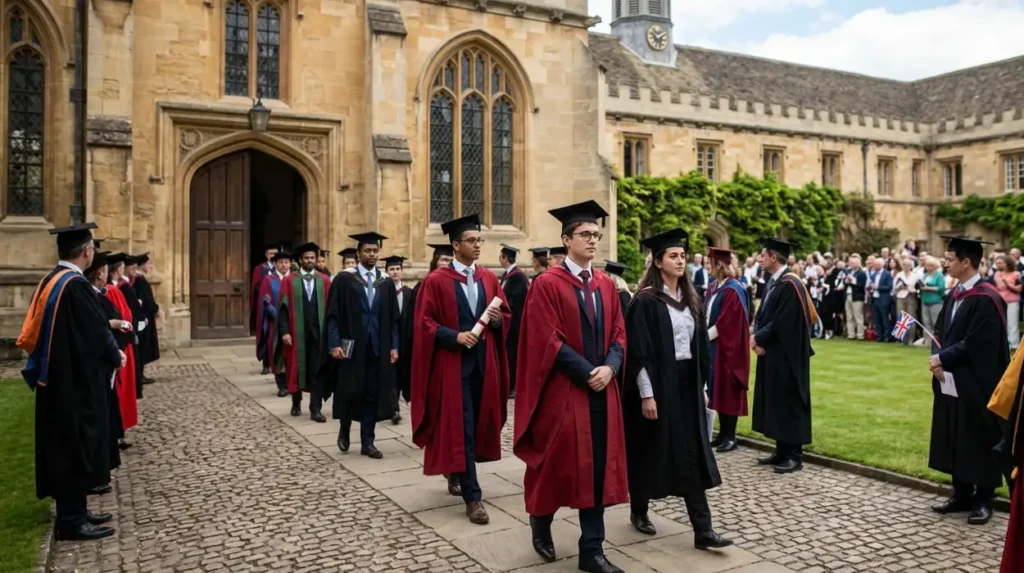
Matriculation represents the formal admission ceremony into the university, occurring on the Saturday of Week 1 in Michaelmas term. Wearing subfusc, the formal academic dress consisting of dark suits, white ties, and gowns, thousands of first-year students march to the Sheldonian Theatre. The Vice-Chancellor delivers a Latin address, officially inducting the candidates into the corporate body of the university.
Torpids and Eights Weeks
Bumping races, the unique rowing competitions necessitated by the narrow dimensions of the River Thames, occur during specific weeks of the winter and spring terms.
- Torpids: Held during Week 7 of Hilary term, this regatta tests the endurance of college crews in cold, winter conditions, with boats chasing each other to score a “bump.”
- Summer Eights: Occurring in Week 5 of Trinity term, this premier sporting event attracts thousands of spectators to the college boathouses, acting as a major social focal point of the academic year.
The Formal Examination Ritual of Trashing
The conclusion of final exams in Trinity term, usually spanning Weeks 6 through 9, culminates in the tradition of “trashing.” As students exit the Examination Schools on High Street, peers pelt them with shaving cream, champagne, flour, and confetti. While the university administration conducts campaigns to curb the practice due to environmental impact, it remains a defining ritual marking the end of the rigorous term cycle.
How Do Term Times Affect Local Oxford Businesses and the City Economy?
Oxford term times create a cyclical economic environment, driving massive retail and hospitality revenue during the 24 weeks of Full Term, followed by sharp declines during vacations. Local businesses must optimize their operations to survive these predictable seasonal shifts.
The Student Economy Peak
During Full Term, the sudden influx of over 26,000 students dramatically alters the local commerce landscape. Restaurants, traditional pubs, bookshops, and clothing retailers experience maximum demand. Independent businesses rely on the term weeks to generate the core profits required to sustain their operations across the entire fiscal year, tailoring their inventories directly to student purchasing habits.
The Vacation Tourism Shift
When students vacate the city during the interim months, the local economy transitions from student-driven commerce to international tourism and conference hosting. Colleges lease their historic dining halls and student accommodations to global academic conferences and corporate retreats. This strategy preserves employment for thousands of hospitality workers in the city, offsetting the vacancy left by the student body.
Rental Market Dynamics and Housing Pressures
The strict residency terms directly influence the broader Oxford real estate market. Private landlords catering to undergraduate and postgraduate tenants structure their lease agreements around the academic calendar, often enforcing 9-month or 10-month contracts. This dynamic creates an intense annual housing rush between January and March, driving up rental costs for non-academic residents who must compete for limited housing stock within the city limits.
What Are the Administrative Requirements for Staff During Vacation Periods?
University faculty and administrative staff remain under full contractual obligations during vacation periods, transitioning from undergraduate teaching to intensive research, admissions processing, and institutional governance. Vacations represent the primary window for operational upgrades.
The Admissions Cycle in December
For academic staff, the start of the Christmas Vacation coincides with the undergraduate admissions process. Throughout Weeks 9 and 10 of Michaelmas term, faculty members conduct thousands of interviews for prospective applicants. This process requires continuous coordination across college faculties, administrative screening boards, and departmental selection panels to ensure fair selection metrics before the winter break.
Research Outputs and Grant Procurement
The eight weeks of Full Term demand the complete teaching focus of professors, leaving minimal time for laboratory work or long-form writing. Consequently, faculty members utilize the six-week vacations and the three-month Long Vacation to conduct advanced research, write peer-reviewed journal articles, and draft funding proposals for global research councils.
Governance and Facilities Maintenance
Central university administrators utilize the quieter vacation blocks to execute structural overhauls across the estate. Major IT system upgrades, library restorations, and laboratory asbestos abatements are scheduled exclusively outside of Full Term to minimize disruption to teaching. University committees continue to meet regularly during these periods to debate financial allocations, policy changes, and long-term strategic plans.
How long is an Oxford University term?
Each Oxford term includes eight weeks of formal teaching, known as Full Term, although students often return before and remain after Full Term for examinations and academic activities.