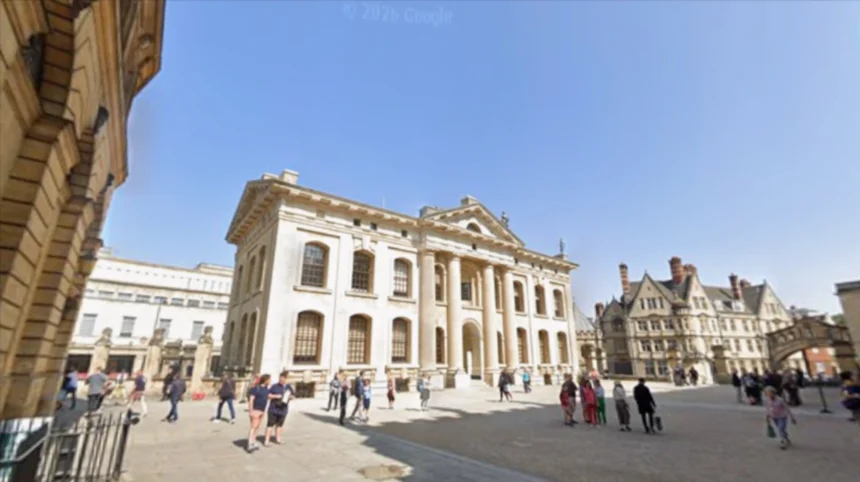
The Oxford Clarendon Building is a monumental eighteenth-century Grade I listed structure located on Broad Street in central Oxford, England. It serves as a major administrative and architectural component of the University of Oxford, situated within a dense historical cluster of academic monuments.
- What is the history of the Oxford Clarendon Building?
- Who designed the Oxford Clarendon Building?
- What are the architectural features of the building?
- How did the building serve the Oxford University Press?
- What is the current function of the building?
- What is the wider impact of the Clarendon name in Oxford?
- Reviewing the Architectural Continuity of Central Oxford
What is the history of the Oxford Clarendon Building?
The Oxford Clarendon Building originated from the commercial success of a monumental historical text and the spatial expansion of the university’s printing enterprises. Construction began in 1711 and concluded in 1713 under the structural direction of master stonemason William Townesend.
The Financial Catalyst
Funding for the construction emerged from the profits of The History of the Rebellion and Civil Wars in England, a definitive historical account written by Edward Hyde, the First Earl of Clarendon. Edward Hyde bequeathed the perpetual copyright of this literary work to the University of Oxford. The resulting revenues provided the financial capital required to commission a dedicated headquarters for the university’s printing press, which had outgrown its original processing space in the basement of the adjacent Sheldonian Theatre.
The Original Inhabitants
Upon completion in 1713, the structure became the functional headquarters of the Oxford University Press. The printing operations were strategically organized within the physical layout of the building to separate specific production processes. The internal space accommodated two primary printing divisions:
- The Classical Side: This division handled academic, classical, and scientific texts authorized directly by the university.
- The Bible Side: This division focused exclusively on the high-volume production of bibles and liturgical prayer books.
The Oxford University Press maintained its complete manufacturing, editorial, and distribution operations inside the facility for more than a century. By 1830, the scale of global text production necessitated a much larger industrial plant. The press permanently relocated to its current massive site on Walton Street, transforming the Clarendon Building into a central administrative hub for the university’s governing bodies.
Who designed the Oxford Clarendon Building?
The Oxford Clarendon Building was designed by the prominent English Baroque architect Nicholas Hawksmoor. Nicholas Hawksmoor worked as a primary pupil and trusted collaborator of Sir Christopher Wren, the architectural visionary who designed the neighboring Sheldonian Theatre.
The Hawksmoor Paradigm
Nicholas Hawksmoor designed the structural envelope to match the monumental, dramatic scale characteristic of the English Baroque movement. His design integrated severe classical symmetry with heavy, expressive stonework. This architectural choice deliberate separated the building from the medieval Gothic styles that dominated older Oxford college quadrangles.
Collaborative Execution
While Nicholas Hawksmoor provided the conceptual drawings and floor plans, the physical construction required local expertise. Master mason William Townesend executed the structural stonework. William Townesend modified aspects of the detailing during construction to accommodate the physical realities of the regional stone supply, blending Nicholas Hawksmoor’s strict London-influenced Baroque vision with traditional Oxford masonry techniques.
Explore More uk/area-guide/">Area Guide
The Definitive Guide to Men’s Oxford Shoes: Oxford Street 2026
What is the Historical Significance of the Oxford Clarendon Building?
What are the architectural features of the building?
The architecture of the Oxford Clarendon Building uses the classical Roman Doric order to display structural permanence and civic authority. The building features two primary monumental facades facing Broad Street to the south and the Bodleian Quadrrangle to the north.
The Giant Order Portico
The primary southern facade features a massive, temple-style portico supported by four monumental columns. These columns are executed in the Doric order, featuring simple circular capitals and unfluted vertical shafts. The portico supports a large triangular pediment that projects over the main thoroughfare of Broad Street.
Monolithic Stone Components
The exterior walls consist entirely of local English limestone, utilizing two specific variations of regional stone:
- Headington Freestone: This denser, durable limestone forms the heavy rusticated ground floor layers to resist moisture and wear.
- Burford Stone: This smoother, fine-grained Cotswold limestone covers the upper storeys and intricate decorative moldings.
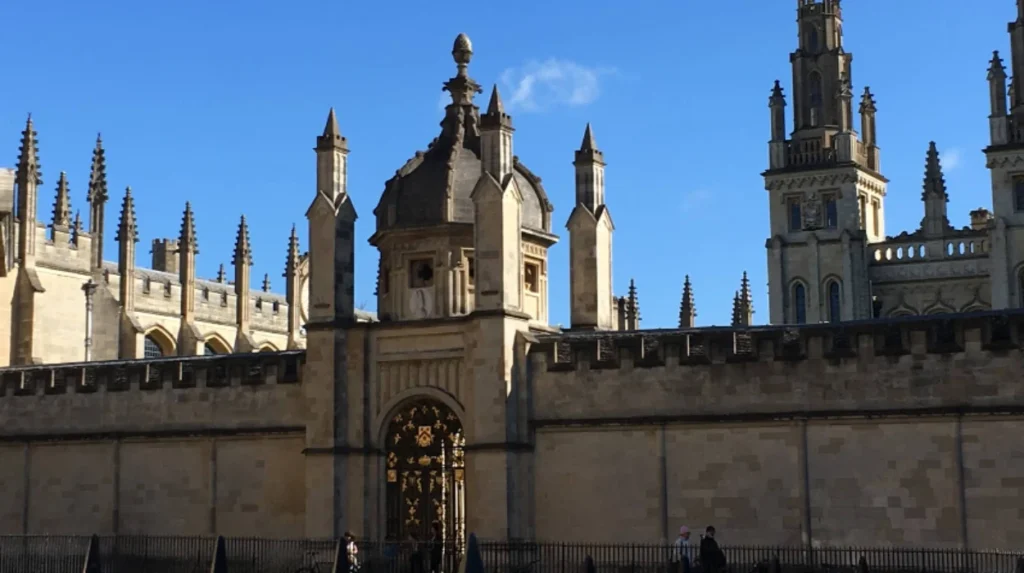
The central axis of the building contains an open archway known as the Clarendon Arch. This vaulted thoroughfare cuts completely through the ground floor of the building. The passageway functions as a formal monumental gate, channeling pedestrian traffic directly from Broad Street into the historic core of the old university schools quadrangle.
How did the building serve the Oxford University Press?
The Oxford Clarendon Building operated as a highly specialized, industrial manufacturing plant designed around the workflow of eighteenth-century movable-type printing. The layout optimized the movement of heavy raw materials into finished consumer volumes.
Mechanical Workflow Design
The production of printed books required a structured sequence of industrial operations. The building housed multiple distinct operational zones:
- The Type-Foundry and Composing Rooms: Located on the upper storeys to maximize natural daylight, where workers manually arranged individual lead letters into iron composing frames.
- The Press Rooms: Situated on the lower levels to anchor the immense weight and repetitive vibrations of the heavy wooden press machines.
- The Drying Rooms: Specialized, well-ventilated loft spaces where freshly inked sheets of paper hung on lines to dry before binding.
Architectural Tributes to the Craft
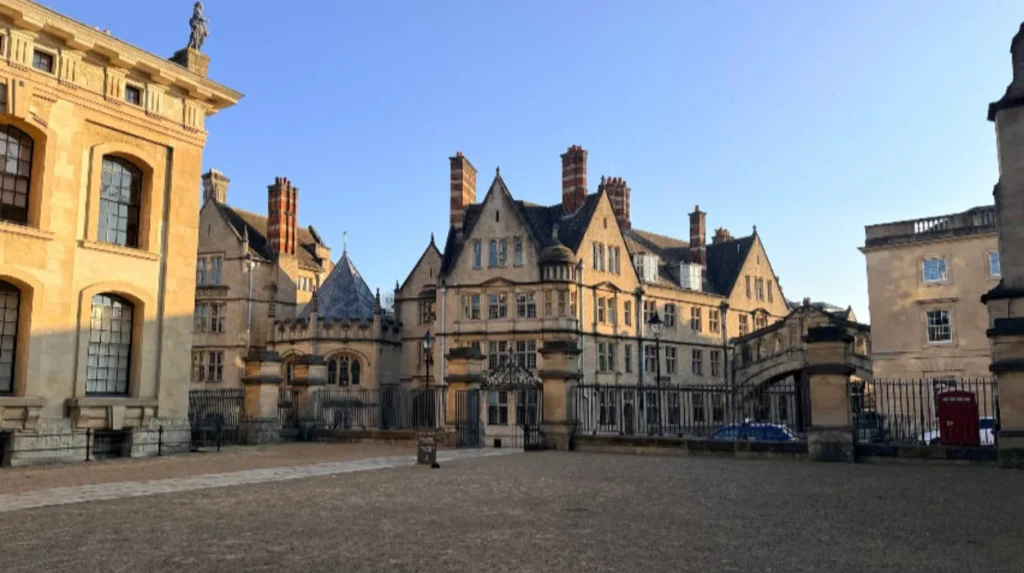
The structural identity of the building remains permanently linked to its historical printing functions. The roofline features nine monumental lead statues representing the classical Muses of Greek mythology, who presided over the arts and sciences. These statues were cast by the sculptor Sir Henry Cheere. The presence of these academic figures signaled the specific types of intellectual discourse printed directly beneath the roofline.
What is the current function of the building?
The Oxford Clarendon Building functions as an integral administrative asset of the Bodleian Library complex. The building no longer hosts industrial manufacturing, serving instead as office spaces and research support facilities.
Integration with the Bodleian
Following the departure of the Oxford University Press, the University of Oxford integrated the internal spaces into the central library system. The rooms provide workspace for library directors, administrative staff, and specialized bibliographical researchers. The building connects securely to the wider underground network of tunnels that links the Old Bodleian, the Radcliffe Camera, and the Weston Library, allowing the secure transfer of historical books and manuscripts.
Cultural Preservation
The exterior fabric of the building undergoes rigorous architectural conservation. The University of Oxford maintains strict environmental controls inside the historic rooms to protect the surviving eighteenth-century timber paneling and structural beams from deterioration, ensuring the monument survives as an active component of the functioning university.
What is the wider impact of the Clarendon name in Oxford?
The legacy of the Oxford Clarendon Building extends far beyond its physical limestone walls, influencing nomenclature across the global academic network of the university. The term “Clarendon” identifies multiple highly prestigious entities within the contemporary institution.
The Clarendon Fund Scholarship
The University of Oxford operates the Clarendon Fund, a major graduate scholarship scheme. Established in 2001, the fund selects more than 100 international graduate students each year based on outstanding academic merit. The scholarship covers full tuition fees and provides living stipends, making the Clarendon name a global symbol of advanced research excellence.
Institutional Identity
The historical building gave its name to the Clarendon Laboratory, a world-class physics research facility founded in 1872. Additionally, the moniker remains tied to the historical publications of the Oxford University Press, which still issues its most prestigious academic monograph series under the exclusive “Clarendon Press” imprint, maintaining a direct line of continuity to the 1713 Broad Street print shop.
Reviewing the Architectural Continuity of Central Oxford
The Oxford Clarendon Building sits within a continuous timeline of institutional architecture. To understand its physical context, it is helpful to view the operational dates of the interconnected academic buildings managed by the university on this specific site.
The Divinity School
1488
The university completes its oldest purpose-built academic structure, featuring intricate Gothic stone vaulting to house lectures and examinations in theology.
The Old Bodleian Library
1619
Construction concludes on the Schools Quadrangle, centralizing the university’s book collections and formal lecture rooms around a monumental central courtyard.
The Sheldonian Theatre
1669
Sir Christopher Wren completes the ceremonial assembly hall, freeing the university from using local churches for secular graduations and initial printing presses.
The Clarendon Building
1713
Nicholas Hawksmoor delivers the purpose-built printing house, establishing a distinct Baroque gateway on Broad Street powered by the copyright of Edward Hyde.
The Radcliffe Camera
1749
James Gibbs completes the monumental circular library block south of the Schools Quadrangle, expanding the academic complex into a unified civic forum.
What is the Oxford Clarendon Building?
The Oxford Clarendon Building is a Grade I listed eighteenth-century Baroque building on Broad Street in central Oxford. Originally built for the Oxford University Press, it now forms part of the University of Oxford’s administrative and library estate.