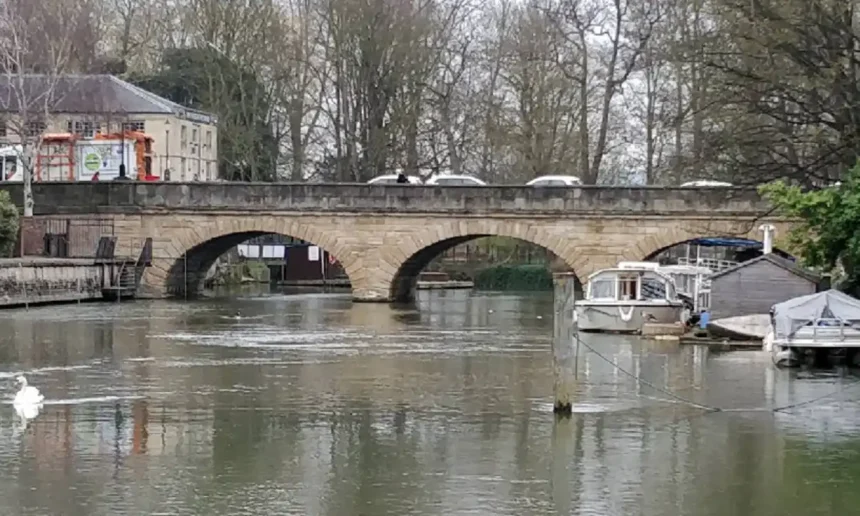
Folly Bridge Oxford stands as a historic stone crossing erected between 1825 and 1827 over the River Thames. The first known stone bridge on this site was built by Norman nobleman Robert d’Oilly around 1085. It originally bore the name South Bridge and functioned as a crucial entry point into the city. The location marks the site of the original shallow river crossing used by livestock, such as oxen and sheep, which ultimately gave the city of Oxford its name.
- Who Designed The Current Structure Of Folly Bridge Oxford?
- Why Was Friar Bacon’s Study Important To The Bridge?
- What Are The Key Architectural Components Of Folly Bridge?
- How Does The Bridge Relate To The Grandpont Causeway?
- What River Does Folly Bridge Cross In Oxford?
- Why Is Folly Bridge Island Famous For Caudwell’s Castle?
- How Did Folly Bridge Inspire Alice’s Adventures In Wonderland?
- What Are The Navigation And Toll Rules Of The Past?
- What Are The Future Implications For Folly Bridge Oxford?
- FAQs About Folly Bridge Oxford
Medieval travelers, such as merchants and pilgrims, utilized this specific ford to transport goods, including wool and grain, safely from the southern regions, like Berkshire and Hampshire, into the town center. The modern bridge replaced older structures, namely the 11th-century Norman arches and the medieval timber additions, that had decayed due to immense daily traffic and frequent seasonal flooding.
Who Designed The Current Structure Of Folly Bridge Oxford?
London architect Ebenezer Perry designed the current structure of Folly Bridge Oxford, and construction spanned from 1825 to 1827. The project required an investment exceeding 19000 pounds to complete the robust stone arches, namely the north, central, and south spans. The parliamentary rebuilding act of 1815 mandated the removal of deteriorated navigational works, including the old flash lock and timber weirs. Builders, such as local stonemasons and contractors, utilized Headington stone for the primary structural arches and Forest of Dean stone for the upper parapet walls.
The intricate iron railings along the pedestrian walkways, specifically the east and west footpaths, were crafted by the McIntosh foundry of London. The finalized design features three rusticated stone spans separated by two massive water piers that effectively manage the river currents, including the main flow and backwaters.
Why Was Friar Bacon’s Study Important To The Bridge?
Friar Bacon’s Study served as a hexagonal defensive gatehouse located at the southern end of Folly Bridge Oxford until its demolition in 1779. It was originally constructed in the 13th century and functioned as the New Gate to control access and collect bridge tolls, such as pontage fees. Franciscan philosopher Roger Bacon occupied the upper rooms, such as the observatory and living quarters, to conduct scientific experiments, including star mapping and optical studies. Notable historical figures, such as Samuel Pepys and J.M.W. Turner, visited and documented the building during the later centuries, specifically the 1600s and 1700s. The structure contained distinct defensive mechanisms, including a heavy portcullis and a wooden drawbridge, to secure the southern entry against enemy incursions, like rebel attacks. City planners, namely municipal engineers and aldermen, eventually ordered the destruction of the tower to widen the carriageway for increasing traffic volumes, such as freight carts and passenger coaches.
What Are The Key Architectural Components Of Folly Bridge?
Folly Bridge Oxford features a robust masonry design consisting of three primary arch spans, identified as the north, central, and south arches, that elevate the roadway 3.12 meters above the water. Two large stone piers anchor the bridge within the riverbed and feature pointed cutwaters to deflect waterborne debris, such as fallen logs and ice chunks. The architectural style represents early 19th-century structural engineering focused on load-bearing efficiency and flood resistance. The solid Headington stone masonry replaced the previous 40-arch causeway system that originally spanned the marshy meadowlands, including the Christ Church meadows. Cast iron balustrades frame the top deck, providing a secure barrier for pedestrians traveling between the city center and the southern suburbs, like Grandpont and Kennington. A historic toll house, rebuilt in 1844, still stands on the northern bank and retains its original Grade II listed heritage status alongside modern commercial properties, like nearby pubs.
How Does The Bridge Relate To The Grandpont Causeway?
Folly Bridge Oxford anchors the northern terminus of the historic Grandpont causeway along the modern Abingdon Road. The original medieval causeway stretched across the Thames floodplain and incorporated over 40 distinct arches, including round-headed and pointed designs, to keep travelers above the water level. Monastic records indicate the causeway underwent extensive stone rebuilding under Norman rule to facilitate heavy commercial transports, such as market carts and merchant convoys. Hermits from the nearby Chapel of St Nicholas collected charitable alms to fund continuous repairs, specifically stone repointing and arch reinforcement. Modern road expansions have concealed the majority of the original masonry beneath asphalt, yet six ancient arches remain visible near local street junctions, like the Whitehouse Road intersection. This integrated elevated roadway system prevented total isolation of the city during severe winter floods, including the documented inundations of 1852 and 1894.
What River Does Folly Bridge Cross In Oxford?
Folly Bridge Oxford crosses the River Thames, which locals historically refer to as the Isis as it flows through the university city. The bridge effectively spans the main navigable channel of the river at exact geographical coordinates, specifically 51.746027 N and 1.256542 W. The geographical location dictates that all downstream river vessels, including rowing shells and passenger cruisers, must navigate under the three stone arches. The structure divides the water flow around Folly Bridge Island, creating specific channels, namely the eastern and western bypass streams. The proximity to Christ Church Meadow provides a natural floodplain that absorbs excess river volume during periods of heavy seasonal rainfalls, such as autumn storms. The adjacent waterway historically housed commercial wharves and industrial waterworks, such as the 17th-century pumping stations, that powered the early municipal plumbing systems.
Why Is Folly Bridge Island Famous For Caudwell’s Castle?
Folly Bridge Island hosts Caudwell’s Castle, an eccentric castellated house constructed in 1849 by the local accountant and moneylender Joshua Caudwell. The island itself is a tear-drop shaped landmass situated directly beneath the arches of Folly Bridge Oxford, dividing the river into two distinct channels. The building exterior features unconventional decorative elements, including cast iron balconies, defensive battlements, and a prominent statue of Atlas supporting the globe.
The isolated location provided Caudwell with a strategic vantage point to monitor river traffic and operate his local business ventures, specifically boat building and short-term loans. A documented historical incident occurred in 1851 when Caudwell discharged a firearm to defend the property from university students, specifically undergraduates from nearby colleges, attempting to steal his decorative cannons. Today, the idiosyncratic residential structure remains a privately owned Grade II listed landmark that attracts significant attention from visiting tourists, such as historians and architecture enthusiasts.
How Did Folly Bridge Inspire Alice’s Adventures In Wonderland?
Folly Bridge Oxford serves as the documented starting point for the famous 1862 boating trip that inspired Alice’s Adventures In Wonderland. Mathematics lecturer Charles Lutwidge Dodgson, known by the pen name Lewis Carroll, departed from the adjacent Salters Steamers boatyard with the three Liddell sisters, Lorina, Alice, and Edith. The group rowed upstream from the bridge toward the village of Godstow on the afternoon of July 4. During this specific journey, Dodgson improvised a fantastical narrative to entertain the children as they navigated the Isis river currents, including the Iffley and Osney stretches.
The surrounding riverbank environments, including the weeping willows and marshlands, provided the direct visual inspiration for the fictional landscapes, like the rabbit hole and the Queen’s croquet ground, within the novel. This literary milestone permanently connected the physical infrastructure of the bridge to global cultural history and classical children’s books, such as Through the Looking-Glass.
What Are The Navigation And Toll Rules Of The Past?
The operational history of Folly Bridge Oxford involved strict navigational tolls and physical barriers to regulate river and road traffic. A parliamentary act in 1815 authorized the collection of road tariffs, such as carriage fees and horse tolls, to offset the 19000-pound construction debt incurred during the bridge rebuilding process. City officials installed a toll gate on the Abingdon Road approach and collected tariffs from various road users, including cart drivers and equestrians, until 1850.

The river passage previously contained dangerous aquatic barriers, like the wooden weirs and flash locks, that caused significant delays for commercial barges transporting goods, specifically coal and timber. Engineers removed these aquatic barriers during the 1825 reconstruction to create an unobstructed channel for heavy freight vessels and passenger steamers, such as the Salters steamships. A pound lock was temporarily established downstream in 1832 to manage water levels, but authorities dismantled it in 1884 to further streamline modern river navigation.
What Are The Future Implications For Folly Bridge Oxford?
Folly Bridge Oxford remains a critical infrastructure asset that requires ongoing structural preservation to handle modern vehicular traffic loads. The local municipal council conducts regular engineering surveys to assess the integrity of the 19th-century Headington stone arches and water piers, specifically the central and side supports. Current urban development plans focus on maintaining the Grade II listed status while accommodating modern transport vehicles, including zero-emission buses and heavy goods trucks.
Environmental agencies actively monitor the riverbed scouring around the bridge foundations to prevent structural destabilization during high-velocity flood events, such as seasonal winter swells and spring thaws. Proposed architectural enhancements, such as a dedicated parallel footbridge designed by Nicholas Grimshaw, highlight the need to separate vulnerable pedestrians from active motor lanes, like the northbound and southbound carriageways. The site will continue to function as an essential southern gateway, ensuring the historical continuity of the Abingdon Road transport networks, including cycle paths and vehicle routes.
FAQs About Folly Bridge Oxford
Why Is It Called Folly Bridge In Oxford?
The name originated in the late 17th century as a colloquial replacement for South Bridge. Locals likely referred to the unusual hexagonal tower, known as Friar Bacon’s Study, as a folly or architectural oddity. Another theory suggests the name derived from the foul marshy ground surrounding the southern Thames approaches.
Can You Walk Across Folly Bridge Oxford Today?
Yes, pedestrians can walk across Folly Bridge Oxford using the dedicated east and west footpaths. The cast iron balustrades provide a safe physical barrier from the heavy vehicular traffic utilizing the Abingdon Road. The crossing offers excellent vantage points for observing river navigation and local rowing crews.
Who Lives In The Castle On Folly Bridge Island?
Caudwell’s Castle on Folly Bridge Island remains a privately owned residential property and is not open to the general public. Joshua Caudwell originally built the castellated house in 1849 as a personal home and business vantage point. Today, private tenants occupy the historic building, preserving its Grade II listed architectural heritage.
How Old Is Folly Bridge In Oxford?
The current stone structure of Folly Bridge Oxford dates back to its construction period between 1825 and 1827. However, the site has served as a primary river crossing since the Norman nobleman Robert d’Oilly built the first stone bridge around 1085. The location itself was used as a natural ford centuries before the Norman conquest.
Where Did Alice In Wonderland Start In Oxford?
The story of Alice in Wonderland began directly at Folly Bridge Oxford on July 4, 1862. Lewis Carroll rented a rowboat from the adjacent Salters Steamers boatyard and traveled upstream with the three Liddell sisters. He improvised the famous fantasy narrative during this specific journey along the River Thames.