The Pitt Rivers Museum in Oxford, England, holds one of the most remarkable accumulations of human material culture ever assembled. Founded in 1884, the museum contains over 600,000 objects from every continent, arranged not by geography or chronology but by function and type. This structural decision, along with the extraordinary nature of individual objects within it, has made Pitt Rivers Museum’s eccentric collections globally recognized as unlike any other institution of its kind.
- What Is the Pitt Rivers Museum and Why Was It Founded?
- How Did Pitt Rivers Museum’s Eccentric Collections Grow Beyond the Founding Gift?
- What Is the Typological Arrangement That Defines Pitt Rivers Museum’s Eccentric Collections?
- How Does the Display of Human Remains Feature in Pitt Rivers Museum’s Eccentric Collections?
- What Role Did Colonial History Play in Building Pitt Rivers Museum’s Eccentric Collections?
- Why Does Pitt Rivers Museum’s Eccentric Collections Remain Relevant to Modern Research and Visitors?
- What are the most bizarre objects you can see at the Pitt Rivers Museum in Oxford?
- Why does the Pitt Rivers Museum group objects so differently from other museums?
- Did the Pitt Rivers Museum really display shrunken heads and human remains?
- How did the Pitt Rivers Museum end up with over 600,000 objects?
- Is the Pitt Rivers Museum free to visit and is it worth it?
What Is the Pitt Rivers Museum and Why Was It Founded?
The Pitt Rivers Museum is an archaeological and anthropological museum at the University of Oxford, founded in 1884 when British Army officer Augustus Henry Lane Fox Pitt Rivers donated approximately 22,000 objects to the university, with the legal condition that a permanent lecturer in anthropology be appointed to teach from the collection.
Augustus Pitt Rivers (1827-1900) was a British general and pioneering figure in the fields of archaeology and evolutionary anthropology. Over decades of military service and personal travel, he assembled a vast private collection of weapons, tools, ceremonial objects, and everyday artefacts from cultures across the world. In 1880, he decided the collection required a permanent institutional home and formally offered it to the University of Oxford in 1882. The university accepted on 30 May 1882.
A purpose-built annexe was constructed at the rear of the Oxford University Museum of Natural History, measuring approximately 70 by 86 feet. Construction began in 1885 and was completed in 1886. Edward Burnett Tylor was appointed the first Reader in Anthropology in the UK following this donation in 1885. Henry Balfour became the museum’s first curator. The original deed specified that the general arrangement of objects must be maintained as long as Pitt Rivers lived, and that any post-mortem changes must not alter the founding principle of typological display.
How Did Pitt Rivers Museum’s Eccentric Collections Grow Beyond the Founding Gift?
The founding collection of approximately 22,000 objects has expanded to over 600,000 items through donations, bequests, purchases, and fieldwork acquisitions contributed by colonial officials, travellers, scholars, and missionaries throughout the 19th and 20th centuries.
The growth of the collection was driven by the museum’s institutional reputation and its position within the University of Oxford’s academic network. Colonial-era officials and anthropologists who worked across Africa, Asia, the Pacific, and the Americas regularly deposited objects with the museum. Wilfred Thesiger, the British explorer, contributed a photographic archive alone numbering 38,000 images. The museum also expanded into sound recordings, film archives, and manuscript collections alongside physical objects.
Today, the photographic and audio holdings represent a separate major collection within the institution. The museum currently supports over 600 research visits per year and continues to expand its holdings through active fieldwork by students and researchers. This pattern of accumulation over 140 years, combined with the breadth of original donations, explains why the collections span virtually every human culture and historical period represented in the physical record.
What Is the Typological Arrangement That Defines Pitt Rivers Museum’s Eccentric Collections?

The typological arrangement organizes objects by their function or use rather than by their cultural origin, historical period, or geographic region. A Roman sword, a Pacific Island club, and a medieval European blade all appear together under the category “weapons” regardless of where or when they were made.
This organizational principle was Pitt Rivers’ own invention, rooted in his belief that human technology evolves progressively from simple to complex forms. He intended visitors to trace the development of tools, weapons, and cultural practices across civilizations simultaneously. The layout produces an effect unlike any modern museum: a 19th-century English whalebone corset sits adjacent to Burmese neck coils and a Ugandan lip plug under the category “Reshaping.” Blowpipes from the Amazon share cases with darts from Southeast Asia.
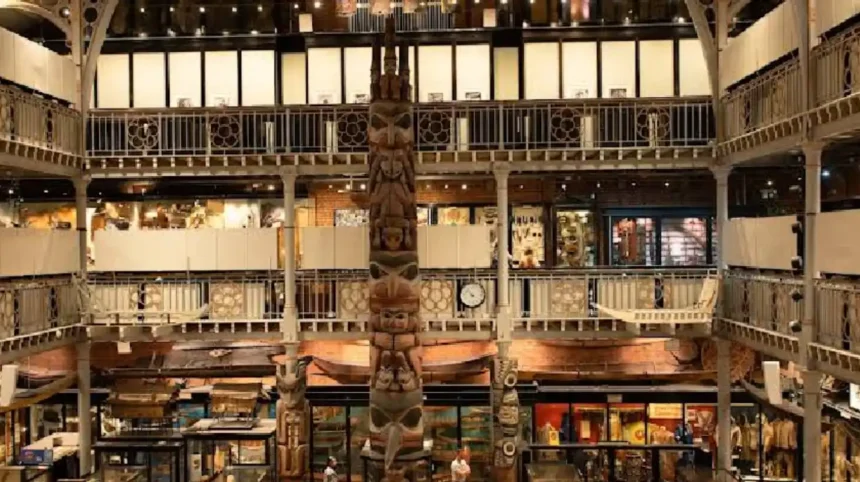
Fishing boat models from Norway, Japan, and the Pacific Islands occupy the same display. This deliberate juxtaposition of objects from unrelated cultures creates visual connections that no regionally organized museum replicates. The Pitt Rivers Deed of Gift legally required the university to preserve this arrangement, which is why the typological system remains intact despite modern museum practice having moved away from evolutionary frameworks. The main exhibition space is a large rectangular colonnaded room with two mezzanine levels and a vaulted ceiling, filled with dense glass display cases arranged in this typological order.
What Are the Most Eccentric Individual Objects in the Pitt Rivers Museum Collections?
The Pitt Rivers Museum holds objects that include shrunken human heads from South America, sealed witch bottles from Britain, a Haida totem pole from the Pacific Northwest, gold torcs from the Bronze Age Stirlingshire hoard, and reindeer-skin underwear worn by Evenki women from northeastern Siberia.
The shrunken heads, known as tsantsas, originate from the Shuar and Achuar peoples of Ecuador and Peru. They were produced through a specific ritual process involving the removal of the skull and the shrinking of the skin using heated sand and water. The museum acquired multiple examples during the 19th and early 20th centuries. Witch bottles are sealed glass or ceramic containers holding pins, hair, and urine, buried in England during the 17th and 18th centuries to repel curses. The Haida totem pole is one of the most physically imposing objects in the collection, standing in the main gallery as a record of Pacific Northwest Indigenous carving traditions.
The gold torcs originate from the Law Farm hoard in Stirlingshire, Scotland, representing the richest Bronze Age gold deposit ever found in that country. The Evenki reindeer underwear demonstrates the museum’s commitment to including utilitarian everyday objects alongside ceremonial and artistic pieces. A USB stick excavated from a muddy London playing field in 2012 was also added to the collection as a contemporary archaeological object, illustrating the museum’s stated philosophy that archaeology is being created continuously.
How Does the Display of Human Remains Feature in Pitt Rivers Museum’s Eccentric Collections?
The Pitt Rivers Museum removed all human remains from public display in September 2020 as part of a formal decolonisation process. The museum had previously displayed skulls, mummified bodies, and prepared skeletal material collected during the colonial period.
Human remains had formed part of the museum’s displays since its founding in 1884, reflecting the scientific and anthropological frameworks of the Victorian era, which treated the physical remains of colonized populations as study specimens. The September 2020 decision to remove these objects from display attracted worldwide attention and positioned the museum as a leader in the decolonisation movement within the UK museum sector. The museum simultaneously installed a new Introductory Case in its permanent galleries that directly addresses the colonial legacy of its collections.
This change affected the most controversial category of objects in the museum but did not alter the core typological structure of the remaining displays. The tsantsas were also reassessed as part of this process. The museum’s approach to decolonisation has been described as sector-leading within the UK heritage community. The museum was named a finalist for the Art Fund Museum of the Year Award in 2019, partly due to its work on critical reassessment of its collections.
What Role Did Colonial History Play in Building Pitt Rivers Museum’s Eccentric Collections?
The vast majority of the 600,000 objects in the Pitt Rivers Museum were acquired through donations by colonial officials, missionaries, military personnel, and travellers operating within the British Empire between the 1880s and 1940s. This colonial network of acquisition shapes both the content and the ethical debate surrounding the collection today.
The British Empire at its peak covered approximately 24 percent of the world’s land surface, and British officials stationed across Africa, India, Southeast Asia, the Pacific, and the Americas regularly collected local objects and dispatched them to institutions in Britain. The Pitt Rivers Museum was a primary recipient of this material. Objects arrived without standardized records of origin, consent, or cultural significance. The Benin Bronzes represent one prominent category of contested objects within the collection.
These brass plaques and sculptures were looted from the Kingdom of Benin in present-day Nigeria during the British Punitive Expedition of 1897. The museum has engaged in formal discussions regarding the return of Benin Bronzes to Nigeria. The Deed of Gift’s requirement to maintain typological display has historically complicated the museum’s ability to respond flexibly to deaccession requests, though the university has proceeded with specific returns where legal and ethical grounds were clear.
Why Does Pitt Rivers Museum’s Eccentric Collections Remain Relevant to Modern Research and Visitors?
The Pitt Rivers Museum hosts over half a million visitors annually and supports more than 600 specialist research visits per year. Its collections serve active academic research in anthropology, archaeology, conservation science, and decolonial studies at the University of Oxford.
The museum’s relevance extends beyond its historical objects. The collections document material cultures that in many cases no longer exist in their original forms, making the Pitt Rivers holdings irreplaceable primary sources. Conservators use advanced techniques to stabilize ethnographic materials, which include organic substances such as leather, feather, bone, shell, plant fibre, and pigment that deteriorate at different rates. The museum’s online collections database provides public access to information about objects and historic photographs in the holdings.
The museum won the Guardian newspaper’s Family Friendly Museum of the Year award in 2005 and has maintained a consistent visitor attendance of over 500,000 per year. Its innovative outreach programmes engage communities whose cultural heritage is represented within the collection, including multilingual tours for migrant visitors. The museum is also a research and teaching department of the University of Oxford, meaning its collections directly inform undergraduate and postgraduate courses in anthropology and archaeology. The combination of historical depth, physical scale, typological uniqueness, and ongoing ethical engagement makes the Pitt Rivers Museum’s eccentric collections a living institution rather than a static archive.
What are the most bizarre objects you can see at the Pitt Rivers Museum in Oxford?
The Pitt Rivers Museum holds some genuinely strange objects, including shrunken human heads (tsantsas) from Ecuador and Peru, sealed witch bottles buried in 17th-century England, reindeer-skin underwear from Siberia, and a USB stick excavated from a London playing field in 2012. A Haida totem pole stands in the main gallery alongside gold Bronze Age torcs and Burmese neck coils. The typological display means these objects sit next to culturally unrelated items, making every corner of the museum unpredictable.
Why does the Pitt Rivers Museum group objects so differently from other museums?
The museum organizes its entire collection by function and type rather than by culture, country, or time period. This system was invented by founder Augustus Pitt Rivers, who believed human technology evolved progressively from simple to complex forms across all civilizations. A Roman sword, a Pacific Island club, and a medieval blade therefore share the same display case. The original Deed of Gift legally requires the university to maintain this typological arrangement.
Did the Pitt Rivers Museum really display shrunken heads and human remains?
Yes, the museum displayed shrunken heads and human skeletal material collected during the colonial period from its founding in 1884. In September 2020, the museum formally removed all human remains from public display as part of its decolonisation process. The decision attracted international attention and was recognized as a significant step in the UK museum sector. The tsantsas and other human remains are now held off public display pending ongoing ethical review.
How did the Pitt Rivers Museum end up with over 600,000 objects?
The founding collection of around 22,000 objects donated by General Augustus Pitt Rivers in 1884 expanded rapidly through donations from colonial officials, missionaries, soldiers, and travellers operating across the British Empire. The museum’s position within the University of Oxford attracted further academic and fieldwork donations throughout the 20th century. Photographic archives, sound recordings, and manuscripts added tens of thousands of additional items. Active acquisition through student fieldwork and purchases continues today.
Is the Pitt Rivers Museum free to visit and is it worth it?
The Pitt Rivers Museum is free to enter and is accessible through the Oxford University Museum of Natural History. It consistently ranks among Oxford’s most popular attractions and welcomes over half a million visitors per year. The dense Victorian-style display cases, dim lighting, and the sheer variety of objects from every human culture make it a genuinely unique experience. Most visitors find a single visit insufficient to see everything the collection contains.