Iconic bridges for punting views include the Bridge of Sighs and Mathematical Bridge in Cambridge, alongside Magdalen Bridge in Oxford. These structures provide unique vantage points for viewing university architecture, historical college grounds, and the natural landscape of the river banks.
- Why is the Bridge of Sighs famous for river views?
- How does the Mathematical Bridge design impact its appearance?
- What views are visible from the bridges of the Cambridge Backs?
- How do Oxford bridges compare for punting experiences?
- What is the historical significance of Magdalene Bridge
- How do seasonal changes affect punting bridge views?
The Bridge of Sighs in Cambridge is a primary focal point for river tours. It is a covered stone bridge that connects the Third Court and New Court of St John’s College. Built in 1831, this structure reflects the Gothic Revival style and is famous for its intricate stonework. Punting underneath this bridge allows passengers to view the arched windows and the historic red-brick facades of the college. Queen Victoria described this location as her favorite spot in Cambridge during her visit in 1847.
The Mathematical Bridge is another essential structure located at Queens’ College. It was designed by William Etheridge and constructed by James Essex in 1749. This bridge utilizes a tangent-and-radial trussing system, which creates an arch using only straight timbers. Although a popular myth suggests it was built without bolts, the structure contains visible iron fastenings. From a punt, visitors can observe the complex geometric patterns of the wood and the 15th-century Riverside Building nearby.
In Oxford, Magdalen Bridge offers the most significant punting views on the River Cherwell. This stone bridge was designed by John Gwynn and completed in 1790. It serves as a gateway to the city and provides a panoramic view of the Magdalen College Tower and the Botanic Garden. Punting in this area is characterized by a more tranquil and wooded environment compared to the collegiate density of Cambridge.
Why is the Bridge of Sighs famous for river views?
The Bridge of Sighs is famous for river views due to its unique covered Gothic architecture and its position within St John’s College. It offers a romantic and enclosed aesthetic that contrasts with the open stone bridges of the river.
The Bridge of Sighs is the only covered stone bridge spanning the River Cam. It was designed by architect Henry Hutchinson and takes its name from the Ponte dei Sospiri in Venice. Unlike the Venetian version, which leads to a prison, the Cambridge bridge connects student accommodation to the examination halls. This cultural association with student anxiety contributes to its historical narrative. From the water, the bridge frames the river, creating a natural tunnel effect for photographers.
The architectural details of the bridge are best appreciated from a low angle in a punt. The structure features recessed panels, quatrefoil decorations, and narrow vertical windows. These elements reflect the 19th-century interest in medieval aesthetics. The bridge spans 15 meters and is constructed primarily from limestone. Because the college grounds are private, the river provides the only public access for viewing the bridge’s northern and southern elevations.
Environmental factors also contribute to its fame. The ivy-covered walls of the New Court and the surrounding trees provide a seasonal backdrop that changes from deep green in summer to vibrant red in autumn. Punting tours often stop beneath the arch to allow passengers to hear the acoustic resonance created by the stone vaulting. This site has been used as a filming location for several historical dramas and films, including The Theory of Everything (2014).
How does the Mathematical Bridge design impact its appearance?
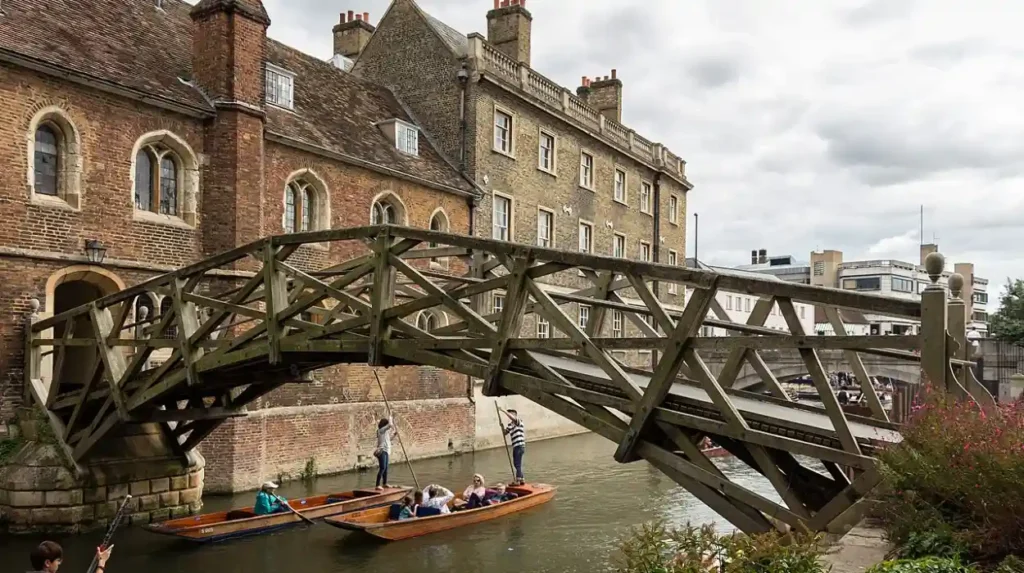
The Mathematical Bridge design impacts its appearance by creating a distinct arched silhouette through the use of straight wooden beams. This engineering feat utilizes geometric principles to provide structural stability and a striking visual pattern for observers.
The Mathematical Bridge is technically a timber arch bridge. Its design is based on the principle of tangent-and-radial trussing, where the main load-bearing timbers are arranged in a series of tangents to the arch. Smaller radial members connect these tangents to form a rigid frame. This creates a series of interlocking triangles and quadrilaterals that are highly visible from a punt. The current version of the bridge is made of teak, which replaced the original oak in 1905.
The bridge represents a transition in 18th-century engineering. William Etheridge, the designer, previously worked on the original Westminster Bridge in London. He applied his knowledge of large-scale carpentry to the smaller span at Queens’ College. The bridge connects the medieval part of the college to the more modern 18th-century additions. This juxtaposition of architectural eras is a key feature of the view from the River Cam.
From a punting perspective, the bridge appears remarkably low to the water. This proximity allows passengers to see the joinery and the iron bolts that hold the structure together. The contrast between the dark wood of the bridge and the red brick of the President’s Lodge creates a high-contrast visual. Scientists and engineers frequently study the bridge to understand the distribution of compression and tension forces within the timber members.
What views are visible from the bridges of the Cambridge Backs?
The bridges of the Cambridge Backs offer views of seven major colleges and their private gardens. These vantage points allow punters to see the transition from medieval to modern university architecture across a single stretch of water.
The Cambridge Backs refer to the area where the colleges back onto the River Cam. As a punt travels from Silver Street to Magdalene Bridge, it passes under several iconic structures. These include the King’s College Bridge, which provides a direct view of the King’s College Chapel. This chapel is a masterpiece of Perpendicular Gothic architecture and features the world’s largest fan vault. The bridge itself was built in 1819 and was designed by William Wilkins.
Clare College Bridge is the oldest bridge on the river, dating back to 1640. It features 14 stone balls on its parapets, one of which has a missing wedge. Legend states that the builder removed the piece to avoid paying the full tax on the bridge. From the river, this bridge offers a classical view of the Clare College gardens, which are known for their floral displays. The architecture of Clare College is influenced by the Italian Renaissance style.
Further downstream, the Trinity College Bridge offers views of the Wren Library. This library was designed by Sir Christopher Wren and completed in 1695. It houses significant historical documents, including Isaac Newton’s personal copy of the Principia Mathematica. The bridge is a three-arched stone structure that provides a symmetrical view of the college’s expansive lawns. Punting through this section offers a sense of the scale and wealth of the university’s largest colleges.
How do Oxford bridges compare for punting experiences?
Oxford bridges compare for punting experiences by offering a more natural and less crowded environment than Cambridge. The bridges on the River Cherwell are characterized by their integration into the wooded landscape and botanical gardens of the city.
Punting in Oxford primarily occurs on the River Cherwell, which is a tributary of the Thames. The experience begins at Magdalen Bridge, which is the most recognizable structure in the area. This bridge is much longer than those in Cambridge, spanning several branches of the river. The view from the water includes the 144-foot Magdalen Tower, which has been a landmark since the 15th century. The surrounding area is part of the University of Oxford Botanic Garden, founded in 1621.
Unlike the stone-heavy views of the Cambridge Backs, Oxford punting involves navigating through the Christ Church Meadow and Mesopotamia. Mesopotamia is a narrow strip of land between two branches of the Euphrates. The bridges in this area are often small, wooden, or cast-iron structures that blend into the parkland. This provides a pastoral aesthetic that is distinct from the urban-collegiate feel of Cambridge.
High Bridge, located near the University Parks, is a notable spot for views. It was built in 1881 and is often referred to as the Rainbow Bridge due to its arched shape. From here, punters can see the expansive green spaces used for university sports and recreation. The Oxford experience is often considered more challenging for beginners because the River Cherwell has more overhanging trees and variable currents than the managed River Cam.
What is the historical significance of Magdalene Bridge

The historical significance of Magdalene Bridge lies in its role as the site of the original Roman crossing into Cambridge. It marks the transition between the commercial center of the city and the private university college grounds.
Magdalene Bridge is located at the site of the Great Bridge, which was the only river crossing in Cambridge for centuries. Roman engineers originally built a bridge here to connect the settlement at Castle Hill to the road leading to Colchester. The current iron bridge was designed by Arthur Browne and constructed in 1823. It is a Grade II listed structure. From a punt, this bridge serves as the northern entrance to the scenic college backs.
The area around the bridge is known as Quayside. This was once a bustling commercial port where grain and coal were traded. Today, it is the primary launching point for punting tours. The bridge overlooks the Magdalene College buildings, including the Pepys Library. This library holds the original diaries of Samuel Pepys, a 17th-century naval administrator and chronicler. The architectural contrast between the industrial history of Quayside and the academic history of the college is highly visible from the water.
Hydrological records indicate that this part of the river was prone to flooding before modern management systems were implemented. The height of the bridge was designed to allow commercial barges to pass through, which is why it remains high above the water today. This height provides punters with a wide field of vision as they move south toward the more decorative college bridges.
How do seasonal changes affect punting bridge views?
Seasonal changes affect punting bridge views by altering the color of the surrounding foliage and the water levels of the river. These variations provide distinct visual experiences for visitors throughout the spring, summer, and autumn months.
In spring, the areas surrounding the bridges are filled with blooming flowers and fresh greenery. At the Cambridge Backs, the lawns of King’s College are often covered in crocuses and daffodils. The light in spring is typically crisp, which enhances the clarity of the stone carvings on the Bridge of Sighs. Water levels are often higher during this time due to spring rainfall, which can decrease the clearance under lower bridges like the Mathematical Bridge.
Summer is the peak season for punting and offers the most vibrant views. The trees are in full leaf, providing shade for the river. This is the best time to see the gardens of Clare College and Trinity College in full bloom. However, the river is also at its most crowded, which can make it difficult to find a stationary spot for photography. The warm weather also promotes the growth of aquatic plants, which can change the color and texture of the water’s surface.
Autumn provides a dramatic change in the aesthetic of the river. The ivy on the walls of St John’s College turns various shades of orange and red, creating a famous visual known as the Flaming Walls. This color is reflected in the water, providing a unique palette for photographers. Winter punting is less common but offers the clearest views of the bridge architecture. Without the obstruction of leaves, the structural details of the stone and timber become more prominent against the sky.
Which bridge is the best for taking photos while punting?
The Bridge of Sighs in Cambridge is widely considered the best for photography. Its enclosed Gothic architecture and the way it frames the river provide a classic academic aesthetic. Most chauffeured tours will pause here to allow passengers to capture the intricate stonework and reflections.
Can you go under the Bridge of Sighs in Oxford?
While Oxford has its own Bridge of Sighs (Hertford Bridge), it does not span a river and cannot be punted under. It crosses New College Lane. For a punting experience under a “Bridge of Sighs,” you must visit the River Cam in Cambridge.
Is punting better in Cambridge or Oxford for bridge views?
Cambridge is generally better for bridge views because the River Cam flows directly through the “Backs,” where seven colleges and numerous iconic bridges are concentrated. Oxford punting is more about nature and parkland, with fewer large-scale collegiate bridges along the River Cherwell.
What is the lowest bridge to watch out for when punting?
The Mathematical Bridge and the Garret Hostel Bridge in Cambridge have relatively low clearance during periods of high water. Self-punters should be cautious and keep their limbs inside the boat when passing under these structures to avoid injury or getting stuck.
Are the bridges illuminated for evening punting?
Some bridges, such as the Bridge of Sighs and the Mathematical Bridge, are occasionally illuminated for special college events or May Balls. However, standard punting tours usually operate during daylight hours, and the river is not permanently lit for public navigation at night.