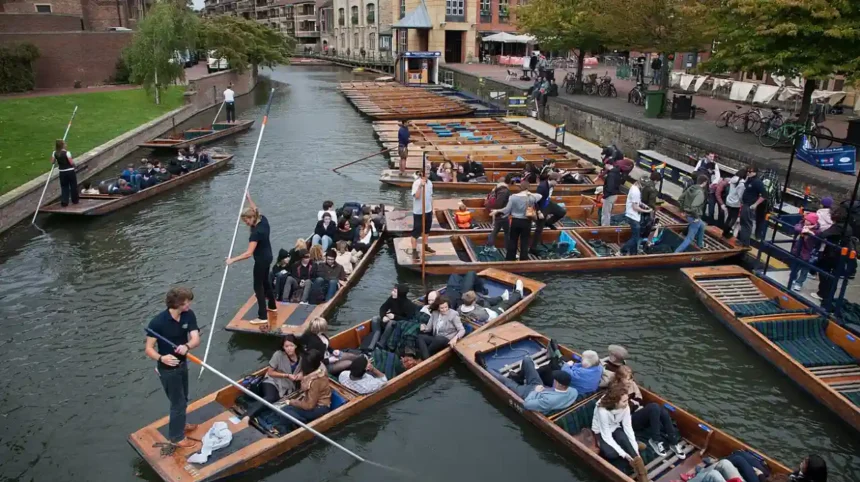
Punting in Oxford originated in the 1860s as a recreational adaptation of a working-class transport method. A punt is a flat-bottomed boat with a square-cut bow and stern, originally designed for navigating shallow waters for fishing and cargo transit.
- How did punting evolve from a commercial activity to a leisure pursuit?
- What are the technical characteristics of an Oxford punt?
- Why is punting associated with the University of Oxford?
- What is the difference between Oxford and Cambridge punting?
- Which river routes are historically significant for Oxford punting?
- What are the rules and etiquette of Oxford punting?
- How has the punting industry in Oxford changed over time?
- What role does punting play in Oxford’s modern cultural identity?
The fundamental design of the punt dates back to the medieval period when residents used these vessels for utilitarian tasks in the marshy areas of the River Cherwell and the River Thames. These early boats allowed for the transportation of reeds, livestock, and produce through narrow, weed-choked waterways where traditional keeled boats would run aground. The transition from labor to leisure occurred as students and academics from the University of Oxford sought new outdoor activities that provided privacy and physical engagement.
By the mid-Victorian era, the punt became a specialized recreational craft distinct from its heavier, industrial ancestors. Builders began constructing punts using lighter woods like mahogany and cedar to increase speed and maneuverability for recreational users. The unique propulsion method, involving a long pole pushed against the riverbed, allowed navigators to explore parts of the river inaccessible to rowboats or sailing vessels. This capability solidified the punt as the primary leisure craft for the Oxford collegiate community.
How did punting evolve from a commercial activity to a leisure pursuit?
The evolution occurred as the University of Oxford expanded its athletic culture during the nineteenth century. Improvements in boat design and the establishment of rental businesses at Magdalen Bridge and Folly Bridge enabled students to adopt punting as a social pastime.
During the early 1800s, punts were strictly functional tools used by professional river workers, including fishermen and ferrymen, to navigate the shallow tributaries of the Thames. The shift toward leisure began around 1860 when the Oxford University community sought alternatives to the highly structured and competitive nature of collegiate rowing. Unlike rowing, which required intense training and synchronized teamwork, punting offered a relaxed and individualistic experience.
Commercial boatbuilders recognized this demand and started manufacturing “pleasure punts” which featured comfortable seating and waterproof cushions for passengers. The establishment of specialized boathouses, such as the Cherwell Boathouse in 1904, provided the infrastructure necessary for widespread public and academic participation.
These businesses offered seasonal rentals, making the activity accessible to a broader demographic beyond the landed gentry. By the Edwardian era, punting had become the quintessential summer activity for Oxford residents, synonymous with picnics and academic breaks. The development of lighter poles made from ash or spruce further facilitated this transition by making the activity manageable for non-professionals.
What are the technical characteristics of an Oxford punt?
An Oxford punt is a wooden, flat-bottomed vessel measuring approximately 24 feet in length and 3 feet in width. It features a tiller at the stern and a “deck” at the bow, traditionally propelled using a 14-foot pole.
The construction of a traditional Oxford punt relies on a ladder-like frame made of oak or ash, which provides the necessary structural rigidity. The hull is typically planked with wood such as mahogany or larch, which resists rot and maintains buoyancy over long periods of immersion. One of the most defining features of the Oxford punt is the “box” or “till” located at the stern, which is a small enclosed compartment used for storage. The flat-bottomed nature of the hull allows the boat to draw only a few inches of water, making it ideal for the silt-heavy beds of the River Cherwell.
This design ensures stability, preventing the boat from tipping easily when passengers move between seats. The pole, often tipped with a metal “shoe” or “fork,” serves as the primary means of steering and propulsion. This shoe prevents the wood from splintering against the rocky or muddy river floor. While modern versions may use fiberglass or aluminum, the traditional Oxford aesthetic remains rooted in polished timber and brass fittings. These technical specifications have remained largely unchanged for over a century, preserving the historical integrity of the craft.
Why is punting associated with the University of Oxford?

Punting is associated with the University of Oxford because it became an integral part of the collegiate social fabric and architectural experience. The river routes pass through university-owned land, providing unique views of colleges like Magdalen and Wolfson.
The geography of the University of Oxford is inextricably linked to its waterways, particularly the River Cherwell, which flows past several prominent colleges and parks. During the late 19th century, the university integrated river activities into the student experience as a form of “muscular Christianity” and healthy recreation. Many colleges maintained their own private fleets of punts for the exclusive use of fellows and students, reinforcing the activity as an academic privilege. The quiet, slow-paced nature of punting provided an ideal environment for scholarly discussion and social networking outside the formal lecture hall.
Major university events, such as Eights Week and Commemoration Balls, historically utilized punting as a primary decorative and logistical element of the festivities. Literary works written by Oxford alumni, such as Lewis Carroll and Evelyn Waugh, frequently depicted punting, cementing the association in the global public consciousness. This cultural reinforcement transformed a simple boating method into a symbol of the Oxford educational lifestyle. Today, the university continues to foster this connection through college punting clubs and annual competitions.
What is the difference between Oxford and Cambridge punting?
The primary difference lies in the position of the punter and the design of the boat ends. In Oxford, the punter stands inside the boat at the “regatta” end, while in Cambridge, the punter stands on the deck.
Technique and tradition dictate that an Oxford punter stands on the floor of the boat at the end known as the “till” or “decked” end, which is usually the stern. By standing inside the boat, the Oxford punter maintains a lower center of gravity, which offers greater stability in the sometimes turbulent waters of the Thames. Conversely, Cambridge punters stand on the flat, raised platform at the very end of the boat, which requires a more refined sense of balance. The design of the boats reflects these preferences, with Oxford punts often having a more pronounced slant to the bow to handle different river currents.
The rivers themselves also dictate these differences; the River Cherwell in Oxford is narrower and more winding than the River Cam in Cambridge. These environmental factors necessitated a more controlled and stable punting style in Oxford to avoid collisions with overhanging trees and narrow bridge arches. This distinction has led to a friendly rivalry between the two university cities, with each claiming their method is the “correct” way to navigate. The physical orientation of the boat also differs, as Oxford punts are traditionally pushed with the till at the rear.
Which river routes are historically significant for Oxford punting?
The most historically significant routes are the River Cherwell and the Isis, which is the local name for the River Thames. The Cherwell route is preferred for leisure, winding through the University Parks and past Christ Church Meadow.
The River Cherwell offers a tranquil path that begins near the northern edges of the city and flows south toward the confluence with the Thames. This route is famous for passing under the High Street at Magdalen Bridge, providing a view of the 15th-century Magdalen Tower. Another significant section is the stretch through the University Parks, where the river splits into various shallow channels that are perfect for punting. The “Isis” stretch of the Thames is wider and more prone to heavy traffic from rowing eights and motorized vessels, making it less popular for novice punters. However, the route past Christ Church Meadow remains a vital historical link, as it was the site of many early regattas and social gatherings.
Historically, the “Old River” route provided a secluded path for academics seeking solitude away from the busier commercial zones of the city. These waterways are lined with ancient willow trees and historical landmarks, including the rollers at Parson’s Pleasure. Navigating these routes requires knowledge of the river’s depth and the location of underwater obstructions like sunken logs or stone blocks. These paths have been navigated by generations of students, making them essential to the Oxford experience.
What are the rules and etiquette of Oxford punting?
Punting etiquette dictates that the punter must keep to the right side of the river and yield to faster or larger vessels. It is also customary to avoid splashing passengers or other boats while retrieving the pole.
The unwritten rules of the river ensure safety and maintain the serene atmosphere that punting is known for. One essential rule is the “right of way,” where punters must defer to rowing shells and powered craft that have less maneuverability. When two punts meet in a narrow channel, the boat traveling downstream generally has the right of way, although this can vary by local custom. Proper technique involves keeping the pole close to the side of the boat to prevent it from swinging and hitting others.
It is considered poor form to “walk” the boat by moving along the length of the hull; instead, the punter should remain stationary at the stern. Respect for the environment is also a key component of etiquette, including the prohibition of littering and the disturbance of nesting waterfowl like swans and ducks. Historical etiquette also emphasized modesty and quietude, reflecting the academic nature of the participants. Modern punters are expected to manage their poles carefully to avoid getting them stuck in the clay riverbed, which can lead to the punter being pulled into the water. These practices have been passed down through local boathouses to preserve the river’s heritage.
How has the punting industry in Oxford changed over time?
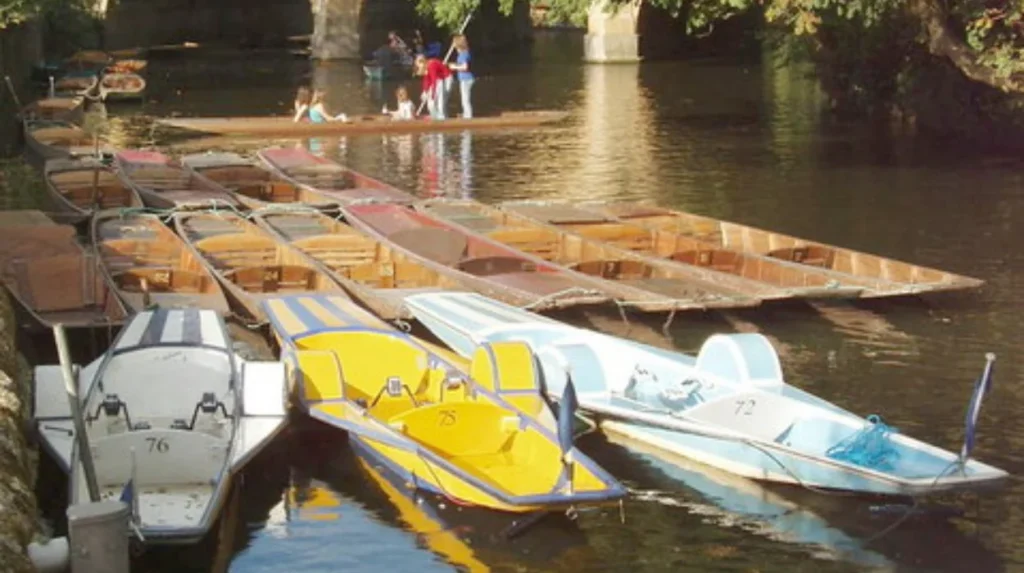
The industry has transitioned from a fragmented collection of independent boatmen to a regulated tourism and leisure sector. Large boathouses now manage standardized fleets and offer professional “chauffeur” services to visitors and tourists.
In the 19th century, punting was serviced by individual craftsmen who built, maintained, and rented their own vessels from small riverside plots. As the popularity of the activity grew, these small operations consolidated into larger enterprises like the Magdalen Bridge Boathouse and the Cherwell Boathouse. These institutions standardized the design of the Oxford punt, ensuring that rental fleets were uniform in size and quality. The mid-20th century saw a decline in private punt ownership as the costs of maintenance and storage rose, leading to the dominance of the rental market.
Recently, the industry has adapted to global tourism by providing professional punters who provide historical tours for those unable to navigate themselves. This shift has allowed the industry to remain profitable despite changes in student demographics and local leisure habits. Safety regulations have also increased, with boathouses now required to provide life jackets and regular hull inspections to meet modern maritime standards. Despite these modernizations, the core experience of punting remains a manual, low-impact activity that relies on traditional skills. The industry remains a vital part of Oxford’s economy, supporting both local employment and historical preservation.
What role does punting play in Oxford’s modern cultural identity?
Punting serves as a primary symbol of Oxford’s heritage, featuring prominently in tourism branding and university recruitment materials. It represents a link between the city’s medieval past and its current status as a global educational hub.
In the 21st century, punting is more than a leisure activity; it is a visual shorthand for the “dreaming spires” aesthetic of Oxford. The image of a punt gliding under a stone bridge is used worldwide to evoke the atmosphere of English academia and tradition. For the local community, punting remains a rite of passage for students and a favorite activity for celebrating the end of examinations. It also plays a role in local environmentalism, as punts are non-polluting, human-powered vessels that encourage the preservation of river ecosystems. Annual events and “punt races” continue to draw crowds, maintaining the competitive spirit that first brought the boats to the university.
The activity also bridges the gap between “town and gown,” as both permanent residents and university members share the same waterways. It is one of the few historical traditions that remains active and functional rather than being relegated to a museum. The continued presence of punts on the Cherwell ensures that the river remains a living part of the city’s geography. As long as the university and the river exist, punting will likely remain a central pillar of Oxford’s cultural landscape.
What is the origin of punting?
Punting originated as a functional method for navigating shallow, marshy waters using flat-bottomed boats. Medieval laborers used these vessels for fishing, transporting cargo, and moving livestock across riverbeds where traditional keeled boats would frequently get stuck in the heavy silt.
When did punting start in Oxford?
Punting started in Oxford during the 1860s as a recreational activity for students and academics. While the boats existed for commercial use earlier, the mid-Victorian era marked the official shift toward leisure, specifically on the River Cherwell and Thames.
What is the science behind punting?
The science of punting relies on Newton’s Third Law of Motion and hydrostatic stability. By pushing a pole against the solid riverbed, the punter creates an equal and opposite reaction that propels the flat-bottomed hull forward through the water.
Is punting gambling?
Punting is not gambling in the context of Oxford river traditions; it refers exclusively to the act of boating. While “punting” is a slang term for placing bets in horse racing, the two concepts share no historical or functional connection.
Who are some famous punters?
Famous punters include literary figures like Lewis Carroll and Evelyn Waugh, who frequently used the activity as inspiration for their writing. Additionally, numerous British monarchs and international dignitaries have engaged in punting during official visits to the University of Oxford.