Key Points
- Officers from the Kidlington Neighbourhood Team confiscated an illegal electric bike after residents raised concerns about uninsured and unroadworthy vehicles on local roads.
- Thames Valley Police said PC Brody and PC Barton seized the e-bike after seeing it ridden illegally on a public highway.
- Police warned that electric bikes that do not meet Electrically Assisted Pedal Cycle (EAPC) standards are legally classified as motor vehicles, meaning riders must have a driving licence, insurance, and vehicle registration.
- Thames Valley Police said they have a zero-tolerance policy on illegal e-bikes and e-scooters in the area, and asked owners to check if their bikes are road legal.
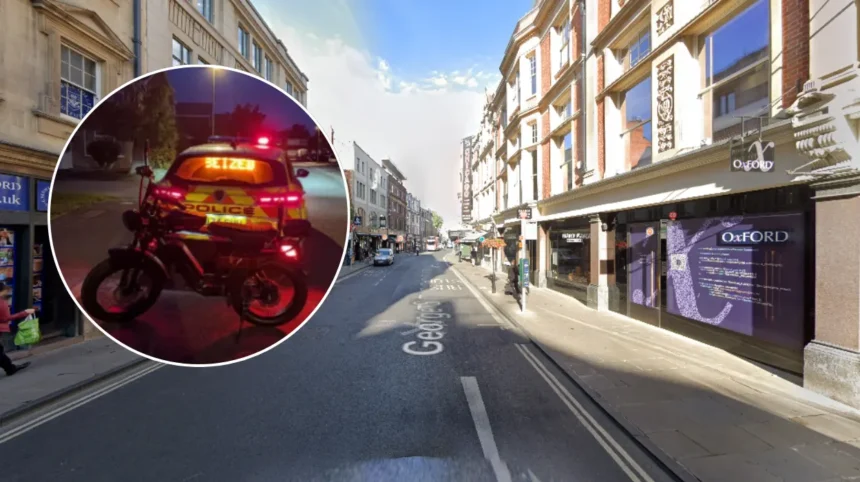
Kidlington (Oxford Daily) October 8, 2026 – Thames Valley Police officers operating in Kidlington have confiscated an illegal electric bike following sustained public safety complaints from local residents regarding uninsured and unroadworthy vehicles being operated across public thoroughfares in Oxfordshire.
- Key Points
- What Are the Legal Requirements for Operating an Electric Bike on UK Roads?
- Why Are UK Police Forces Escalating Enforcement Against Non-Compliant E-Bikes?
- What Happens to Non-Compliant Vehicles Following Police Seizure?
- Background of Electric Bike Regulations and Police Enforcement
- Prediction: How This Development Will Affect Key Audiences
As reported by police reporting staff at the Oxford Mail, PC Brody and PC Barton from the local Kidlington Neighbourhood Team intercepted and seized the non-compliant e-bike after observing it being driven illegally on a public road. The intervention follows targeted police activity designed to clear non-compliant, unregistered, and high-speed motor vehicles from pedestrian pathways and traffic lanes across the Cherwell district.
Addressing the circumstances surrounding the operational seizure, a spokesperson for TVP Cherwell stated: “While we’re all for greener ways to travel, there are rules in place to keep everyone safe. If an e-bike doesn’t meet legal requirements, it may actually be classed as a motor vehicle, meaning insurance, a licence and other legal requirements could apply.”
In an official public safety advisory issued shortly after the seizure, Thames Valley Police highlighted the statutory boundaries separating standard bicycles from illegal motor vehicles. As reported by the Oxford Mail, the force warned: “There is zero tolerance when it comes to the illegal use of e-bikes and e-scooters on our patch.”
TVP Cherwell further urged vehicle owners to review their transport hardware, adding: “If your bike can outpace traffic with barely a pedal in sight, it might be time to check whether it’s actually road legal. Not every bike with pedals is legally a bicycle.”
What Are the Legal Requirements for Operating an Electric Bike on UK Roads?
Under current statutory frameworks enforced across England and Wales, electric bicycles must comply strictly with Electrically Assisted Pedal Cycle (EAPC) regulations to be ridden legally on public roads without registration, tax, or motor insurance.
To qualify under EAPC guidelines, an electric bicycle must be fitted with pedals that can be used to propel it. The maximum continuous power output of the electric motor must not exceed 250 watts, and the electrical assistance must automatically cut out once the vehicle reaches a speed of 15.5 mph (24.9 km/h).
If an electric cycle features a motor exceeding 250 watts, provides assistance past the 15.5 mph limit, or operates via a throttle mechanism without active pedalling (outside of low-speed start assistance or specific type-approval exemptions), it is classified in law as a motor vehicle—specifically a moped or motorcycle. Consequently, operating such a modified or overpowered vehicle on public highways without a valid driving licence, third-party motor insurance, helmet, and vehicle registration constitutes an offence under the Road Traffic Act 1988.
Why Are UK Police Forces Escalating Enforcement Against Non-Compliant E-Bikes?
The confiscation in Kidlington forms part of a national escalation in police activity targeted at unregistered high-powered electric two-wheelers. Police forces across the United Kingdom have faced increasing pressure from community councils, pedestrian advocacy groups, and local residents over the risks posed by modified e-bikes travelling at high speeds through residential streets, pedestrianised shopping zones, and public parks.
Officers routinely deploy statutory powers under Section 165A of the Road Traffic Act 1988, which empowers police to seize vehicles believed to be operated without valid insurance or driving licences. Additionally, officers utilize Section 59 of the Police Reform Act 2002 to confiscate vehicles used anti-socially or in a manner causing alarm, distress, or annoyance to the public.
In parallel with Oxfordshire enforcement, neighbouring forces have similarly intensified crackdowns. As reported by news personnel at Essex Police, officers in Tendring confiscated 88 illegal e-scooters and e-bikes over a two-month period following safety concerns regarding modified devices. Furthermore, as reported by Gloucestershire Constabulary, officers in Brockworth recently appealed for witnesses after a rider operated an illegal high-speed e-bike dangerously on the wrong side of the road, running red lights and endangering pedestrians.
What Happens to Non-Compliant Vehicles Following Police Seizure?
Once an illegal or non-compliant e-bike is impounded by law enforcement under motor vehicle seizure powers, the recovery process requires strict documentary proof. Because an overpowered or de-restricted e-bike is legally treated as a motor vehicle, official police recovery pounds will not release the machine unless the claimant produces photo identification, proof of ownership, a valid driving licence, and a certificate of valid motor insurance.
Standard bicycle or cycle insurance policies do not fulfill motor insurance requirements. If the owner is unable to present statutory motor insurance—which is virtually impossible to obtain for non-type-approved or home-modified electric bikes—the police retain the vehicle. Following the mandatory statutory retention period, unclaimed or unreleaseable motor vehicles are disclaimed and systematically sent for destruction or crushing.
Background of Electric Bike Regulations and Police Enforcement
The legislative framework surrounding electric bikes in the United Kingdom was constructed to encourage low-emission urban mobility while preserving pedestrian safety. The Electrically Assisted Pedal Cycles Regulations 1983 (amended in 2015 to align with European Union standard EN15194) established the 250-watt ceiling and 15.5 mph assistance limit.
Over the past decade, the rapid growth of e-commerce platforms and aftermarket conversion kits has allowed consumers to easily purchase high-capacity hub motors, de-restriction dongles, and throttle components online. These modifications easily convert standard bicycles into unregistered electric mopeds capable of speeds between 30 mph and 50 mph.
This technological surge created a regulatory gap. While law-abiding commuters rely on EAPC-compliant bicycles for daily transit, the influx of illegal high-speed electric motorbikes on footpaths and cycle lanes led to a sharp increase in public complaints. In response, the Home Office and regional police forces have equipped neighbourhood policing teams with clearer operational mandates to identify off-spec hardware, seize illegal units at the roadside, and issue fixed penalty notices or driving licence penalty points to offenders.
Prediction: How This Development Will Affect Key Audiences
For E-Bike Riders and Commuters
Commuters using fully legal, factory-spec EAPCs (250W motors with a 15.5 mph cut-off) will experience increased police scrutiny during roadside spot checks. Legitimate cyclists may face temporary disruptions if officers check motor specifications or perform speed-cut tests. Conversely, individuals riding modified or high-powered e-bikes risk immediate roadside vehicle seizure, financial penalties up to £300, six penalty points on their driving licence, and the permanent destruction of their equipment.
For Retailers and Delivery Drivers
Commercial gig-economy couriers and delivery riders who rely on high-speed e-bikes to meet tight time windows will face heightened operational risks. Increased police seizures will force delivery workers to transition toward fully compliant EAPC vehicles or obtain official motorcycle licences and commercial motor insurance. Retailers and online vendors selling conversion kits or non-compliant e-bikes will also face growing regulatory oversight and pressure to provide explicit point-of-sale warnings regarding UK road legality.
For Local Communities and Pedestrians
For residents across Oxfordshire and the wider UK, sustained enforcement against non-compliant e-bikes is expected to reduce dangerous, high-speed vehicle anti-social behavior on footpaths and in pedestrianized town centres. Greater clarity and active policing will improve overall road safety, lower pedestrian collision risks, and establish a cleaner boundary between legal green micro-mobility and illegal motor vehicle operation.