Key Points
- French riot police fired tear gas and used crowd control weapons at student barricades outside Paris secondary schools, including Lycée Hélène Boucher and Lycée Sophie-Germain.
- Demonstration organisers said up to 450,000 students, teachers, and parents marched across France, while Interior Ministry figures recorded over 250,000 turnout nationwide and 56,000 in Paris.
- Prime Minister Sébastien Lecornu told the National Assembly that at least 215 teenagers, 85 teachers, and more than 700 police officers have been injured since protests began in late September.
- Police have arrested more than 6,600 people across the country since the start of the movement, including nearly 500 detentions in a single day.
- Protesters are asking for more state funding, smaller class sizes, building repairs, and an end to police force against underage students.
PARIS (Oxford Daily) October 8, 2026 — French riot police fired tear gas and deployed heavy crowd control gear at barricaded secondary schools across the capital as nationwide student demonstrations showed no sign of abating, leaving hundreds injured and causing widespread educational disruption (Paris News) October 8, 2026 —
Why Are French High School Students Protesting in Paris?
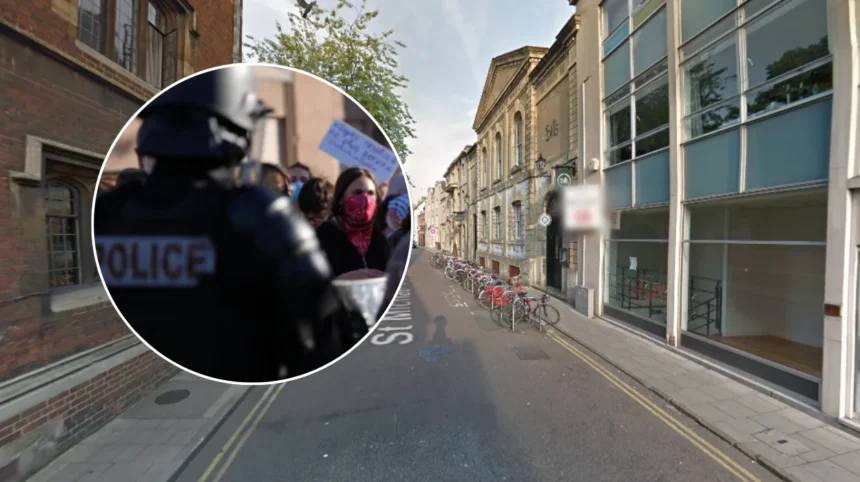
Dozens of high school pupils dragged wheelie bins, construction barriers, and shopping trolleys into position outside the Lycée Hélène Boucher in northeastern Paris early on Thursday morning, erecting makeshift ramparts before law enforcement officers moved in with tear gas to clear the access routes.
The confrontation represents the latest focal point in an escalating confrontation between secondary school students and the French state over what campaigners describe as chronic underfunding, dilapidated facilities, and acute staffing shortages across the national public education system.
As reported by John Leicester and Angela Charlton of the Associated Press, police officers gathered in adjacent side streets as masked pupils converged on school entrances to maintain blockades.
According to figures released by the French Education Ministry, at least 375 high schools across the country were either fully closed or partially blocked by student actions on Thursday, whilst roughly 40 per cent of public higher education institutions experienced operational disruptions, occupations, or closures.
The anger driving the youth movement extends beyond classroom infrastructure to encompass police conduct. As reported by Angelique Chrisafis of The Guardian, pupils outside the Lycée Sophie-Germain in central Paris held banners calling for greater equality and educational resources whilst condemning police tactics.
Livia, a 17-year-old high school student in northern Paris, stated to The Guardian that “we’re teenagers with wheelie bins, and the police have heavy weapons, it’s totally mismatched… The police are extremely violent in France. This is state violence and it’s horrible seeing police allowed to target children”.
What Is the Casualty and Arrest Toll Across France?
The human toll of the confrontations has escalated rapidly, prompting warnings from human rights watchdogs and civil liberty groups. As reported by Elizabeth Pineau and Gabriel Stargardter of Reuters, French Prime Minister Sébastien Lecornu told lawmakers in the National Assembly that the casualties mark “the heaviest toll in decades paid by the school system”.
Official statistics confirmed that at least 215 teenagers and 85 school staff members have been injured in clashes, whilst the Prime Minister’s office noted that more than 700 police officers have also suffered injuries. Serious injuries have been documented on the front lines, including an incident on Monday in which a teenage demonstrator lost a hand during explosive clashes.
In terms of law enforcement operations, the French Interior Ministry confirmed that police have made over 6,600 arrests nationwide since the protests broke out in late September. A single day of action on Tuesday yielded 488 detentions across the country, as reported by French news outlet Libération.
The French human rights watchdog issued an official statement expressing grave concern over the situation, calling on the executive branch to “strengthen dialogue with young people and guarantee the exercise of their rights” whilst highlighting “the disproportionate use of force and procedural abuses” committed by police forces.
Conversely, Prime Minister Sébastien Lecornu maintained a firm stance, stating before the National Assembly that “we cannot allow any space for tolerance for violence” whilst condemning destructive incidents occurring on the margins of student rallies.
International figures have also weighed in on the domestic crisis. Former US President Donald Trump commented on social media, attributing the secondary school unrest to “out of control mass migration”.
Writing on Truth Social, Trump stated: “What’s happening in France is nothing less than out of control mass migration. This isn’t about schools, this is about Islam wanting to take over a once great Country!”.
Background of the Particular Development
The wave of high school disruptions began in late September 2026 in the working-class, lower-income outer suburbs (banlieues) of Paris before spreading to major urban centres including Marseille, Toulouse, Rennes, and Lyon. Initial localized walkouts were sparked by severe teaching vacancies at the start of the academic year, overcrowded classrooms, and neglected physical infrastructure in secondary lycées.
This unrest comes at a delicate political moment for President Emmanuel Macron’s administration. Following the 2024 parliamentary elections in which President Macron’s centrist coalition lost its absolute majority, the French government has struggled to pass state budgets and implement structural economic reforms.
With the state attempting to curb ballooning public sector deficits and reduce national debt under strict European Union fiscal frameworks, spending constraints have hit public services, including the Ministry of National Education.
The resulting friction has fueled political polarization, with both far-left and far-right opposition parties exploiting public discontent ahead of the upcoming presidential election cycle. As teachers’ unions and parent associations joined the secondary school movement, localized school blockades evolved into a nationwide anti-government movement.
Prediction: How This Development Can Affect French Society and Secondary Education
The continuation of coordinated high school blockades and police interventions threatens to create prolonged operational instability across the French national education system.
For pupils and parents, extended school closures, entrance blockades, and teaching disruptions will directly impair academic progress, particularly for senior students preparing for national baccalauréat examinations. The psychological impact of riot control measures—such as tear gas canisters and tear gas spray deployed directly outside secondary school gates—risks further alienating French youth from state institutions and standard police authority.
For the French government and Prime Minister Sébastien Lecornu, the escalation poses a grave political dilemma. If the executive branch maintains an uncompromising law-and-order stance backed by riot police, it risks further angering public sector trade unions, driving higher turnout on the streets, and deepening societal divisions.
Conversely, making significant budgetary concessions to meet student and teacher demands would undermine fiscal tightening efforts, potentially destabilising France’s standing with international credit rating agencies and European financial regulators.