Key Points
- Westminster City Council has written to the UK Government and Transport for London demanding a full Environmental Impact Assessment before the Oxford Street pedestrianisation scheme moves forward.
- The council accused Mayor Sir Sadiq Khan and TfL of trying to get permission from the Ministry of Housing, Communities and Local Government to skip standard environmental evaluations for the project.
- Local officials warned that re-routing buses, taxis, and commercial vehicles will drive congestion, air pollution, and noise into nearby residential streets across central London.
- The council raised concerns over unaddressed operational issues, including round-the-clock street cleaning, waste collection, emergency access, and accessibility for visually impaired pedestrians.
- Mayor Sadiq Khan and the Oxford Street Development Corporation maintain that closing the street to vehicles is necessary to make the retail area greener, safer, and economically resilient.
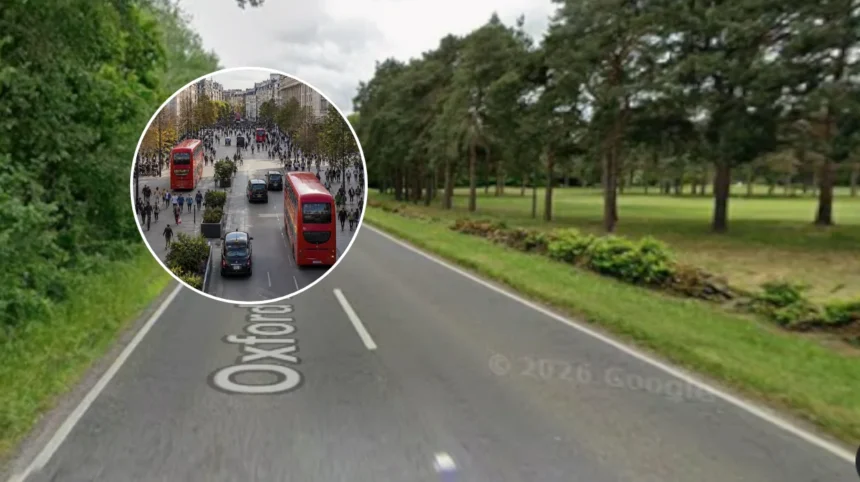
WESTMINSTER — (Oxford Daily) August 29, 2026 — Westminster City Council has formally challenged the Mayor of London’s high-profile project to pedestrianise Oxford Street, demanding that central government intervene to enforce a mandatory, full Environmental Impact Assessment (EIA) on the proposals.
- Key Points
- Why Is Westminster City Council Challenging Sadiq Khan’s Oxford Street Scheme?
- What Environmental and Logistics Issues Have Been Raised by Officials?
- How Has City Hall and Transport for London Responded to the Pushback?
- Background of the Oxford Street Pedestrianisation Development
- Prediction: How This Development Will Affect Key Audiences
Why Is Westminster City Council Challenging Sadiq Khan’s Oxford Street Scheme?
The conflict between local municipal authorities and City Hall escalated after Transport for London (TfL), operating under the direct instruction of London Mayor Sir Sadiq Khan, requested permission from the Ministry of Housing, Communities and Local Government (MHCLG) to bypass standard environmental impact checks. The scheme involves closing the stretch of Oxford Street between Orchard Street and Great Portland Street to all private motorised vehicles, buses, taxis, private hire cars, and bicycles.
Westminster City Council maintains that pushing forward without an exhaustive study on air quality, acoustics, public safety, and traffic displacement undermines standard statutory planning protocols designed to safeguard urban communities.
As reported by Rachael Burford of The Evening Standard, Westminster City Council has written directly to Ministers to express grave concern over TfL seeking an exemption from a full EIA. The council argues that removing vehicular traffic from one of Europe’s busiest shopping streets will simply displace thousands of vehicle movements daily into quiet residential side streets, worsening environmental conditions for local taxpayers.
Speaking on the dispute, Councillor Tim Barnes, Deputy Leader of Westminster City Council, stated: “Our position on pedestrianisation is simple, if you must do it, get it right. A needlessly rushed scheme will be a disaster for residents and worse for business. This scheme will have an impact way beyond Oxford Street affecting bus routes and traffic flow right across the capital. The Mayor has important questions to answer about managing traffic, noise, impact on air quality or how to clean the roads. The consequences of getting this wrong are potentially terrible for central London.”
Barnes added: “London deserves a world class shopping district at its centre and instead we’re headed for an unmanaged mess with noisy, gridlocked roads, poor air quality and waste in the streets. The Mayor is trying to cut corners when it comes to ensuring this plan is safe for Londoners. That’s cheating them of the reassurances they are entitled to and the Government should not let him get away with it.”
What Environmental and Logistics Issues Have Been Raised by Officials?
The environmental and practical concerns raised by Westminster town hall extend far beyond simple traffic jams. Local representatives argue that City Hall has failed to present granular operational blueprints for essential public services once motorized access is severed during daytime trading hours.
As reported by Tiana Mudkavi of The Fitzrovia News, Westminster Cabinet members previously sent TfL a comprehensive 15-point mitigation demand addressing major systemic flaws in the project. Among the council’s primary concerns is how the total ban on cycling along Oxford Street will impact low-carbon commuting. Local officials have urged TfL to reconsider permitting cycling prior to 11:00 AM—when footfall is light—or establish dedicated alternative east-west cycle paths prior to closing the main road.
Furthermore, municipal logistics present a significant challenge. Servicing vehicles will only be permitted access to the traffic-free zone between midnight and 07:00 AM. Westminster Council highlighted that pedestrianised zones naturally require more intensive maintenance, street washing, and refuse consolidation. Without clear timetables for street cleaning and waste collection, authorities warn of potential refuse build-ups and pest issues along commercial corridors.
Accessibility groups and urban planning observers have similarly called for clarity. Although disability advocacy organisations such as Guide Dogs have welcomed pedestrianisation principles, council members stress that universal accessibility—including step-free transit connections at Oxford Circus and Marble Arch Tube stations, tactile paving, and dropped kerbs—must be fully verified before major infrastructure alterations commence.
How Has City Hall and Transport for London Responded to the Pushback?
City Hall and TfL leadership maintain that the scheme is vital to securing the economic future of the West End. The Mayor of London’s office asserts that transforming Oxford Street into a green, pedestrian-first thoroughfare will rejuvenate retail trade, boost footfall, and create a safer environment for visitors and residents.
According to official project design documentation released by the Greater London Authority (GLA), the Oxford Street Development Corporation (OSDC) has outlined a vision featuring extensive tree planting, climate-resilient urban greening, sustainable low-carbon construction materials, increased public seating, and improved street lighting.
Alex Williams, Chief Customer and Strategy Officer at Transport for London, defended the project trajectory, stating: “It’s great that we are now proceeding with pedestrianisation along Oxford Street between Orchard Street and Great Portland Street, following the publication of the consultation report for the required highways and traffic changes. We are confident that these plans will make Oxford Street and the surrounding area more attractive and thriving for residents as well as for visitors and businesses, and are committed to monitoring the impacts of any changes on the local area and would work with residents and other groups to mitigate any issues.”
Similarly, Nabeel Khan, Chief Executive of the Oxford Street Development Corporation, emphasized that public safety and sustainability are foundational to the Mayoral Development Area’s mandate: “We have a bold and unifying vision to transform Oxford Street into a safer, greener and more welcoming place where everyone feels they belong. Our plans put public safety first, including the safety of women and girls, and champion inclusive design so the street works for everyone. This will result in a more resilient public realm with more planting, sustainable materials and spaces where people can spend time.”
Background of the Oxford Street Pedestrianisation Development
The ambition to transform Oxford Street into a pedestrian-only zone has been a central and contentious debate in London local governance for nearly a decade.
In September 2024, Mayor Sadiq Khan, backed by the Deputy Prime Minister and Secretary of State for Housing, Communities and Local Government, Angela Rayner, announced plans to bypass local council blocking mechanisms by utilizing statutory powers under the Localism Act 2011. By establishing a Mayoral Development Corporation (MDC)—the Oxford Street Development Corporation (OSDC)—the Mayor effectively assumed direct planning oversight over the Oxford Street corridor, stretching from east of Tottenham Court Road to Marble Arch.
Prior to this intervention, Westminster City Council had spent two years executing its own £90 million public realm improvement initiative. That council-led strategy prioritized wider pavements, enhanced junctions, and improved lighting while preserving essential bus transit links and taxi access.
In early 2025, City Hall launched a public consultation regarding the creation of the OSDC, reporting that approximately 70 per cent of respondents supported the Mayoral Development Area, with two-thirds endorsing pedestrianisation. The OSDC was officially established on 1 January 2026, holding its inaugural board meeting later that month.
Despite formal consultation processes, local political opposition has intensified. Westminster City Council previously explored legal avenues, including judicial review proceedings, to halt the transfer of powers. While internal legal counsel advised that a late judicial review claim faced significant procedural hurdles, council leaders have continued to utilize procedural, environmental, and planning mechanisms to challenge TfL’s timeline.
Prediction: How This Development Will Affect Key Audiences
The legal and procedural conflict between Westminster City Council, TfL, and the Ministry of Housing, Communities and Local Government will directly impact several key stakeholder groups across central London:
1. Local Residents in Surrounding Neighbourhoods (Marylebone, Mayfair, and Fitzrovia)
If TfL proceeds without implementing extensive traffic displacement mitigations, residents living on parallel streets (such as Wigmore Street, Mortimer Street, and Henrietta Place) face significant negative externalities. Re-routing hundreds of buses and taxis daily will likely cause severe localized congestion, elevated noise levels, and higher nitrogen dioxide ($NO_2$) concentrations in residential side streets. Conversely, if Westminster’s intervention forces a full EIA, residents may gain permanent air-quality monitoring stations, traffic-calming infrastructure, and accelerated electric-bus deployments.
2. West End Retailers and Business Owners
For retailers along Oxford Street, a delayed or legally disputed scheme prolongs operational uncertainty. While pedestrianisation aims to increase footfall and dwell time, short-term construction disruptions and restrictions on daytime delivery vehicles (limited to 00:00–07:00) could complicate inventory logistics. Small businesses on surrounding secondary streets may experience spillover footfall, but risk delivery blockages caused by displaced vehicular traffic.
3. Commuters, Cyclists, and Public Transport Users
The total removal of buses from Oxford Street will force major alterations to central London’s public transit network. Passengers reliant on direct bus connections through the West End will experience increased walking times between diverted bus stops on adjacent corridors. For cyclists, the proposed ban on Oxford Street, combined with a lack of dedicated alternative east-west cycle lanes, will create navigational friction until City Hall establishes safe bypass routes.
4. Elderly and Mobility-Impaired Visitors
The complete removal of surface public transport and black cabs along the main shopping strip creates accessibility challenges for visitors with reduced mobility. Unless TfL delivers comprehensive zero-emission micro-shuttles or step-free access upgrades across nearby Underground stations, the pedestrianised zone risks excluding demographics reliant on doorstep vehicle drop-offs.