Key Points
- Transport for London closed nearly one kilometre of Oxford Street, between Orchard Street and Great Portland Street, to all vehicles on Monday, 26 October 2026.
- The ban covers motorised traffic, red buses, black cabs, bicycles, and e-scooters along the pedestrianised section.
- Delivery vehicles can only access the street overnight between midnight and 7:00 AM.
- Mayor of London Lord Sadiq Khan called the launch a “momentous day” for London and local retail trade.
- Public reaction is split, as shoppers welcome the clear walking space while taxi drivers and cyclists raise concerns over access and alternative routes.
Central London (Oxford Daily) November 2, 2026 — One week after Transport for London officially closed a major stretch of Oxford Street to vehicles, Europe’s busiest shopping thoroughfare is experiencing its most radical operational shift in decades.
- Key Points
- How has the public reacted to the newly pedestrianised scheme?
- What are civic leaders and transport authorities saying about the progress?
- What concerns have taxi drivers and local business groups raised?
- Background of the Oxford Street pedestrianisation development
- Prediction: How will this development affect shoppers, retailers, and commuters?
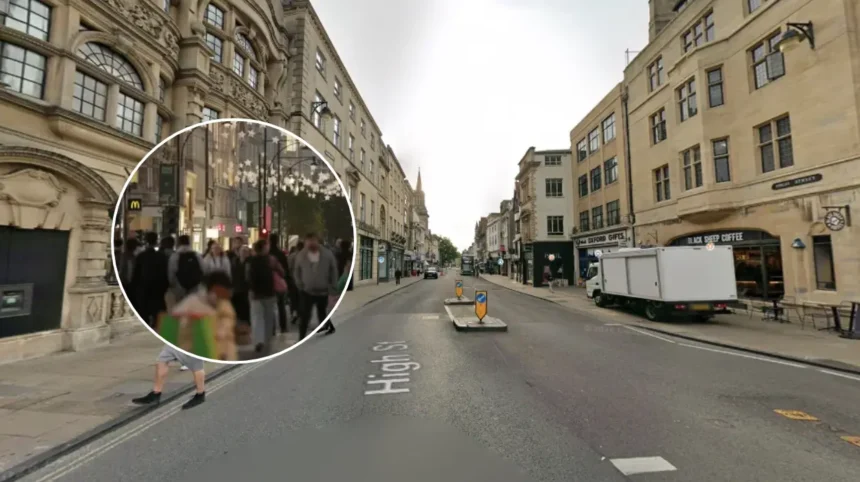
Under the dynamic scheme enacted on Monday, 26 October 2026, almost a kilometre of road between Orchard Street and Great Portland Street has been cleared of cars, red double-decker buses, black cabs, bicycles, and e-scooters.
The landmark move aims to reverse years of declining footfall, boost the West End’s £3.1 billion annual retail economy, and provide a safer environment for millions of visitors.
How has the public reacted to the newly pedestrianised scheme?
Initial public reactions over the past seven days highlight a stark divide between pedestrians enjoying the open space and transport operators adapting to rerouted roads. Pedestrians visiting the West End have overwhelmingly welcomed the lack of vehicular traffic.
As reported by Rachel Hall and Gwyn Topham of The Guardian, holidaymaker Raquel Cox stated that “We couldn’t believe it. We said, ‘We have to go there and experience it first-hand’” after seeing early news reports of the traffic ban.
Furthermore, The Guardian reported that another visitor described the updated stretch, noting that “It’s a more pleasant environment. People are happier because they can walk around” without constantly jostling on narrow pavements.
However, the ban on cycles and taxis has drawn immediate pushback from commuters and accessibility advocates.
As reported by Rachel Hall and Gwyn Topham of The Guardian, a cyclist named Jack expressed frustration at being stopped by security wardens, stating: “I’ll be completely honest with you. I’m not going to listen to no one. I’m going to ride down this road, whether they like it or not… It’s not going to work for me.”
What are civic leaders and transport authorities saying about the progress?
London’s leadership has positioned the traffic restriction as an essential structural overhaul to rescue the high street from retail decline.
As reported by Jordan Reynolds of The Evening Standard, Mayor of London Lord Sadiq Khan stated during a visit to John Lewis that “This is a momentous day for Oxford Street, but also for London. Look, it’s really important that we support our fantastic retail”. Mayor Khan added that “We’ve seen over the last couple of decades this street in decline… I want this to be a proof of concept – that investing in people rather than traffic leads to better footfall and spend”.
Transport chiefs have similarly maintained that nearby transport links remain robust enough to absorb diverted passenger flows. Transport for London Commissioner Andy Lord stated that the project creates a significantly safer urban space for visitors.
Transport for London officials also noted that Elizabeth line connections at Bond Street and Tottenham Court Road offer direct access to the sector without requiring surface vehicular traffic on Oxford Street itself.
What concerns have taxi drivers and local business groups raised?
Despite the optimistic tone from City Hall, representative groups for taxi drivers and local access campaigners have highlighted disruption across adjacent residential streets.
As reported by Rachel Hall and Gwyn Topham of The Guardian, local black cab driver Ben McMullan stated that “accessibility is a huge problem” for elderly and disabled passengers who rely on direct drop-offs outside major retail stores.
Critics from business bodies and driver associations have also warned that diverting dozens of bus routes and taxi journeys into surrounding narrow thoroughfares, such as Henrietta Place and Wigmore Street, threatens to worsen congestion elsewhere in Mayfair and Marylebone.
Transport for London has clarified that freight deliveries are restricted strictly to night-time windows between midnight and 7:00 AM to prevent operational friction during trade hours.
Background of the Oxford Street pedestrianisation development
The effort to pedestrianise Oxford Street has been one of the most fiercely debated urban planning proposals in London’s modern history. For over a decade, successive mayoral administrations attempted to remove traffic from the 1.2-mile thoroughfare to address severe pedestrian overcrowding, high air pollution levels, and poor road safety statistics.
Previous attempts stalled due to governance conflicts between City Hall and Westminster City Council, as well as opposition from resident groups worried about traffic spillover into surrounding streets. However, in September 2025, the Mayor of London secured official approval to take over planning powers for Oxford Street as part of a Mayoral Development Corporation structure.
Following extensive public consultations in early 2026, final authorization was granted to implement the first section between Orchard Street and Great Portland Street.
Prediction: How will this development affect shoppers, retailers, and commuters?
In the short term, retailers along Oxford Street are expected to see higher footfall and improved dwell times during the peak festive shopping season, as the expanded walking area creates a more relaxed shopping atmosphere.
However, commuters and transport users face ongoing adjustments as dozens of bus routes remain diverted onto secondary roads. If surrounding congestion worsens over the coming months, Transport for London may face increased pressure to refine traffic routing and expand blue-badge parking access for mobility-impaired visitors.
Over the long term, if footfall and retail spend increase as projected, this initial phase could pave the way for full pedestrianisation across the remainder of Oxford Street towards Tottenham Court Road.