Key Points
- University of Oxford physicists, working with the international ATLAS collaboration at CERN, observed quantum entanglement between short-lived Z bosons.
- The entangled Z boson pairs formed through the decay process of Higgs bosons generated in high-energy proton collisions.
- The measurement recorded quantum entanglement at higher energy levels than previous tests.
- Researchers calculated the spins of the Z bosons by measuring the flight angles and paths of the electrons and muons left behind as they decayed.
- The findings confirmed that high-energy particle colliders can generate and test entangled quantum states.
GENEVA (Oxford Daily) September 15, 2026 — As reported by the news team at the University of Oxford Media Office, researchers from the University of Oxford, working alongside the international ATLAS collaboration at CERN’s Large Hadron Collider (LHC) near Geneva, have successfully observed quantum entanglement at record-breaking energy levels on September 14, 2026. The landmark study, published in the peer-reviewed journal Physical Review Letters, confirms that Albert Einstein’s famous “spooky action at a distance”—where two particles remain intrinsically linked regardless of distance—persists even among extremely massive and fleeting subatomic particles created during high-energy collisions.
How was the quantum effect detected inside the Large Hadron Collider?
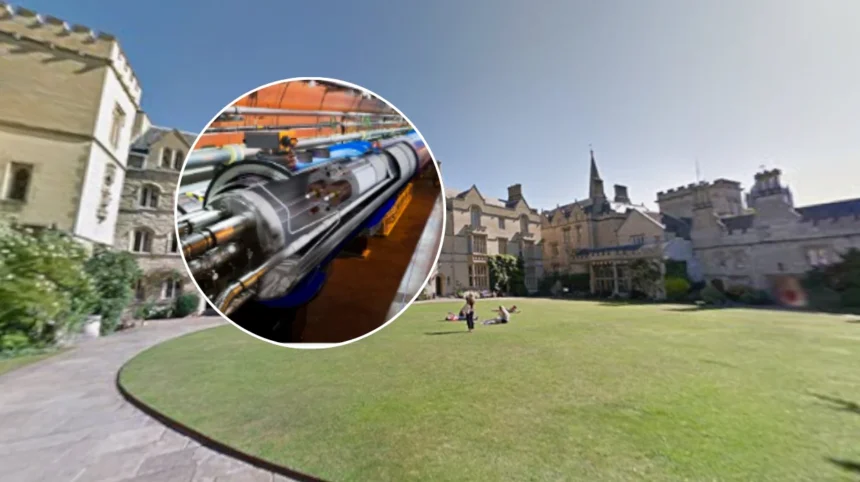
According to details published by the University of Oxford, the international research team utilised the massive ATLAS detector situated along the 27-kilometre subterranean ring of the Large Hadron Collider near the Swiss-French border. The experiment focused on observing pairs of Z bosons produced through the decay of Higgs bosons—the fundamental particle discovered at CERN in 2012.
When a Higgs boson is created in proton-proton collisions operating at energies up to 13 trillion electron volts (TeV), it can briefly split into two Z bosons before both instantly decay into lighter, stable particles such as electrons and muons. Because Z bosons vanish almost immediately after creation, they cannot be observed directly. However, as reported by Quantum Zeitgeist, the precision sensors within the ATLAS detector successfully tracked the paths, momenta, and angles of the resulting electrons and muons.
By mathematically reconstructing these emission trajectories, the research team was able to infer the spin orientation of the original parent Z bosons. The statistical analysis confirmed a strong quantum correlation between the spins of the two Z bosons, providing conclusive evidence that they were entangled at the moment of their creation.
What did the lead researchers say about the discovery?
As reported by the University of Oxford Press Office, Professor Alan Barr of the Oxford Department of Physics—who was among the first theorists to propose using particle accelerators to test quantum entanglement at ultra-high energies—emphasised the significance of finding the effect in such violent conditions:
“Finding it alive and well among particles as heavy and short-lived as Z bosons, created in some of the most violent collisions we can produce on Earth, shows just how fundamental and robust this quantum effect really is. It’s a nice reminder that the same strange rules of quantum mechanics that may one day power quantum computers are at work everywhere in nature, even at the extreme energies of the Large Hadron Collider.”
Furthermore, as noted in reports by the University of Oxford, Professor Daniela Bortoletto, the United Kingdom coordinator for module production for the ATLAS detector’s upgraded pixel system, highlighted the collaborative achievement:
“This measurement demonstrates the scientific power of the ATLAS collaboration and the unique capabilities of CERN’s Large Hadron Collider… Oxford researchers have played a leading role in developing these new approaches to studying quantum phenomena at the highest energies, and we are proud to contribute to an international effort that is opening new ways to explore the fundamental laws of nature.”
Background of the particular development
Quantum entanglement was first highlighted as a theoretical puzzle in the 1930s by Albert Einstein, Boris Podolsky, and Nathan Rosen, who questioned whether quantum mechanics offered a complete description of physical reality. For decades, experimental confirmations of entanglement were restricted to low-energy, highly controlled laboratory settings using single photons, ions, or atomic systems.
The shift toward testing quantum information theory inside particle colliders represents a recent breakthrough in particle physics. In 2023, the ATLAS collaboration achieved the first-ever measurement of quantum entanglement between top quarks—the heaviest known elementary particles. Following that success, physicists began actively exploring whether high-energy collisions could serve as natural quantum information processors.
This latest observation involving Z bosons produced via Higgs boson decays extends those initial top-quark findings. It confirms that quantum links are not delicate anomalies restricted to isolated optical laboratories, but are fundamental properties governing matter even at the highest energy scales reachable by human technology.
Prediction: How this development can affect quantum researchers and high-energy physicists
This experimental verification is expected to have a transformative impact on both high-energy particle physics and quantum information science:
- For Particle Physicists: Measuring quantum properties like entanglement and quantum state entropy in subatomic debris provides an entirely new class of observables. Physicists can now use entanglement metrics as high-precision tools to test for subtle deviations from the Standard Model of particle physics, potentially uncovering hints of unknown fundamental forces or dark matter interactions.
- For Quantum Information Scientists: Observing quantum state persistence in ultra-short-lived, massive particles offers a unique testbed for studying quantum decoherence—the process by which quantum systems transition into classical behavior. Understanding how entanglement behaves at extreme energy density and velocity may inform theoretical models for protecting quantum information in advanced quantum computing architectures.
- For Future Collider Experiments: As CERN prepares for the High-Luminosity Large Hadron Collider (HL-LHC) upgrade, datasets will expand dramatically. Researchers will be able to apply novel quantum algorithms directly to collider data streams, fundamentally changing how raw particle interaction data is processed, filtered, and analyzed.