Key Points
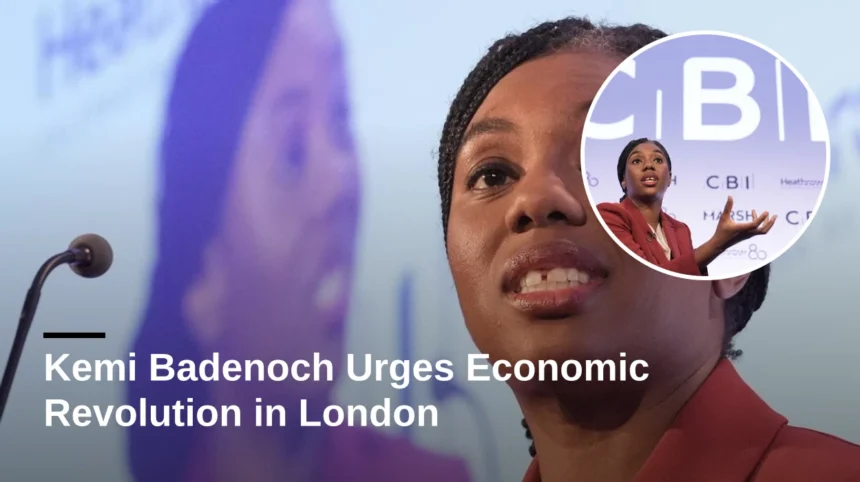
- Kemi Badenoch called for an “economic revolution” at the Confederation of British Industry’s annual conference.
- She criticised Prime Minister Andy Burnham for reopening arguments over Britain’s relationship with the European Union.
- Badenoch proposed lower taxes, reduced regulation, cheaper energy and stronger support for business.
- She warned that Britain risked falling behind the United States and China in artificial intelligence and other advanced technologies.
- She said neither rejoining nor remaining outside the European Union would, by itself, resolve Britain’s economic problems.
London (Oxford Daily) November 23, 2026 – Conservative Party leader Kemi Badenoch urged businesses and politicians to support an “economic revolution” rather than reopen the Brexit debate, during a speech at the Confederation of British Industry’s annual conference in central London. Badenoch criticised Prime Minister Andy Burnham’s efforts to reset relations with the European Union, saying the country should focus on growth, living standards and technological competitiveness. She proposed cutting taxes, regulation and energy costs while promoting wealth creation and business investment.
Why did Kemi Badenoch call for an economic revolution?
As reported by ITV News, Badenoch said Britain faced a choice between accepting lower living standards and pursuing a new economic direction. She argued that high energy costs, taxation and regulation were holding back growth and weakening the public finances.
“Britain needs to be more ambitious than just changing our relationship with Brussels,” Badenoch said. “We need an economic revolution.”
She said Britain retained strong universities, innovators, legal institutions, language and culture, but needed to use those advantages more effectively. Badenoch also warned that the United Kingdom risked being left behind as the United States and China competed to develop artificial intelligence and other disruptive technologies.
What did Badenoch say about reopening the Brexit debate?
According to BBC reporting from the conference, Badenoch said reopening the Brexit debate was “the last thing our country needs right now”. She accused Burnham of looking backwards and argued that renewed debate about the European Union had created uncertainty, frozen investment and distracted politicians from economic growth.
Badenoch said the relationship with the European Union mattered, but that the issue had become a defining political focus for some politicians. She added that rejoining the European Union would not fix Britain’s economic problems, while remaining outside it would not automatically solve them either.
What measures did Badenoch propose?
As reported by The Sun, Badenoch’s proposals included lower taxes, reduced red tape, cheaper energy and a more flexible labour market. The report also said she planned to repeal parts of the Employment Rights Act and support business as part of a five-point approach to growth.
Badenoch said Britain could not afford to lock itself into European trading rules if it wanted to pursue wider global opportunities. Earlier statements reported by the Belfast Telegraph showed her arguing that closer European ties could reduce British control over money, laws and borders.
What could the speech mean for Badenoch’s economic message?
Badenoch’s speech places economic growth, productivity and living standards at the centre of her appeal to business leaders and Conservative supporters. By presenting tax, regulation and energy costs as the main barriers to growth, she sought to shift attention away from a renewed constitutional argument over Brexit.
Her warning about competition from the United States and China also gives the message a technological focus, particularly around artificial intelligence. However, the proposals would require detailed policy decisions on public finances, employment protections, energy markets and the United Kingdom’s future trading arrangements.
Background
Badenoch’s intervention followed renewed political debate over the United Kingdom’s relationship with the European Union under Prime Minister Andy Burnham. Burnham has supported closer practical cooperation with Brussels on areas including food, energy and youth mobility. Badenoch has argued that cooperation should not involve surrendering control over British money, laws or borders. The Conservative leader has repeatedly said successive governments failed to make enough use of opportunities created by Brexit.
What does this mean for Badenoch’s intended audience?
The speech gives business leaders and economically focused Conservative voters a message centred on growth rather than renewed debate about EU membership. It may help Badenoch distinguish her argument from both those seeking closer European integration and those who believe Brexit alone can resolve Britain’s economic difficulties. Her emphasis on tax, regulation, energy prices and artificial intelligence could appeal to companies seeking lower operating costs and greater investment. The effect will depend on whether she can provide fully costed measures that improve growth while protecting public finances and employment standards.