Key Points
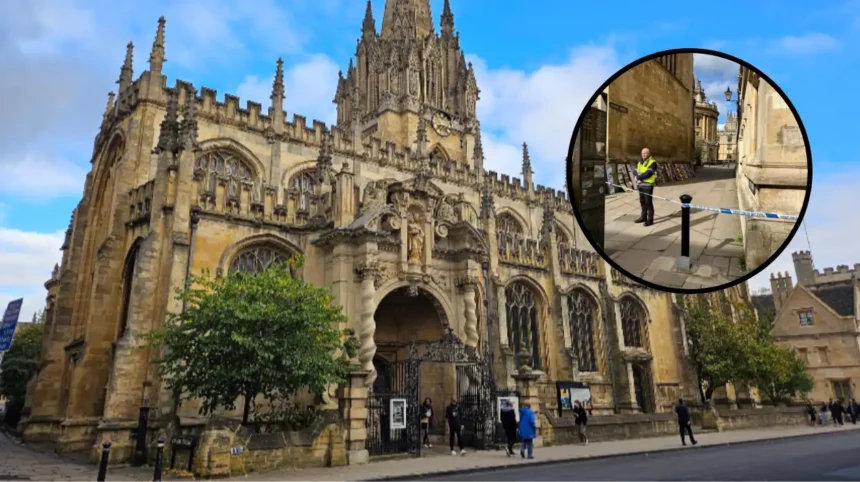
- Tragic Incident: Russell Bretherton, a 52-year-old Oxford resident described by his family as a “really sweet and kind man,” passed away following a catastrophic fall from the tower of the University Church of St Mary the Virgin on Oxford High Street.
- Coroner’s Final Verdict: At the conclusion of the formal proceedings, Assistant Coroner Joanna Coleman delivered a narrative conclusion, explicitly stating she was not satisfied to rule the death a suicide due to a complete absence of documented suicidal ideation.
- Medical Findings: Consultant Pathologist Dr Eve Fryer conducted a comprehensive post-mortem examination, determining that the official cause of death was “massive trauma” resulting from the high-altitude fall, leaving emergency services with no viable life-saving opportunities.
- Mental Health Background: The court heard that Mr Bretherton had been diagnosed with bipolar disorder in 2011 and experienced associated manic episodes; at the time of his passing, he was residing in specialist housing managed by the mental health charity Response.
- Timeline of Events: On 10 March, Mr Bretherton paid a £6 entry fee to ascend the historic church tower alone, an action captured on closed-circuit television (CCTV). A subsequent toxicology report confirmed he was completely sober and free from intoxicating substances.
- Family Remembrances: A moving statement from the deceased’s father, James Bretherton, read aloud in court, painted a poignant picture of an “eccentric” but gentle individual who had previously lived in Japan before returning to the United Kingdom in 2016.
Oxford (Oxford Daily) July 1, 2026 – A comprehensive public inquest conducted at the Oxfordshire Coroner’s Court has formally concluded into the tragic passing of Russell Bretherton, a 52-year-old local resident who died from massive trauma after falling from the landmark tower of the University Church of St Mary the Virgin. The detailed legal and medical hearing, presided over by Assistant Coroner Joanna Coleman, meticulously reviewed the events of 10 March, during which emergency services converged on Oxford High Street following a series of frantic calls from eyewitnesses. The court officially discounted a conclusion of suicide, citing a lack of evidence regarding intent, and instead recorded a narrative verdict that highlighted the deceased’s complex history with bipolar disorder alongside a total absence of prior suicidal ideation.
- Key Points
- What Were the Specific Findings of the Post-Mortem and Toxicology Reports?
- How Did Russell Bretherton’s Mental Health History Impact the Case?
- What Did the Statement From James Bretherton Reveal About His Son’s Life?
- What Did the Witness Testimony and Church CCTV Footage Show?
- Why Did the Coroner Reject a Verdict of Suicide?
- How Did the University Church of St Mary the Virgin Respond?
The severe impact of the incident drew immediate responses from emergency medical personnel and local authorities, who cordoned off portions of the high-profile tourist sector situated directly between the church and the iconic Radcliffe Camera. As reported by Toby Oliver, a prominent court reporter for the Oxford Mail, the formal record confirmed that Mr Bretherton succumbed to his injuries directly in the vicinity of the historic religious site. The proceedings revealed that the deceased had purchased a standard admission ticket to access the upper viewing platforms of the architectural structure shortly before the fatal descent took place, leaving bystanders and church staff profoundly shaken by the sudden event.
What Were the Specific Findings of the Post-Mortem and Toxicology Reports?
To establish the precise medical circumstances surrounding the fatality, the Oxfordshire Coroner’s Court called upon expert forensic evidence. As reported by Toby Oliver of the Oxford Mail, the formal post-mortem examination was independently conducted by Dr Eve Fryer, a highly qualified consultant pathologist. Dr Fryer’s expert clinical findings explicitly detailed that the sheer velocity and impact of the descent resulted in immediate, non-survivable physical injuries. The official cause of death entered into the medical and legal records was categorized unequivocally as “massive trauma.”
Furthermore, Dr Fryer’s post-mortem analysis verified that the catastrophic nature of the injuries sustained meant there were no viable life-saving opportunities available to the emergency medical technicians, paramedics, or rapid-response doctors who arrived at the High Street scene within minutes of the alarm being raised.
In addition to the physical autopsy, the court reviewed a comprehensive toxicology screening aimed at determining whether the deceased was under the influence of any substances that might have impaired his cognitive faculties, balance, or judgment. As reported by Toby Oliver of the Oxford Mail, the comprehensive toxicology report verified that Mr Bretherton was not intoxicated at the time of his death. The diagnostic screen returned negative results for both elevated blood-alcohol levels and illicit substances, establishing that his actions on the morning of 10 March were not driven by acute substance misuse or temporary chemical impairment.
How Did Russell Bretherton’s Mental Health History Impact the Case?
The court dedicated a significant portion of the hearing to understanding the long-term psychological profile of the deceased, acknowledging that mental health played an overarching role in his day-to-day life. As reported by Toby Oliver of the Oxford Mail, the inquest heard detailed testimony confirming that Mr Bretherton had been formally diagnosed with bipolar disorder in 2011. Bipolar disorder, a complex and enduring mental health condition characterized by severe shifts in mood, energy, and activity levels, had significantly shaped the deceased’s adult life for over a decade.
The medical records submitted to the assistant coroner outlined that Mr Bretherton’s condition was frequently marked by severe manic episodes. These periods of mania are medically understood to cause heightened states of energy, erratic behaviors, altered perceptions of risk, and grandiosity, which can drastically impair an individual’s normal risk assessment capabilities.
To ensure he received adequate social care and psychological stability, Mr Bretherton had been placed into supported accommodation. As reported by Toby Oliver of the Oxford Mail, the inquest heard that at the time of his death, Mr Bretherton was residing in specialized housing managed directly by Response, a well-known Oxford-based charity dedicated to providing housing and mental health support services to vulnerable adults within the county.
Explore More Oxford Crime News
Georgia Man Arrested After Fatal Shooting of Wife and Daughter, Oxford 2026
Oxford court jails Oliver Cosh after child abuse trial 2026
What Did the Statement From James Bretherton Reveal About His Son’s Life?
A deeply personal and illustrative window into the life of the deceased was provided through a formal written statement penned by his father, James Bretherton. This evidence was read aloud to the court by Assistant Coroner Joanna Coleman to establish character context and historical background. As reported by Toby Oliver of the Oxford Mail, James Bretherton described his late son as having been an “unusual child” during his early formative years, noting that he was widely regarded by those close to him as being “a bit eccentric.”
The father’s reflective statement traced his son’s unconventional path through adulthood, which included a prolonged period spent living abroad in East Asia. The court learned that Russell Bretherton had moved to Japan, where he met and married a Japanese national. In a reflection of his guarded and private nature, the father’s statement noted that his son initially chose not to disclose the marriage to his immediate family members in the United Kingdom, keeping that chapter of his life separate for a considerable duration.
However, Mr Bretherton’s time abroad was eventually marred by the onset of severe psychiatric difficulties, which intersected directly with local foreign law enforcement. As reported by Toby Oliver of the Oxford Mail, the statement from James Bretherton revealed that his son was arrested by Japanese authorities for a relatively minor infraction, specifically the theft of a single can of beer.
Following this interaction with the law, local authorities recognized that his behavior was driven by a profound underlying psychiatric crisis rather than criminal intent. Consequently, Mr Bretherton was formally sectioned under relevant mental health legislation by the police in Japan, leading to a period of involuntary psychiatric hospitalization. Following his stabilization, he was repatriated to the United Kingdom in 2016, where he entered the continuity of care provided by British mental health services and supported housing charities. Despite these significant lifelong struggles, James Bretherton concluded his testimony with a touching, definitive tribute to his son’s fundamental character, writing:
“He was a really sweet and kind man.”
What Did the Witness Testimony and Church CCTV Footage Show?
To reconstruct the exact chronology of the fateful morning, the investigation relied heavily on technical surveillance data and eye-witness accounts gathered from the immediate vicinity of Oxford High Street. As reported by Toby Oliver of the Oxford Mail, the assistant coroner reviewed critical closed-circuit television (CCTV) footage captured by security cameras installed at the University Church of St Mary the Virgin. The video evidence provided definitive proof that Mr Bretherton had arrived at the ecclesiastical site entirely unaccompanied on 10 March.
The surveillance footage tracked his movements as he approached the visitor reception desk, where he followed standard protocols by paying the mandatory £6 admission fee required for members of the public wishing to ascend the historic tower to view the city’s famous dreaming spires.
Who Witnessed the Incident on High Street?
The physical descent from the upper architectural levels of the church tower did not occur in isolation. As reported by Toby Oliver of the Oxford Mail, the inquest heard that his fall was directly witnessed by multiple horrified passers-by navigating the busy city centre thoroughfare, as well as by staff members who were actively working inside and around the church grounds. The suddenness of the event prompted immediate panic and a rapid mobilization of local emergency services, including Thames Valley Police units, South Central Ambulance Service crews, and specialized trauma medical professionals. Though response times were exceptionally rapid, the sheer physical reality of the fall rendered clinical intervention impossible.
Why Did the Coroner Reject a Verdict of Suicide?
When assessing cases involving falls from elevated structures, a primary duty of the coroner is to determine whether the act was intentional. In this instance, Assistant Coroner Joanna Coleman explicitly rejected a conclusion of suicide, citing strict legal thresholds that must be met regarding proof of intent. As reported by Toby Oliver of the Oxford Mail, Ms Coleman informed the court that she was not satisfied to give a conclusion of ‘suicide’ due to there being no previous suicidal ideation reported by medical professionals, support workers, or family members.
The absence of any explicit or implied suicidal intent, suicide notes, or recent expressions of self-harm led the coroner to determine that a suicide verdict would be legally inaccurate and unsupported by the available evidence. Instead, Ms Coleman opted to record a formal narrative conclusion. A narrative conclusion is a factual statement that sets out the circumstances of a death without assigning a definitive, singular label such as suicide or accidental death, particularly when a person’s underlying mental health condition or manic state makes their cognitive intentions at the exact moment impossible to verify. Concluding the formal legal proceedings, the assistant coroner passed her sincere, heartfelt condolences to the family of Mr Bretherton for their profound loss.
How Did the University Church of St Mary the Virgin Respond?
The institution at the centre of the tragedy expressed deep institutional and spiritual grief over the loss of life on their premises. Following the incident on 10 March, the church authorities quickly issued an official public statement to address the community and express their condolences. As reported by Toby Oliver of the Oxford Mail, a spokesperson for the University Church of St Mary the Virgin issued a statement on Friday, 13 March, stating:
“We are deeply saddened that a member of the public died outside the church.”
The ecclesiastical leadership further utilized their public statement to extend gratitude to the professional teams who managed the harrowing scene, stating:
“We are grateful to the emergency services who attended the scene and are supporting those affected.”
Recognizing the deep psychological impact the public incident had on visitors, university students, and church employees, the spokesperson concluded by offering spiritual solidarity, stating:
“Our thoughts and prayers are with the person’s family and loved ones at this very difficult time.”
What Support Services Are Available for Individuals Facing Mental Health Crises?
For individuals experiencing severe mood disorders, manic episodes, or thoughts of self-harm, numerous dedicated resources provide completely confidential, round-the-clock support across the United Kingdom:
- The Samaritans: Available 24 hours a day, 365 days a year. Individuals can dial 116 123 from any phone completely free of charge to speak with a trained volunteer.
- Mind: The leading mental health charity offers an information helpline via 0300 123 3393, providing advice on treatment options, legal advocacy, and local supported housing.
- NHS 111: For urgent but non-life-threatening mental health concerns, dialing 111 connects callers directly to mental health professionals who can deploy local crisis resolution teams.