Iconic bridges for punting views represent the architectural and historical intersection of academic heritage and river navigation in cities like Cambridge and Oxford. These structures provide essential visual landmarks that define the aesthetic experience of traditional wooden boat tours on local waterways.
- Which Cambridge bridges offer the best views for punting on the River Cam?
- How does the Bridge of Sighs contribute to the punting experience at St. John’s College?
- Why is the Mathematical Bridge a focal point for visitors punting in Cambridge?
- What historical bridges define the punting route through Oxford’s waterways?
- How do architectural styles of bridges impact the visual quality of a punting trip?
- What are the environmental and structural challenges facing these iconic bridges?
- How has punting influenced the design and placement of river bridges over time?
Punting is a method of boating where a person uses a long pole to push a flat-bottomed boat against the riverbed. This activity occurs primarily on the River Cam in Cambridge and the River Cherwell and River Thames in Oxford. The bridges crossing these rivers serve as critical infrastructure for university colleges and the public. In Cambridge, the section of the river known as the Backs features a high density of Grade I and Grade II listed bridges.
These structures provide the primary backdrop for tourism and academic life. The aesthetic value of these bridges is documented in historical archives and architectural surveys. They represent various styles including Gothic Revival, Neoclassical, and Renaissance designs. Modern punting operations rely on these bridges as navigational markers and points of interest for passengers. The cultural impact of these views influences international perceptions of British university life and heritage conservation.
Which Cambridge bridges offer the best views for punting on the River Cam?
The River Cam features several renowned structures including the Bridge of Sighs at St. John’s College and the Mathematical Bridge at Queens’ College. These bridges offer distinct architectural perspectives that are only fully accessible to those traveling by water.
The Bridge of Sighs was completed in 1831 and designed by architect Henry Hutchinson. It is a covered stone bridge that connects the Third Court of St. John’s College to the New Court. This bridge is famous for its Neo-Gothic style and intricate stonework. Further downstream, the Mathematical Bridge is a wooden footbridge rebuilt in 1905 based on an original 1749 design by William Etheridge. It utilizes a sophisticated radial stepping design that creates an arch using straight timbers. King’s College Bridge provides an expansive view of King’s College Chapel, which is a masterpiece of Perpendicular Gothic architecture. This bridge was built in 1819 by William Wilkins. Clare College Bridge is the oldest bridge on the River Cam, dating back to 1639. It features fourteen stone spheres, one of which is missing a section. These bridges collectively form the visual core of the Cambridge punting experience.
How does the Bridge of Sighs contribute to the punting experience at St. John’s College?
The Bridge of Sighs serves as the most photographed landmark in Cambridge because of its unique enclosed corridor and Gothic window tracery. It creates a dramatic tunnel effect for punters passing underneath while offering a framed view of the college.
This bridge is named after the Bridge of Sighs in Venice, although the two structures share few architectural similarities. The Cambridge version is a single-span bridge made of limestone. Queen Victoria reportedly favored this bridge over any other spot in the city during her visits. Its placement over the River Cam allows punters to view the dramatic contrast between the older brick buildings and the 19th-century stone additions. The bridge remains a private thoroughfare for members of St. John’s College.
Passengers on punts can observe the intricate carvings on the exterior walls that are not visible from the street. The bridge is part of the college’s Grade I listed status. It acts as a gateway between the medieval and modern sections of the campus. The water level under the bridge is consistently maintained to allow for safe passage of standard punting vessels throughout the year.
Why is the Mathematical Bridge a focal point for visitors punting in Cambridge?
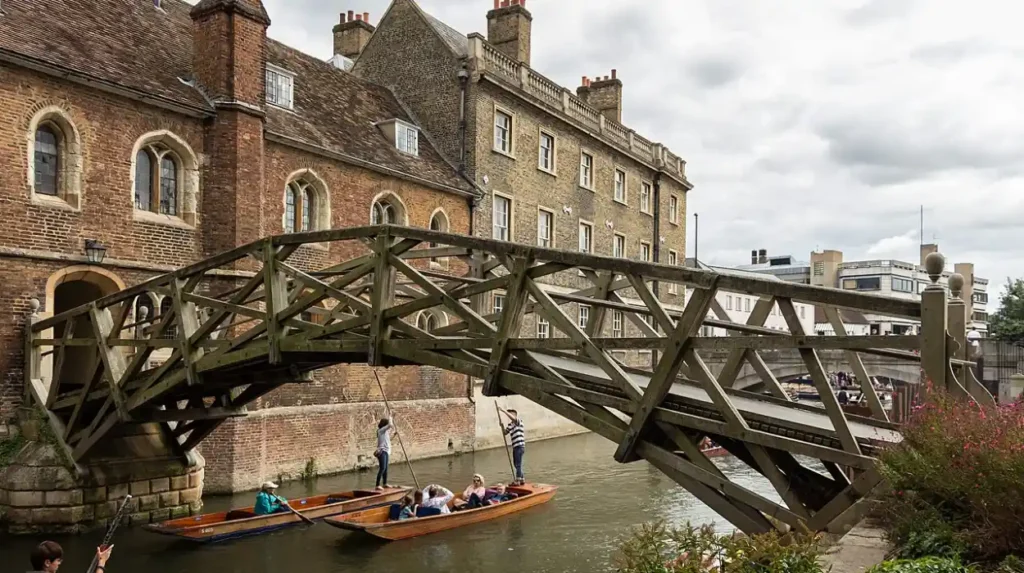
The Mathematical Bridge is a focal point due to its unique engineering history and the popular myth regarding its construction without nuts or bolts. It represents the application of geometric principles to traditional timber bridge building in the eighteenth century.
The bridge connects the two halves of Queens’ College, spanning the River Cam. While the myth suggests Sir Isaac Newton built it without fasteners, the bridge actually uses iron pins and bolts at its joints. The current structure is the third iteration of the design, following the 1749 and 1866 versions. Its distinctive arched shape is achieved through the arrangement of timber members in a series of tangents.
This design distributes forces efficiently across the span. From a punt, the bridge appears as a complex lattice of dark wood against the college’s red brick backdrop. It is one of the few wooden bridges of its age and style still in active use. The bridge is a designated Grade II listed structure. It provides a low-clearance passage that requires skill from the punter to navigate safely. The view from the water emphasizes the mathematical symmetry that gives the bridge its name.
What historical bridges define the punting route through Oxford’s waterways?
In Oxford, punting views are defined by structures such as Magdalen Bridge and the various footbridges crossing the River Cherwell. These bridges link the historic University of Oxford botanical gardens and college meadows to the central city.
Magdalen Bridge is a stone arch bridge built in the 1770s to replace an older medieval structure. It is the primary starting point for punting on the River Cherwell. The bridge features grand arches that provide a wide perspective of the Magdalen College Tower. This tower stands 144 feet tall and was completed in 1509. As punters move south, they pass under the High Bridge within the University Parks. This area provides a more natural and pastoral view compared to the urbanized riverbanks of Cambridge. The bridges in Oxford are often simpler in design, emphasizing the surrounding greenery and wildlife.
Christ Church Meadow is bordered by several small bridges that offer views of the college spires. These structures are integral to the flood management systems of the Thames valley. Punting in Oxford offers a quieter, more distributed view of academic architecture. The bridges serve as gateways to the quiet meadows that have inspired literary figures for centuries.
How do architectural styles of bridges impact the visual quality of a punting trip?
Different architectural styles including Classical, Gothic, and Palladian create a diverse visual narrative during a punting trip. These styles reflect the era of college expansion and the prevailing aesthetic values of the university at the time.
Classical bridges like the Kitchen Bridge at St. John’s College emphasize symmetry and proportion. This bridge was designed by Sir Christopher Wren and offers a clear view of the college’s domestic architecture. Gothic Revival bridges, such as the Bridge of Sighs, introduce drama and verticality to the river landscape. The use of Ketton stone and Portland stone provides varying textures and colors that change with the light. Palladian influences are seen in the balanced arches of the Clare College Bridge.
These architectural details are best viewed from the low angle of a punt. The reflection of these structures in the water doubles the visual impact for the observer. Maintenance of these bridges is strictly regulated by Heritage England to preserve their original appearance. The materials used, such as weathered brick and carved limestone, provide a sense of permanence. Punting allows for a slow-paced appreciation of these fine details that pedestrians often overlook.
What are the environmental and structural challenges facing these iconic bridges?
Iconic bridges face challenges from water erosion, structural vibration from foot traffic, and the environmental impact of climate change. Conservation teams must balance the preservation of historical integrity with the requirements of modern safety standards.
The foundations of many Cambridge bridges sit on wooden piles driven into the riverbed. Over centuries, the shifting silt of the River Cam can affect the stability of these footings. Increased rainfall and higher river levels put additional pressure on the stone arches. In 2014, significant restoration work was required on several bridges to repair masonry damaged by frost and pollution. The growth of algae and moss can also degrade the stone surfaces over time.
Bridge authorities use non-destructive testing to monitor cracks and shifts in the masonry. Punting operators are prohibited from allowing boats to strike the bridge piers to prevent impact damage. Pollution from urban runoff can cause chemical weathering of the limestone. National heritage laws mandate that any repairs use traditional materials and techniques. These efforts ensure that the views remain unchanged for future generations of visitors.
How has punting influenced the design and placement of river bridges over time?
Punting influenced bridge design by necessitating specific clearances and spans to allow for the passage of boats and poles. While many bridges predated punting as a leisure activity, their maintenance now accounts for river traffic needs.
Historically, the River Cam was a commercial artery for transporting coal and grain. Bridges were built with high central arches to accommodate barges. When punting transitioned from a commercial utility to a recreational pursuit in the late 19th century, these clearances became essential for tourists. The height of a punting pole is typically 16 feet, requiring the punter to manage the pole carefully when passing under low spans. Some newer bridges, such as those built in the 20th century, incorporate wider spans to reduce congestion on the water.
The placement of bridges often corresponds to the boundaries between different university colleges. These structures serve as physical barriers that have shaped the development of college gardens. The layout of the river through the Backs is a managed landscape designed to maximize the visibility of the bridges. This synergy between land and water architecture is a result of centuries of deliberate planning. The bridges remain the primary waypoints for anyone navigating the inland waterways of England’s university towns.
What is the famous bridge in Oxford called?
The most famous bridge in Oxford is the Hertford Bridge, commonly known as the Bridge of Sighs. This skyway joins two parts of Hertford College over New College Lane and is a landmark for those seeking iconic bridges for punting views.
Which bridge was used in Harry Potter?
While several locations in Oxford appear in the films, the High Bridge in the University Parks and the cloisters near iconic bridges for punting views provided the atmospheric backdrop for the series. The Duke Humfrey’s Library is the primary filming site.
What is a fun fact about the bridge of sighs?
A fun fact regarding this landmark is that it was never intended to be a replica of the Venetian original. Unlike its namesake, the Cambridge structure is covered and provides one of the most celebrated iconic bridges for punting views today.
What is Britain’s oldest bridge?
Tarr Steps in Exmoor is considered one of Britain’s oldest bridges, featuring prehistoric clapper construction. However, in the context of academic cities, Clare College Bridge remains the oldest of the iconic bridges for punting views on the River Cam, built 1639.
What are the five longest bridges in the UK?
The five longest bridges include the Bromford Viaduct, Prince of Wales Bridge, Tay Rail Bridge, Friarton Bridge, and the Forth Road Bridge. These engineering marvels differ significantly from the decorative and iconic bridges for punting views found in Cambridge and Oxford.