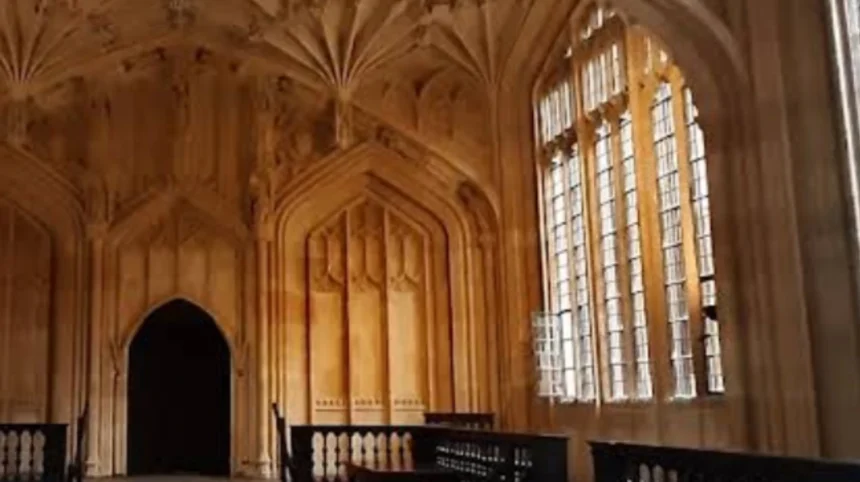
The Divinity School at the University of Oxford stands as one of the most significant monuments to medieval intellectualism and architectural prowess in Europe. Completed in the 15th century, this room was the university’s first purpose-built space for lectures, oral exams, and academic discussions in theology. While the room itself is steeped in the history of the Reformation and the evolution of the British academic system, its most arresting feature is undoubtedly the ceiling. The fan-vaulted stone roof of the Divinity School is not merely a structural necessity but a pinnacle of the Perpendicular Gothic style, representing a moment where stone was made to behave like silk.
- The Genesis of a Masterpiece: Historical Context
- Engineering the Impossible: The Mechanics of Fan Vaulting
- The Iconography of Stone: The 455 Bosses
- William Orchard: The Master Mason Behind the Vision
- The Divinity School in the Modern Imagination
- Preserving the Canopy: Conservation and Challenges
- Visiting the Divinity School: What to Look For
The Genesis of a Masterpiece: Historical Context
The construction of the Divinity School was a prolonged and often fraught endeavor, spanning from 1427 to 1488. The university originally sought to create a space that reflected the prestige of its theological faculty, which was then the premier department of the institution. Funding issues, political upheaval, and the sheer complexity of the design meant that the project languished for decades. It was not until the intervention of Thomas Kempe, the Bishop of London, that the necessary funds were secured to complete the upper portions of the building, including the legendary stone vaulting.
Architecturally, the Divinity School arrived at the tail end of the Gothic era. By the late 15th century, English architects had moved away from the soaring, pointed arches of the High Gothic toward the “Perpendicular” style. This movement emphasized vertical lines, large windows, and increasingly complex decorative vaulting. The Divinity School was designed to be the ground floor of a larger complex, with the Duke Humfrey’s Library situated directly above it. This required a ceiling that was not only aesthetically magnificent but also capable of supporting the immense weight of thousands of books and the oak shelving of the library upstairs.
Engineering the Impossible: The Mechanics of Fan Vaulting
To understand the genius of the Divinity School ceiling, one must look at the evolution of the vault. Early Romanesque architecture relied on barrel vaults, which were heavy and required thick, windowless walls to support the outward thrust. The Gothic revolution introduced the rib vault, which channeled weight onto specific points, allowing for thinner walls and larger windows. Fan vaulting, a uniquely English innovation, took this a step further by using a series of concave cones that meet at the center of the bay.
The Divinity School ceiling is a hybrid of structural ingenuity and decorative excess. Unlike the fan vaults seen at King’s College Chapel in Cambridge, which appear as continuous, flowing waves, the Oxford vault is characterized by its intricate grid of 455 carved stone bosses. These bosses are more than just decoration; they act as the keystones for the various intersecting ribs. William Orchard, the master mason responsible for the vaulting in the 1480s, designed a system where the “fans” do not actually support the entire weight of the roof. Instead, a series of hidden transverse arches bear the primary load of the library floor above, allowing the fans to remain delicate and highly ornamented.
The precision required for this work was staggering. Every stone had to be carved on the ground with mathematical exactitude before being hoisted into place. If a single rib was off by a fraction of an inch, the entire geometric pattern would fail to align at the apex. The result is a ceiling that feels weightless, as if the stone is unfurling from the pillars like the canopy of a forest.
The Iconography of Stone: The 455 Bosses
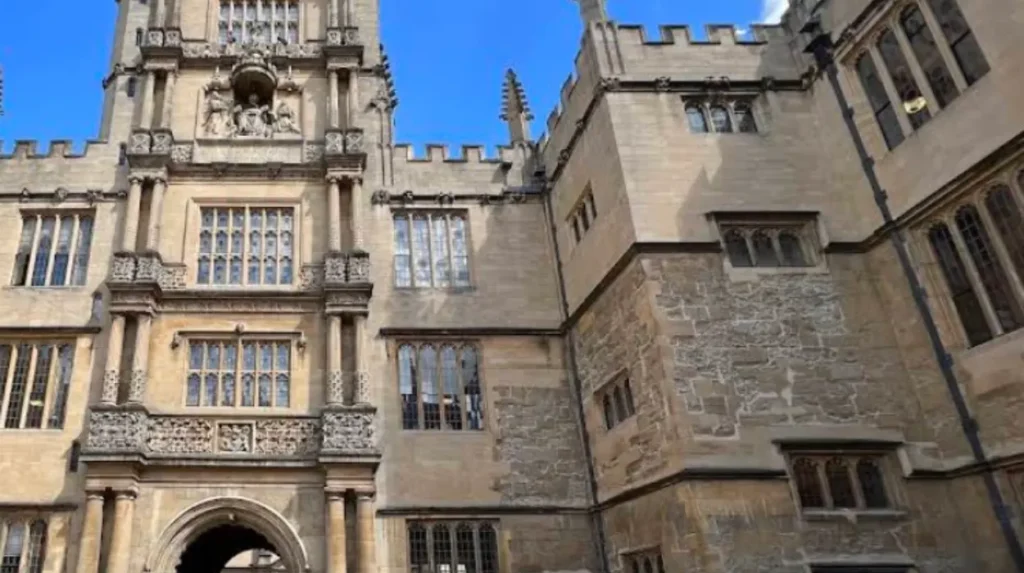
A significant portion of the Divinity School’s fame stems from the sheer density of its carvings. There are 455 stone bosses located at the intersections of the vaulting ribs. These are not generic patterns; they are a curated gallery of 15th-century life, religion, and institutional pride. For the modern visitor, looking up at the ceiling is akin to reading a stone manuscript of Oxford’s history.
Many of the bosses feature the coats of arms of the university’s most prominent benefactors. The prominent “K” symbols throughout the vault honor Thomas Kempe, whose financial contributions rescued the project from obscurity. Interspersed with these heraldic shields are religious symbols, including representations of the Trinity, the Virgin Mary, and various saints. However, there is also a touch of the secular and the whimsical. Grotesques, foliage, and intricate geometric knots fill the gaps, showcasing the creative freedom afforded to the medieval masons.
The use of bosses also served a practical architectural purpose. In medieval construction, the point where multiple ribs meet is structurally vulnerable. By placing a heavy, decorative boss at this junction, the mason provided a “counter-weight” that helped lock the ribs into place through compression. In the Divinity School, Orchard turned this structural necessity into a medium for high art, ensuring that even the most functional parts of the room were beautiful.
William Orchard: The Master Mason Behind the Vision
While many medieval buildings are the work of anonymous craftsmen, the Divinity School ceiling is firmly attributed to William Orchard. Orchard was the leading architect of his day in Oxford, also responsible for the magnificent cloister and great tower of Magdalen College. His work at the Divinity School represents a transition from the rigid geometry of early fan vaulting to the more fluid, “pendant” style that would later characterize the Tudor era.
Orchard’s genius lay in his ability to solve the “Oxford problem”—the need for a stone ceiling that could support a heavy library above without requiring massive, intrusive pillars in the center of the room. By using shallow arches and spreading the load across the exterior buttresses, Orchard maintained an open, airy feel in the Divinity School. His work here influenced subsequent generations of architects, and echoes of his “Oxford style” can be found in the later additions to Christ Church Cathedral and the Hampton Court Palace.
The Divinity School in the Modern Imagination
In the 21st century, the Divinity School has gained a new layer of fame through its role in popular culture. Its timeless, ethereal quality made it the perfect filming location for the Harry Potter film franchise, where it served as the Hogwarts Infirmary and the location for the Yule Ball dance practice. This exposure has introduced the intricacies of 15th-century fan vaulting to a global audience, many of whom visit Oxford specifically to stand beneath Orchard’s stone canopy.
However, beyond the cinematic glamour, the room remains a sacred space for academia. It is still used by the University of Oxford for formal ceremonies and is the entrance to the Bodleian Library’s historic core. The ceiling serves as a constant reminder of the university’s longevity. It has survived the English Civil War—during which it was used as a storehouse for parliament—and the Reformation, which saw many other religious carvings across England defaced or destroyed. Because the Divinity School was a university building rather than a purely ecclesiastical one, its carvings remained largely intact, preserving a rare, unfiltered look at late medieval craftsmanship.
Preserving the Canopy: Conservation and Challenges

The preservation of a 500-year-old stone ceiling is an ongoing challenge for the Bodleian Library and the University. The primary enemy of the Divinity School ceiling is moisture. Because the stone is porous, changes in humidity can lead to the crystallization of salts within the limestone, a process known as efflorescence, which can cause the surface of the carvings to flake away.
In recent decades, conservationists have employed laser cleaning and advanced structural monitoring to ensure the vault remains stable. The weight of the library above—now containing fewer books than in previous centuries to reduce stress—is carefully managed. The lighting in the room has also been updated to LED systems that do not emit the heat or UV radiation that could damage the stone’s natural patina.
Visiting the Divinity School: What to Look For
For those visiting the Divinity School, the experience is best enjoyed by taking the time to observe the details that aren’t immediately apparent. While the overall “fan” effect is the most striking element, a close study of the corners of the room reveals how Orchard integrated the vaulting with the massive windows. The way the stone ribs transition seamlessly into the window tracery is a hallmark of the Perpendicular style, creating a sense of total architectural unity.
Observe also the “pendants”—the points where the vault seems to drop down into the room. In later buildings, such as the Henry VII Chapel at Westminster Abbey, these pendants would become massive, gravity-defying stalactites. At the Divinity School, they are more restrained, providing a sense of depth and shadow that changes throughout the day as the sun moves across the large stained-glass windows.
The fan-vaulted ceiling of the Divinity School is more than just a roof; it is a testament to the period when England led the world in architectural innovation. It represents the intersection of faith, education, and engineering. By mastering the physics of stone, William Orchard and his team of masons created a space that has inspired scholars for over five centuries.
What is the significance of the divinity school at Oxford?
The Divinity School is the university’s oldest purpose-built room for teaching and examinations, dating back to the 15th century. It represents the pinnacle of English Perpendicular Gothic architecture and served as the historic heart of the Theology faculty for centuries.
Why is Cologne Cathedral black?
The cathedral’s dark exterior is primarily the result of a chemical reaction between the sulfuric acid in polluted rain and the building’s natural sandstone. Over decades of industrial exposure, the light-colored stone reacted to form gypsum, which trapped soot and dirt to create a distinctive black patina.
What is the hardest course to get into at Oxford?
Statistically, Computer Science is often cited as the most competitive course, frequently seeing an acceptance rate of roughly 6%. Other high-demand subjects with extremely low success rates include Economics & Management and Medicine.
How hard is it to get into Oxford Theology?
While still highly selective, Theology and Religion typically has a higher acceptance rate than STEM subjects, often hovering around 25-30%. However, applicants must demonstrate exceptional analytical skills and often undergo rigorous interviews and a written ELAT or Philosophy test depending on their joint honors.
What is the easiest degree to get into at Oxford?
There is no “easy” route into Oxford, but Classics and Modern Languages often have higher statistical acceptance rates, sometimes exceeding 35-40%. This is largely due to the specialized nature of the prerequisites and a smaller pool of applicants compared to broader subjects like PPE.