Oxford High Street is the central historic thoroughfare in Oxford, England, stretching approximately 0.6 miles from Carfax Tower in the west to Magdalen Bridge in the east. Known locally as “The High,” it forms the commercial and academic spine of the city.
- What Is the Historical Origin of Oxford High Street?
- Which University of Oxford Colleges Are Located on Oxford High Street?
- What Architectural Styles Define Oxford High Street?
- What Historic Churches and Landmarks Stand on Oxford High Street?
- How Does Shopping and Commerce Operate on Oxford High Street?
- How Do Visitors Access and Navigate Oxford High Street?
- What Is the Cultural and Future Significance of Oxford High Street?
Oxford High Street functions as the primary east-west arterial route through the historic center of Oxford, a university city in Oxfordshire, South East England. The street begins at Carfax, the historic crossroads marked by the 14th-century Carfax Tower, and terminates at Magdalen Bridge, which crosses the River Cherwell.
Along its gentle curve, the street intersects with major historic lanes including Cornmarket Street, St Aldate’s, Queen Street, Turl Street, Catte Street, and Logic Lane.
The curve of Oxford High Street creates a constantly shifting architectural panorama that architectural historian Nikolaus Pevsner famously described as one of the world’s greatest streets.
Because the thoroughfare bends gradually toward the south as it approaches the River Cherwell, pedestrians observe a continuous unfolding of limestone facades, Gothic spires, and Baroque domes. This spatial geometry prevents a single vanishing point and highlights individual college frontages in sequence.
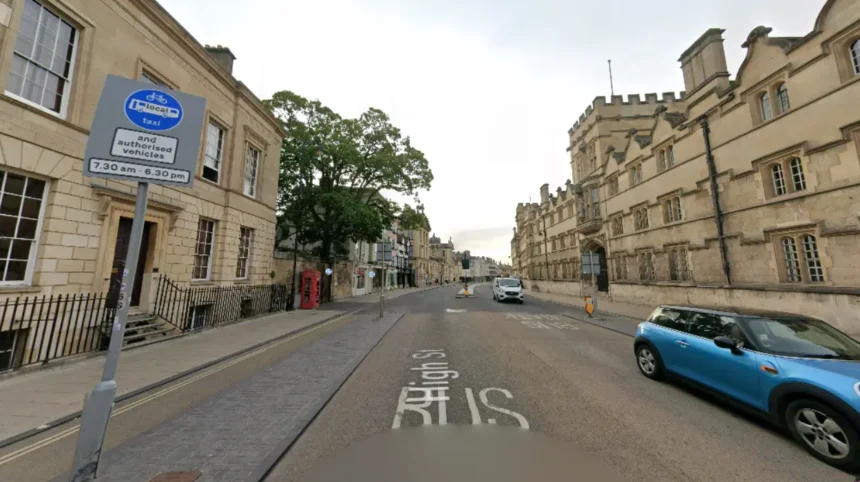
Today, Oxford High Street serves as both an active municipal roadway and a protected conservation area managed by Oxford City Council. Traffic restrictions introduced under the Oxford Transport Strategy limit private motor vehicles during daytime hours, prioritizing buses, taxis, bicycles, and pedestrian footfall.
These regulations preserve the structural integrity of historic stonework while supporting thousands of daily students, residents, and international visitors.
What Is the Historical Origin of Oxford High Street?
Oxford High Street originated in the early 10th century as the principal east-west axis of the Anglo-Saxon fortified town, or burh, established around 911 AD. It connected the western commercial market at Carfax with the eastern river crossing over the Cherwell.
The establishment of Oxford as a strategic defensive settlement under King Edward the Elder shaped the grid layout of the central town. Oxford High Street served as the main thoroughfare linking the eastern gate of the medieval city wall to the central marketplace.
By the time of the Domesday Book survey in 1086, Oxford functioned as a major fortified borough with active trade routes running directly along this corridor.
During the 12th and 13th centuries, the emergence of the University of Oxford transformed the street from a purely commercial market road into an academic district.
Early scholars rented halls and tenements along Oxford High Street and its adjoining lanes before formal residential colleges were endowed. The founding of University College in 1249 and Queen’s College in 1341 established permanent institutional ownership along the thoroughfare.
Over subsequent centuries, major civic and political events unfolded directly on Oxford High Street. During the English Civil War between 1642 and 1646, King Charles I established his royalist capital in Oxford, using the colleges along the street for court administration and military quarters.
In the 18th and 19th centuries, the construction of the current Magdalen Bridge in 1778 and the widening of the roadway modernized transit while retaining medieval property boundaries.
Which University of Oxford Colleges Are Located on Oxford High Street?
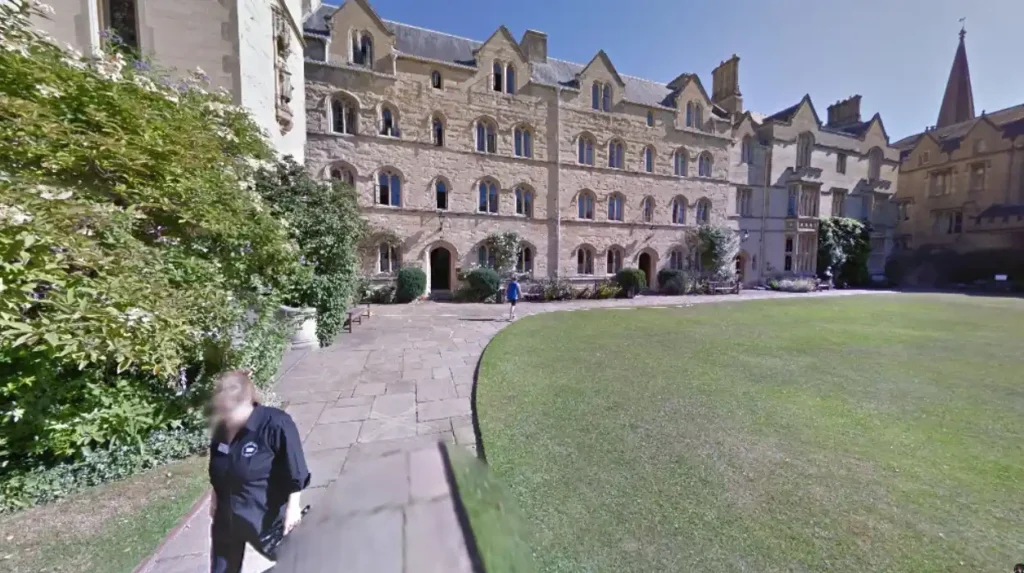
Five constituent colleges of the University of Oxford have primary frontages directly on Oxford High Street: University College, All Souls College, The Queen’s College, Magdalen College, and Oriel College. Brasenose College also maintains a prominent facade on the street’s northern side.
University College stands on the southern side of Oxford High Street and claims the oldest institutional foundation in Oxford, dating to 1249 through an endowment from William of Durham.
Its main frontage features two matching Jacobean-style quadrangles built in the 17th century using local Headington limestone. Adjacent to the western end of the college stands the Shelley Memorial, a neoclassical pavilion housing a marble sculpture of poet Percy Bysshe Shelley.
All Souls College occupies a prominent position on the northern side of Oxford High Street, founded in 1438 by King Henry VI and Henry Chichele, Archbishop of Canterbury.
Unlike other Oxford institutions, All Souls admits no undergraduate students and operates exclusively as a graduate research fellowship. Its High Street range displays late medieval Perpendicular Gothic stonework alongside Nicholas Hawksmoor’s famous twin towers rising behind the front quadrangle.
The Queen’s College sits directly opposite University College on the northern side of the street, founded in 1341 by Robert de Eglesfield, chaplain to Queen Philippa of Hainault.
Its current Palladian facade, designed by Nicholas Hawksmoor and completed in the 1730s, features an open colonnade and a central cupola housing a statue of Queen Caroline. Further east stands Magdalen College, founded in 1458 by William of Waynflete, anchored by the 144-foot Magdalen Great Tower completed in 1509.
What Architectural Styles Define Oxford High Street?
Oxford High Street displays seven centuries of English architectural evolution, combining medieval Perpendicular Gothic, Jacobean, English Baroque, Palladian, and Victorian Gothic Revival styles. Almost every major building utilizes golden-toned oolitic limestone quarried from nearby Headington and Taynton.
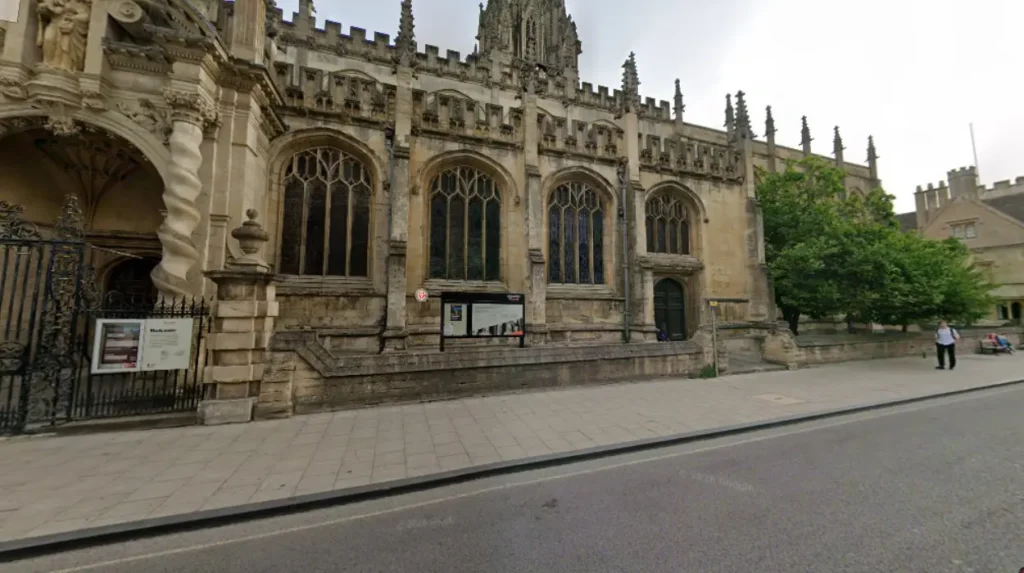
Medieval Perpendicular Gothic architecture dominates the eastern end of Oxford High Street, most notably at Magdalen College and the University Church of St Mary the Virgin.
Constructed between the 13th and 15th centuries, these structures feature pointed arches, vertical window tracery, crenellated parapets, and carved stone gargoyles. The spire of St Mary the Virgin, rising 204 feet above the street, dates to the 1320s and represents one of the finest decorated spires in England.
The 17th and 18th centuries introduced classical symmetry and monumental Baroque design to the streetscape. Nicholas Hawksmoor’s designs at The Queen’s College and All Souls College exemplify English Baroque and Palladian classicism, characterized by rusticated stone arches, pedimented windows, and classical columns.
Across the road, the Examination Schools, designed by Sir Thomas Graham Jackson and completed in 1882, showcase Anglo-Jackson Victorian Renaissance architecture with detailed stone reliefs.
Commercial buildings interspersed between the colleges reflect vernacular timber-framed construction from the 15th to 17th centuries alongside Georgian brick townhouses. Structures such as Kemp Hall and several historic shopfronts retain overhanging upper jetties, mullioned windows, and steep pitched roofs.
Strict heritage listing protections enforced by Historic England prevent structural alterations that would disrupt the cohesive limestone palette and historic roofline of Oxford High Street.
What Historic Churches and Landmarks Stand on Oxford High Street?
Key landmarks on Oxford High Street include the University Church of St Mary the Virgin, Carfax Tower, Magdalen Bridge, the Examination Schools, and the Covered Market entrance. These structures anchor the civic, religious, and commercial life of central Oxford.
The University Church of St Mary the Virgin stands at the center of Oxford High Street and served as the original administrative heart of the University of Oxford before the construction of the Sheldonian Theatre.
Inside this church in 1555, Protestant bishops Thomas Cranmer, Hugh Latimer, and Nicholas Ridley were tried for heresy during the reign of Queen Mary I. Visitors climb the church tower to access panoramic views across Radcliffe Square and the surrounding college spires.
At the western terminus of Oxford High Street rises Carfax Tower, the sole surviving remnant of the 12th-century St Martin’s Church, which served as Oxford’s official city church until 1896.
Standing 74 feet tall, municipal regulations prohibit any building in central Oxford from exceeding its height, preserving the city’s historic skyline. At the opposite eastern end, Magdalen Bridge spans two channels of the River Cherwell and serves as the gathering point for Oxford’s traditional May Morning celebrations every May 1st.
How Does Shopping and Commerce Operate on Oxford High Street?
Oxford High Street operates as a specialized retail and hospitality corridor featuring historic covered markets, academic bookshops, traditional outfitters, and independent cafes. Commercial ground-floor units sit beneath upper-level university accommodation and historic guild halls.
The Oxford Covered Market, established in 1774 to clear messy street stalls from main thoroughfares, has primary pedestrian entrances directly off Oxford High Street.
Operating continuously for over 250 years, the market houses more than 50 independent traders, including traditional butchers, florists, cheesemongers, artisan bakers, and bespoke leatherworkers. Its wrought-iron and glass roof structure preserves the atmosphere of an 18th-century municipal marketplace.
Along the main street frontage, specialized academic and heritage retailers serve university members and visitors. Historic academic outfitters such as Walters of Oxford and Shepherd & Woodward supply sub-fusc examination attire, college scarves, and ceremonial gowns required for university matriculation and graduation.
Independent coffee houses, including the Grand Cafe at 84 High Street, occupy sites documented as the earliest coffee houses in England, dating back to 1650.
How Do Visitors Access and Navigate Oxford High Street?
Visitors access Oxford High Street primarily on foot, by local bus services, or via bicycle, as daytime private car traffic is prohibited between 7:30 AM and 6:30 PM. Automatic Number Plate Recognition cameras enforce these bus-gate restrictions.
Oxford City Council and Oxfordshire County Council enforce strict traffic management zones along Oxford High Street to reduce congestion and nitrogen dioxide emissions.
Only licensed buses, hackney carriages, emergency vehicles, and authorized delivery vans operating outside restricted hours may drive through the central bus gate near Logic Lane. Drivers violating the restriction receive automated penalty charge notices.
Pedestrians arriving from Oxford Railway Station walk approximately 15 minutes east along Park End Street and Queen Street to reach Carfax at the western end of Oxford High Street.
Travelers utilizing Oxford’s five Park and Ride sites, including Thornhill, Redbridge, and Pear Tree, board frequent zero-emission electric buses that stop directly along Oxford High Street at Queen’s Lane and High Street stops. Cycling infrastructure includes designated bike lanes and hundreds of Sheffield cycle stands positioned along side streets.
What Is the Cultural and Future Significance of Oxford High Street?
Oxford High Street remains an internationally recognized heritage corridor and a living model for sustainable urban preservation. Ongoing conservation programs and zero-emission transport zones protect its Grade I and Grade II listed buildings for future generations.
The street maintains enduring cultural prominence through annual civic traditions, academic ceremonies, and literary heritage. Every May Day at 6:00 AM, thousands gather on Magdalen Bridge and Oxford High Street to hear the Magdalen College Choir sing the Hymnus Eucharisticus from the top of Magdalen Great Tower.
Throughout the academic year, students wearing formal sub-fusc robes walk along the street between their colleges and the Examination Schools during Trinity Term exams.
Urban planners and heritage bodies continually invest in stone conservation and public realm improvements along Oxford High Street. Oxfordshire County Council’s introduction of all-electric bus fleets in 2024 and 2025 significantly reduced vibration and particulate pollution affecting fragile Headington limestone facades.
Through coordinated governance between the University of Oxford, local councils, and Historic England, Oxford High Street balances modern urban functionality with unbroken historical continuity.
What Is the Best Time of Day to Walk Down Oxford High Street?
Early morning between 7:00 AM and 9:00 AM offers the quietest conditions for walking and photographing Oxford High Street. During these hours, pedestrian crowds are minimal, morning sunlight illuminates the golden limestone facades, and bus traffic remains light. Late afternoon during golden hour also provides exceptional lighting along the curve toward Magdalen Bridge.
Can You Drive a Private Car Down Oxford High Street?
Private cars cannot drive through the central section of Oxford High Street between 7:30 AM and 6:30 PM seven days a week. Automatic Number Plate Recognition cameras monitor the bus gate near University College and issue automatic fines to unauthorized vehicles. Outside those restricted hours, private motor vehicles may pass through freely.
Why Is Oxford High Street Curved Instead of Straight?
Oxford High Street follows the ancient path connecting the western Anglo-Saxon settlement at Carfax to the natural fording point across the River Cherwell. The gentle curve developed organically around early medieval property boundaries and river topography rather than formal Roman grid planning. This curvature creates the famous shifting perspective of college towers and facades.
Which Oxford Colleges on High Street Are Open to Visitors?
Magdalen College, University College, and The Queen’s College open their grounds and chapels to public visitors during designated afternoon hours outside of exam periods. Magdalen College charges a standard entry fee for access to its cloisters, deer park, and riverside walks. All Souls College opens selectively during limited afternoon slots on weekdays.
Where Was the First Coffee House in England on Oxford High Street?
The first coffee house in England opened in 1650 at the Angel Inn on Oxford High Street, run by a Jewish entrepreneur named Jacob. Today, the historic site at 84 High Street operates as The Grand Cafe, retaining ornate neoclassical interior features. A second early coffee house, Queen’s Lane Coffee House, opened nearby in 1654 and still operates today.