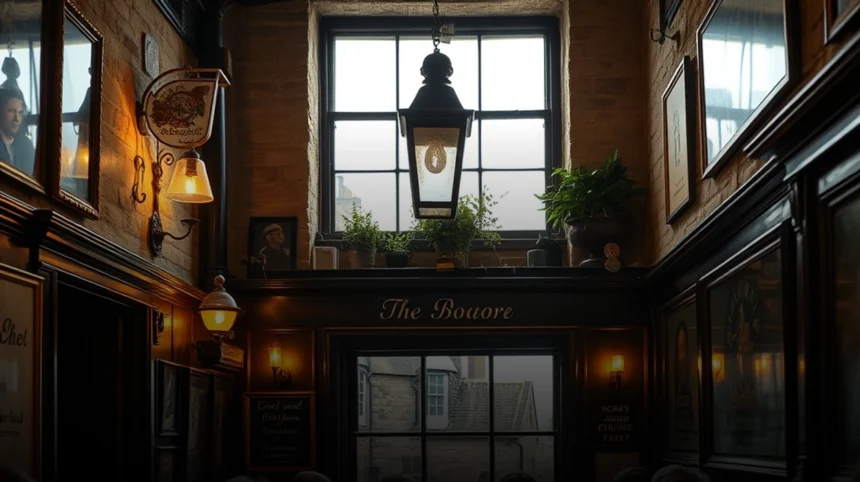
The Oxford Bar Edinburgh: Location, History and What Makes It Special is a guide to one of the city’s best-known traditional pubs. Located at 8 Young Street in Edinburgh’s New Town, the small public house combines an eighteenth-century building, a long history as a drinking and retail premises, and a lasting association with crime writer Ian Rankin’s Inspector Rebus novels.
- Where is The Oxford Bar Edinburgh?
- What is the history of The Oxford Bar?
- Why is The Oxford Bar associated with Inspector Rebus?
- What makes the pub different from larger Edinburgh bars?
- Which writers and cultural figures are connected with The Oxford Bar?
- What should visitors expect when they visit?
- How can The Oxford Bar fit into an Edinburgh walking route?
- Is The Oxford Bar suitable for tourists and locals?
- What nearby places are worth seeing?
- Why does The Oxford Bar remain significant?
Where is The Oxford Bar Edinburgh?
The Oxford Bar Edinburgh is at 8 Young Street, Edinburgh, EH2 4JB, in the New Town, close to George Street, Charlotte Square and Princes Street.
Young Street runs through Edinburgh’s New Town, the planned Georgian district north of the Old Town. The Oxford Bar sits on a comparatively quiet back street, while major visitor areas are only a short walk away. George Street lies to the south, Charlotte Square is nearby, and Princes Street can be reached through the surrounding New Town streets.
The location makes the pub straightforward to include in a central Edinburgh walking route. Visitors exploring the New Town can reach it from Princes Street, Edinburgh Waverley station or the West End. Its domestic-scale frontage can be easy to miss, which is part of the character that distinguishes it from larger, more conspicuous city-centre bars.
Because the premises are small, the experience can vary according to the time of day and how busy the pub is. Travellers should check current trading information before making a special journey, particularly around public holidays or other occasions when opening arrangements may change.
What is the history of The Oxford Bar?
The building was constructed as a house around 1779, became associated with a pub by 1811, briefly operated as a confectioner’s shop, and returned to sustained bar use in the late nineteenth century.
The building is connected with John Young, the builder after whom Young Street is understood to have been named. Its original domestic purpose helps explain the Oxford Bar’s compact layout and house-like appearance. It is not a purpose-built grand Victorian tavern, but a converted Georgian property that developed through several uses.
Historical accounts place its first operation as a bar in 1811. The premises were also recorded as a confectioner’s shop in 1843. By 1893, the building had returned to use as a bar, and it has remained associated with pub life since then.
The Oxford Bar is a Category B listed building. Listing recognises the architectural or historic interest of a property and places the building within Scotland’s system for protecting important built heritage. The listing is relevant because the pub’s significance comes not only from its literary reputation but also from the age and character of the building itself.
Why is The Oxford Bar associated with Inspector Rebus?
The Oxford Bar is associated with Inspector John Rebus because Ian Rankin made it the fictional detective’s favourite Edinburgh pub in the Inspector Rebus series.
Ian Rankin is a Scottish crime writer whose novels are set largely in Edinburgh and follow Detective Inspector John Rebus. Rankin encountered the Oxford Bar during his student years and later used real Edinburgh locations to give the novels a strong geographical and social setting.
In the books, the Oxford Bar is commonly known as “the Ox” and serves as one of Rebus’s regular haunts. The pub is not merely an invented setting detached from the city. Its real address and recognisable atmosphere connect the fictional character to an actual part of Edinburgh’s New Town.
The association has made the Oxford Bar a point of interest for readers, literary tourists and visitors following Rebus-related locations. It also illustrates how contemporary fiction can change the cultural meaning of an ordinary urban place without removing its everyday function as a local pub.
What makes the pub different from larger Edinburgh bars?
The Oxford Bar is distinctive because it is small, traditional and unpretentious, with a domestic-scale interior, a strong local identity and a literary reputation that developed around its ordinary pub character.
The interior is arranged on a compact scale, with the bar and several small rooms rather than a large open-plan space. This layout reflects the building’s earlier life as a house. It creates a more intimate environment than the spacious interiors found in many modern city-centre venues.
The pub’s appeal is also connected with continuity. Its simple design and straightforward atmosphere are often described as having changed relatively little compared with more extensively refurbished bars. That does not make it a museum. It remains a working public house where regular customers and visitors share the same limited space.
Its reputation depends on the relationship between the real and the fictional. Rebus readers may arrive because of the novels, but the pub’s importance predates the character. The literary connection adds another layer to a place already rooted in Edinburgh’s historic New Town.
Which writers and cultural figures are connected with The Oxford Bar?
The Oxford Bar has associations with Ian Rankin and Scottish literary figures including poet Sydney Goodsir Smith, as well as other writers and artists linked with Edinburgh’s cultural life.
Sydney Goodsir Smith was a Scottish poet associated with Edinburgh’s literary scene. His connection, together with Rankin’s, places the Oxford Bar within a broader tradition of writers using pubs as informal meeting places and sources of observation.
These associations should be understood as part of the pub’s cultural history rather than as evidence that every visit recreates a literary gathering. The Oxford Bar remains a functioning local venue, and its significance comes from the accumulation of people, stories and representations connected with it over time.
For literary visitors, the pub works best as one stop within a wider Edinburgh itinerary. Rebus-related locations, the New Town’s Georgian streets and the city’s other literary landmarks provide useful context for understanding why ordinary places feature so strongly in Scottish writing.
What should visitors expect when they visit?
Visitors should expect a small, traditional pub with limited space, a simple atmosphere and a mix of regular customers and people interested in its Rebus connection.
The Oxford Bar is better suited to a quiet drink and an appreciation of place than to a large meal, extensive entertainment programme or spacious group gathering. Its size means that visitors should be considerate of regular customers and avoid treating the interior solely as a tourist attraction.
Daytime visits may offer a clearer opportunity to appreciate the building and surroundings, while busier periods can provide a stronger sense of the pub as an active local venue. Seating and availability cannot be assumed, particularly when several visitors arrive together.
Visitors should follow normal pub etiquette: order from the bar, respect the privacy of other customers, keep photography discreet and avoid blocking the entrance or working areas. The literary connection is part of the experience, but the premises are still a neighbourhood public house rather than a dedicated museum.
How can The Oxford Bar fit into an Edinburgh walking route?
The Oxford Bar fits naturally into a New Town walking route linking Princes Street, George Street, Charlotte Square, nearby Georgian streets and other central Edinburgh attractions.
Starting near Princes Street allows visitors to walk north into the New Town before continuing towards George Street and Charlotte Square. Young Street’s position makes the Oxford Bar a convenient short detour from these prominent streets.
The surrounding area offers architectural context. Edinburgh’s New Town is known for planned Georgian streets, formal squares and neoclassical buildings. The Oxford Bar provides a contrasting, smaller-scale example of how older domestic properties were incorporated into the growing city.
The pub can also be combined with a literary-themed visit to Edinburgh. Readers interested in Ian Rankin may pair it with other Rebus locations, while visitors interested in Scottish writing can explore the city’s wider connections with authors, poets and publishing.
Walking routes should allow time for navigation and a possible wait for space inside. The pub’s compact size is central to its identity, so a short visit may be more realistic than planning a long stop for a large group.
Is The Oxford Bar suitable for tourists and locals?
The Oxford Bar suits tourists seeking literary and historic context as well as locals looking for a traditional central pub, provided visitors respect its small size and everyday community role.
Tourists often visit because the pub connects a real Edinburgh address with the fictional world of Inspector Rebus. That connection gives readers a tangible location to add to a literary itinerary. The building’s age and New Town setting also make it relevant to visitors interested in architecture and urban history.
For local customers, the Oxford Bar is not simply a literary landmark. Its continuing identity as a public house matters because it remains part of the city’s ordinary social life. This distinction explains why respectful behaviour is important when the pub is busy.
The most useful approach is to treat the Oxford Bar as both a heritage location and a working business. Visitors can appreciate the history, ask staff questions politely when appropriate and avoid expecting a staged Rebus experience.
What nearby places are worth seeing?
Nearby places include George Street, Charlotte Square, Princes Street, the wider New Town and central Edinburgh’s literary and architectural landmarks.
George Street is one of the principal east-to-west streets in the New Town and contains historic buildings, shops, restaurants and other hospitality venues. Charlotte Square forms an important Georgian ensemble at the western end of the street and provides a useful architectural contrast to the Oxford Bar’s modest scale.
Princes Street lies close to the southern edge of the New Town and offers views towards Edinburgh Castle and the Old Town. The contrast between the Old Town’s medieval street pattern and the New Town’s planned layout helps visitors understand the city’s urban development.
Edinburgh’s central area also contains museums, galleries, bookshops and other places associated with Scottish culture. Visitors should choose nearby attractions according to their interests rather than treating the Oxford Bar as an isolated destination.
Why does The Oxford Bar remain significant?
The Oxford Bar remains significant because its historic building, continuous pub identity, New Town location and connection with Ian Rankin’s Rebus novels bring architectural, social and literary history together.
Many historic pubs are valued for their age, while literary landmarks are valued for their connection with writers or fictional works. The Oxford Bar combines both forms of significance. Its early history explains the physical setting, while its association with Rebus explains its international recognition among readers.
The pub also demonstrates how a city’s identity is built from ordinary places. Its importance does not depend on grand architecture or a large collection. Instead, it comes from the way an actual address has remained useful to residents while gaining an additional cultural meaning through fiction.
For tourists, the Oxford Bar offers a concise way to encounter several aspects of Edinburgh at once: Georgian urban planning, traditional pub culture, Scottish writing and the relationship between real locations and imagined characters. For locals, it remains part of the New Town’s living social landscape.
Is The Oxford Bar the real pub used by Inspector Rebus?
The Oxford Bar is a real Edinburgh pub at 8 Young Street, and it is the model and regular setting associated with Inspector Rebus in Ian Rankin’s novels. Rebus himself is fictional, but the location is genuine.
What was the building before it became a pub?
The building was originally constructed as a house around 1779. Historical records also associate it with a confectioner’s shop in 1843 before it returned to sustained bar use later in the nineteenth century.
Can visitors take photographs inside The Oxford Bar?
Photography should be discreet and respectful because the Oxford Bar is a working pub with regular customers. Ask permission before photographing people, staff or private areas, and follow any house rules in force during the visit.
Is The Oxford Bar a listed building?
Yes. The Oxford Bar is a Category B listed building in Scotland. Its listing reflects the historic and architectural interest of the property, including its place within Edinburgh’s New Town.
What is the best time to visit The Oxford Bar?
A quieter daytime period may be best for visitors who want to appreciate the small interior and historic setting. Opening hours and crowd levels can change, so check current information before travelling.