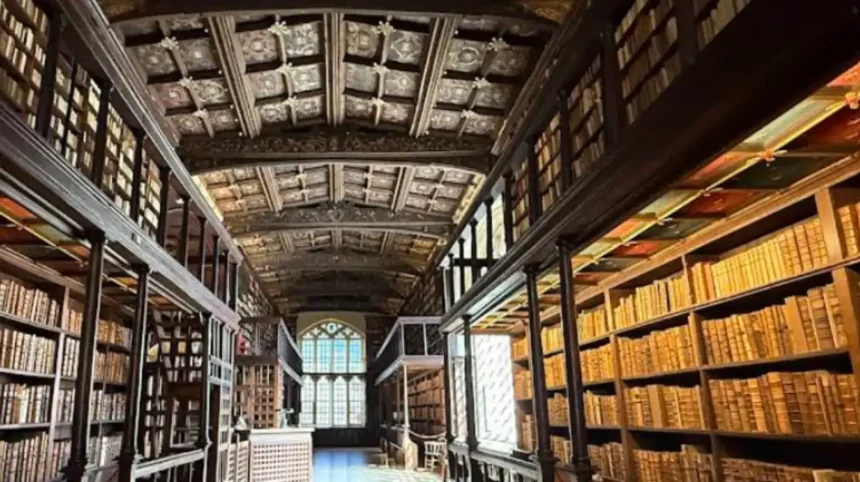
The Bodleian Library stands as one of Oxford’s most treasured landmarks, a testament to centuries of architectural brilliance and scholarly dedication. Nestled at the heart of the University of Oxford, this historic institution captivates visitors with its intricate designs and serene reading environments that have hosted some of history’s greatest minds. From medieval Gothic vaults to Renaissance-inspired towers, its structures blend eras seamlessly, offering an enduring allure that transcends time.
- Origins and Historical Foundations
- Schools Quadrangle: A Renaissance Masterpiece
- Divinity School: Gothic Vaulting Pinnacle
- Duke Humfrey’s Library: Medieval Scholar’s Haven
- Radcliffe Camera: Neoclassical Icon
- Other Iconic Reading Rooms
- Architectural Innovations and Influences
- Cultural and Scholarly Impact
- Visitor Essentials and Legacy
Origins and Historical Foundations
The Bodleian Library’s story begins long before its formal establishment, rooted in Oxford’s medieval academic heritage. Traces of the university’s first library date back to 1320, but it was Sir Thomas Bodley’s visionary refounding in 1602 that birthed the institution we recognize today. Bodley, a diplomat and scholar, revitalized the dilapidated Duke Humfrey’s Library, transforming it into a legal deposit library obligated to receive copies of all books published in England—a status it proudly holds to this day.
This revival was no mere restoration; it marked the dawn of a architectural evolution. Early expansions focused on practicality while embracing aesthetic grandeur, setting the stage for the library’s role as both a knowledge repository and an architectural marvel. By the 17th century, the complex had grown to encompass quadrangles and towers that symbolized the Renaissance humanist ideal, where beauty served intellect. These foundations ensured the Bodleian’s longevity, making it one of Europe’s oldest continuously operating libraries.
Schools Quadrangle: A Renaissance Masterpiece
At the Bodleian’s core lies the Schools Quadrangle, constructed between 1613 and 1619 under the patronage of key university figures. This serene courtyard exemplifies English Renaissance architecture, with its harmonious proportions and detailed stonework evoking Italian influences adapted to local tastes. Flanked by lecture rooms originally intended for university “schools,” the quadrangle now serves administrative functions, yet retains its contemplative atmosphere.
Dominating the space is the Tower of the Five Orders, a five-story marvel rising above the entrance. Designed to showcase the classical architectural orders—Tuscan at the base, progressing through Doric, Ionic, Corinthian, to Composite at the pinnacle—this tower is a pedagogical statement on architectural evolution. Its layered columns, carved from local limestone, create a visual hierarchy that draws the eye upward, mirroring the ascent of knowledge. Visitors entering through its arched gateway immediately sense the transition from bustling Oxford streets to hallowed scholarly ground.
The quadrangle’s paving and surrounding arcades further enhance its elegance, with subtle engravings and balanced symmetry inviting quiet reflection. Rain or shine, this space has witnessed generations of students pacing its paths, pondering texts amid stone that has weathered four centuries. Its design prioritizes natural light and airflow, principles that prefigure modern sustainable architecture.
Divinity School: Gothic Vaulting Pinnacle
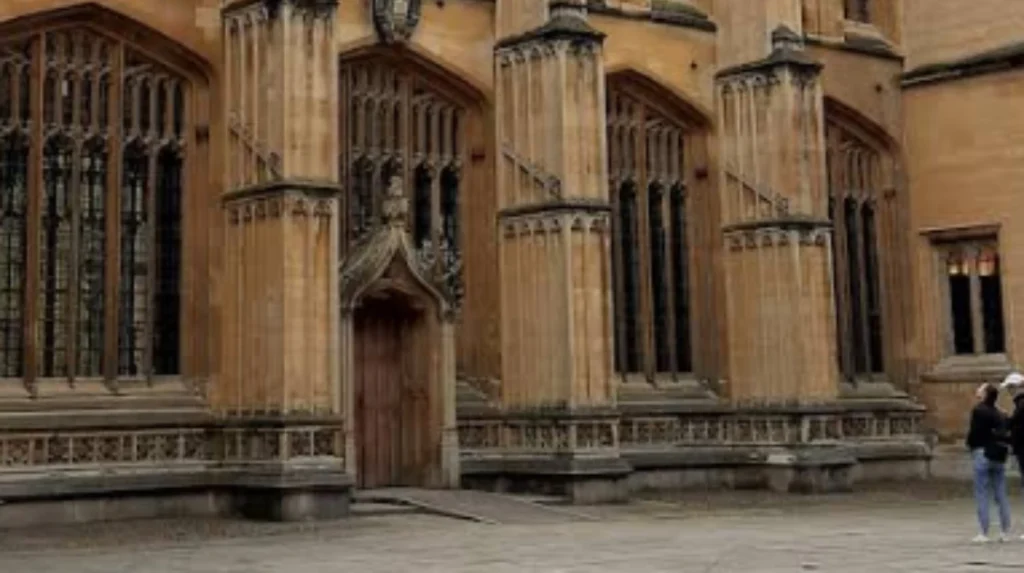
Adjoining the quadrangle, the Divinity School emerges as the Bodleian’s crowning Gothic achievement, built between 1427 and 1490 as Oxford’s theology examination hall. This rectangular chamber boasts the finest surviving example of English Perpendicular Gothic vaulting, where slender stone ribs fan outward like intricate lacework. Completed around 1490, the ceiling’s 455 individual panels form a celestial canopy, each boss adorned with heraldic shields that narrate university history.
Sunlight filters through towering perpendicular windows, their tracery patterns casting ethereal shadows across oak benches below. The room’s proportions—long and lofty—amplify acoustics for debates, while the vault’s engineering genius distributes weight so delicately that it appears to defy gravity. This space influenced later architects, including Christopher Wren, underscoring its status as a medieval structural triumph.
Today, the Divinity School doubles as a reading room for special collections, where scholars handle fragile manuscripts under its protective vaults. Its preservation reflects meticulous conservation efforts, blending original fabric with sympathetic restorations to maintain authenticity. No visit to the Bodleian is complete without lingering here, absorbing the hush that echoes centuries of intellectual discourse.
Duke Humfrey’s Library: Medieval Scholar’s Haven
Ascending a short staircase from the Divinity School leads to Duke Humfrey’s Library, the Bodleian’s oldest reading room, originally constructed in the 1480s and restored by Bodley in 1602. This long, beamed hall exudes medieval warmth, with dark oak shelves housing rare folios and its walls lined by coats of arms from noble donors. Low-arched windows punctuate the space, flooding desks with soft light ideal for prolonged study.
The library’s name honors Humphrey, Duke of Gloucester, who donated over 130 manuscripts in the 1440s, sparking its initial assembly. Restored after the Reformation’s despoliation, it now serves as a controlled-access reading room for priceless items, including early printed books and illuminated codices. Chains once securing volumes—a nod to medieval security—have been removed, but the atmosphere retains that era’s gravity.
Readers seated at ancient desks experience a direct link to history; many positions remain unchanged since Elizabethan times. The room’s subdued grandeur, free of modern distractions, fosters deep focus, making it a pilgrimage site for researchers worldwide. Its architectural restraint—simple yet profound—contrasts with later opulence, highlighting the Bodleian’s diverse stylistic tapestry.
Radcliffe Camera: Neoclassical Icon
A short stroll from the Old Quadrangle brings one to the Radcliffe Camera, completed in 1749 and now integral to the Bodleian. Designed by James Gibbs, this circular domed edifice represents Oxford’s neoclassical zenith, its honey-colored stone glowing under sunlight. Rising 40 meters, the camera’s lower level features Corinthian pilasters, while the drum and lantern draw from St. Paul’s Cathedral, creating a harmonious classical silhouette.
Funded by physician John Radcliffe’s bequest, it initially stood independent as the Radcliffe Science Library before merging with the Bodleian in 1860. Internally, an elliptical reading room spans two levels, connected by spiral stairs, with 24 busts of luminaries overlooking green-baize tables. Bookshelves climb to the cornice, housing science and humanities collections.
The dome’s acoustic properties enhance whispers across its vastness, while clerestory windows ensure even illumination. This space accommodates undergraduates, blending grandeur with functionality in a way that inspired 18th-century library design across Europe. Its external steps and balustrade offer panoramic city views, cementing its status as Oxford’s most photographed structure.
Other Iconic Reading Rooms
Beyond these highlights, the Bodleian offers diverse reading environments showcasing architectural variety. The Lower Reading Room in Radcliffe Camera provides a brighter, more communal space with high ceilings and modernized shelving, accommodating casual study. Upstairs, the Upper Reading Room maintains Regency elegance, its oval plan and bookcases fostering quiet collaboration.
The New Bodleian, opened in 1940 and designed by Giles Gilbert Scott, introduces modernist efficiency with its ziggurat form and subterranean stacks linked by tunnels to the old site. Reading rooms here prioritize light and ventilation, reflecting 20th-century innovations. Proscholium, a recent addition in the Weston Library, blends contemporary glass with medieval undercroft, offering a light-filled space for lower reading room users.
These rooms cater to every scholarly mood—from the intimate nooks of Duke Humfrey’s to the expansive vistas of the Camera—ensuring the Bodleian’s adaptability across eras.
Architectural Innovations and Influences
The Bodleian’s architecture weaves Gothic intricacy with Renaissance order and neoclassical poise, pioneering techniques that rippled through history. Fan vaulting in the Divinity School advanced load-bearing methods, enabling taller, lighter structures without buttresses. The Tower of the Five Orders popularized classical pedagogy in England, influencing Inigo Jones and beyond.
Material choices—Pulpit Hill limestone for durability and warmth—endure climate challenges, while later additions like Scott’s concrete stacks addressed space crises innovatively. Conservation employs laser cleaning and climate control, preserving patina without alteration. These elements position the Bodleian as a living laboratory of design evolution.
Cultural and Scholarly Impact

Filmmakers adore the Bodleian for its cinematic authenticity, featuring in Harry Potter as Hogwarts’ library and The Golden Compass. Yet its true legacy lies in scholarship; from editing Shakespeare’s First Folio to digitizing global collections, its rooms have birthed breakthroughs. Accessibility tours reveal hidden details, broadening appreciation.
Annually, millions engage its wonders via exhibitions and online catalogs, ensuring relevance in the digital age. For Oxford residents and visitors, it symbolizes intellectual heritage, inviting exploration of its timeless beauty.
Visitor Essentials and Legacy
Access requires pre-booked tours, with photography restricted in reading rooms to protect collections. Nearby cafes and gardens extend the experience, blending study with leisure. The Bodleian’s endurance—over 13 million items strong—affirms architecture’s power to elevate the human spirit.
In an era of fleeting trends, these spaces remind us of enduring pursuit: knowledge housed in beauty, inviting all to its eternal embrace.
What are some interesting facts about the Bodleian Library?
The Bodleian, opened in 1602, is one of the UK’s six legal deposit libraries, receiving free copies of every UK publication. It houses over 13 million items, including a Gutenberg Bible, and featured as Hogwarts Library in Harry Potter films.
Which Harry Potter actress studied at Oxford?
Miranda Richardson, who played Rita Skeeter, studied English at Oxford. Helena Bonham Carter (Bellatrix Lestrange) attended nearby Westminster School but not Oxford University.
Did Bellatrix know she killed Dobby?
No, in Harry Potter and the Deathly Hallows, Bellatrix threw the knife that killed Dobby but didn’t realize it hit him amid the chaos at Malfoy Manor. She was unaware of the elf’s presence or fate.
Who was Thomas Bodley?
Sir Thomas Bodley (1545–1613) was an English diplomat and scholar who refounded Oxford’s library in 1602, transforming Duke Humfrey’s medieval space into the Bodleian. His philanthropy ensured its growth as a national treasure.
Is Oxford harder than Harvard?
Difficulty is subjective, but Oxford’s tutorial system demands intense weekly essays and debates, often seen as more rigorous academically than Harvard’s seminar-style courses.