
Cyclosporiasis is a gastrointestinal illness caused by the single-celled protozoan parasite Cyclospora cayetanensis. The macro context of this pathogen involves global food supply chains and international tourism, where travelers consume raw agricultural items irrigated or washed with tainted water supplies. Because the parasite requires a maturation period of days to weeks in the environment before it becomes infectious, person-to-person transmission is biologically impossible. Consequently, outbreaks recorded by public health bodies represent localized point-source exposures abroad or widespread contamination events in commercial crop production.
- What are the official statistics and latest data regarding UK Cyclospora cases?
- What specific symptoms do patients experience following a Cyclospora infection?
- Which medical treatments and pharmaceutical interventions eliminate Cyclospora parasites?
- What preventive measures reduce the risk of contracting Cyclospora during international travel?
The primary vector for transmission involves fresh, unpeeled, or uncooked agricultural produce. Specific items frequently implicated in international outbreaks include fresh raspberries, basil, cilantro, lettuce, and salad leaves. When these crops are harvested in tropical or subtropical regions and exported globally, they carry the resilient oocysts of the parasite.
Standard chemical disinfection methods, such as routine chlorine-based washes or standard municipal water treatments, fail to eradicate the organism due to its robust outer shell. Outbreaks characteristically peak during spring and summer months, corresponding with elevated international travel volumes to endemic regions such as Mexico and parts of the United States.
What are the official statistics and latest data regarding UK Cyclospora cases?
Between 30 April and 15 July 2026, the United Kingdom recorded 67 laboratory-confirmed cases of cyclosporiasis, reflecting a marked elevation compared to historical annual baselines. Surveillance data indicates that 30 cases occurred in England, 27 in Scotland, and 10 in Wales.
Statistical tracking by the UK Health Security Agency (UKHSA), Public Health Scotland, and Public Health Wales establishes that travel-associated infections follow a predictable seasonal curve. Among the 67 patients identified in the 2026 reporting window, complete travel histories were established for 52 individuals. Of those, 48 individuals reported recent travel to Mexico, with specific concentrations in the Riviera Maya and Cancún regions.
Additional exposures included travel to the United States and Kenya. Epidemiological metrics show a median patient age of 46 years, with women accounting for 66% of all cases where sex was recorded.
These figures surpass previous multi-year averages, contrasting sharply with the baseline of 93 average annual cases recorded between 2022 and 2025. Historical data shows higher historical peaks, such as 359 cases in 2016 and 124 cases in 2024, demonstrating persistent annual vulnerability among British holidaymakers.
Routine surveillance operates through the national laboratory notification system rather than active population screening, meaning mild or asymptomatic cases often remain uncounted. Public health agencies coordinate data sharing internationally to track parallel outbreaks, such as concurrent widespread transmission documented across North America.
What specific symptoms do patients experience following a Cyclospora infection?
Cyclospora infection causes prolonged gastrointestinal illness characterized primarily by frequent, watery diarrhea, severe abdominal cramping, explosive bloating, and profound fatigue lasting several weeks if left untreated. The incubation period between oocyst ingestion and symptom onset spans an average of one week, with a clinical range of two to fourteen days.
The clinical presentation of cyclosporiasis involves the invasion of the small intestinal mucosa by the parasite. Patients frequently experience systemic manifestations alongside enteric distress, including a low-grade fever, nausea, myalgia, and significant unintended weight loss.
Unlike bacterial food poisoning that resolves within 48 to 72 hours, untreated cyclosporiasis follows a protracted, relapsing course. Symptoms can spontaneously subside for several days before recurring violently, trapping patients in a multi-week cycle of morbidity.
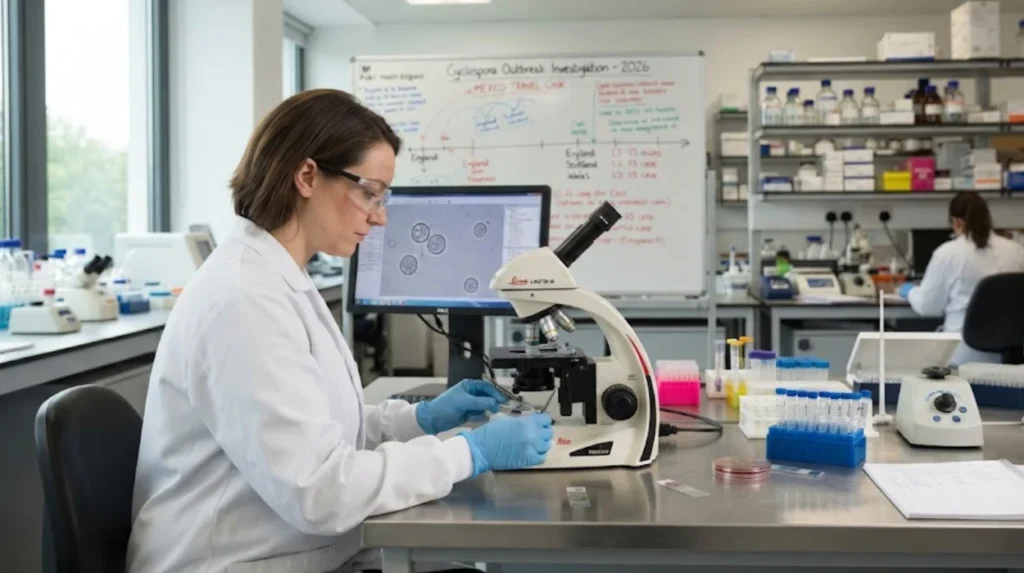
Diagnostic confirmation requires laboratory analysis of stool samples via microscopy, polymerase chain reaction (PCR), or specialized staining techniques administered through general practitioners or travel health clinics. Immunocompromised individuals, such as patients undergoing chemotherapy or those with advanced HIV, face heightened risks of severe dehydration, systemic complications, and prolonged intestinal colonization.
For the general population, the illness is rarely fatal, but the severity of chronic diarrhea routinely necessitates hospital consultation and targeted pharmaceutical intervention.
Which medical treatments and pharmaceutical interventions eliminate Cyclospora parasites?
Cyclospora infections are treated effectively using a specific prescription antibiotic regimen consisting of trimethoprim and sulfamethoxazole, commonly known as co-trimoxazole. Standard broad-spectrum anti-diarrheal medications fail to eradicate the protozoan parasite and can occasionally prolong the duration of illness.
The pharmacological mechanism of co-trimoxazole targets the folic acid synthesis pathway of the Cyclospora cayetanensis organism, terminating its replication cycle within the small intestine. Standard dosage guidelines for adult patients typically involve an oral course administered over seven to ten days.
For individuals with documented sulfonamide allergies, alternative antimicrobial agents such as ciprofloxacin or azithromycin are occasionally evaluated by clinicians, though cure rates vary compared to primary sulfur-based therapies. Rehydration therapy utilizing oral electrolyte solutions or intravenous fluids remains critical for managing acute fluid loss, particularly in vulnerable demographics.
Self-limiting resolution without antibiotics is possible for robust immune systems, but recovery times stretch from four weeks to over two months without pharmaceutical intervention.
Healthcare providers advise patients with travel histories to endemic areas to complete full diagnostic stool testing prior to antibiotic administration to ensure precise targeting of protozoan pathogens rather than bacterial strains.
Public health authorities emphasize that recovering patients must maintain strict personal hygiene to prevent household environmental contamination during active shedding phases, even though direct person-to-person contagion is absent.
What preventive measures reduce the risk of contracting Cyclospora during international travel?
Prevention of cyclosporiasis relies entirely on rigorous food and water hygiene protocols, as no commercial vaccine exists to protect against the parasite. Travelers visiting endemic areas must avoid untreated tap water, ice cubes made from local supplies, and unwashed raw produce.
Oxford Daily health briefings underscore that staying in luxury, high-end all-inclusive resort complexes does not eliminate exposure risks. Because resort kitchens prepare large volumes of fresh salads, garnishes, and fruit platters using local water supplies, contamination vectors remain active regardless of hotel star ratings. Effective precautionary behaviors include consuming exclusively bottled or sealed carbonated beverages, ensuring hot meals are served piping hot, and peeling fresh fruits personally with sanitized utensils. Brushing teeth with tap water represents a frequent oversight that introduces the parasite into the digestive tract.
Washing raw produce with standard kitchen soap, vinegar, or commercial fruit washes fails to destroy the hardy oocysts of Cyclospora cayetanensis. Where cooking is feasible, applying sustained heat of at least 158 degrees Fahrenheit (70 degrees Celsius) successfully destroys the organism.
Travelers experiencing persistent gastrointestinal symptoms upon returning to the United Kingdom must seek prompt medical evaluation, explicitly detailing their international itineraries to ensure physicians order specialized parasite screenings rather than standard bacterial stool cultures.
What is Cyclospora?
Cyclospora is a microscopic single-celled parasite called Cyclospora cayetanensis that causes the intestinal illness cyclosporiasis (cyclosporiasis). It primarily leads to prolonged diarrhea and other digestive symptoms.