Key Points
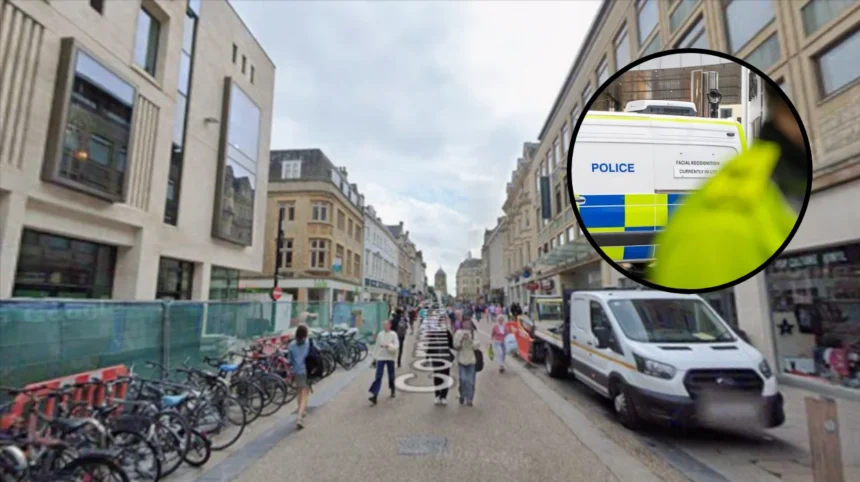
- Thames Valley Police announced that live facial recognition (LFR) vans will return to Cornmarket Street in Oxford on Thursday, July 30.
- The technology debuted in Oxford last year, scanning digital images of human faces against known database profiles to generate possible matches.
- Thames Valley Police defends the deployment, stating the specialist LFR team works alongside local officers to identify known suspects, deter crime, and enhance community safety.
- Force representatives emphasize advance public notifications, stating that preventing crime is equally as important as catching lawbreakers and inviting public inquiries.
- Despite police assurances, the technology remains controversial, with critics such as former Mayor of Witney, Andy Bailey, condemning the practice as “flawed and discriminatory”.
- Previous public reactions in Oxford highlighted a mixture of support for crime prevention and deep-seated privacy concerns regarding potential “Big Brother” surveillance.
- Police officials, including Detective Chief Superintendent Craig Kirby, have previously defended the tech by noting that unmatched biometric data is deleted almost immediately and is not used to harvest mass material.
Oxford (Oxford Daily) July 24, 2026 – Controversial live facial recognition vans are scheduled to make their high-profile return to Oxford’s city centre, with Thames Valley Police firmly maintaining that the technology acts as a vital deterrent against criminal activity despite ongoing public pushback and civil liberty debates. According to updates reported by Matthew J C Evans, reporter for The Oxford Mail, the specialist surveillance vehicles will be deployed along Cornmarket Street on Thursday, July 30. This return follows the initial rollout of the technology in the city last year, which sparked a complex mix of community apprehension and law enforcement justification regarding digital privacy, public surveillance, and modern policing methods.
Why are live facial recognition vans coming back to Oxford?
As reported by Matthew J C Evans of The Oxford Mail, Thames Valley Police has defended the redeployment by asserting that the technology plays an essential role in safeguarding local neighbourhoods. Explaining the operational strategy behind the upcoming deployment, a spokesperson for Thames Valley Police stated that
“the specialist LFR team will be working alongside our local officers to identify known suspects, deter crime and help keep our communities safer for everyone”.
The police force has stressed transparency as a core pillar of this deployment phase, noting that advance notices are routinely issued so that residents and visitors remain fully informed. Elaborating further on the psychological and preventative impact of the deployment, the Thames Valley Police spokesperson stated that
“while this can mean some individuals choose to avoid us, the vans can help deter crime and keep the area safer”
and added that
“preventing crime is just as important as catching those who break the law”.
How does live facial recognition technology operate in practice?
The technology deployed by Thames Valley Police functions by capturing digital images of human faces in real-time crowds, matching those scans against a pre-existing watchlist database of known individuals, and instantly generating potential alerts for nearby officers.
Addressing past public concerns regarding data retention and large-scale tracking, Detective Chief Superintendent Craig Kirby, head of crime and intelligence at Thames Valley Police, previously explained the mechanics of the system to local media. As reported during earlier phases of the rollout by The Oxford Mail, Detective Chief Superintendent Craig Kirby stated that
“These are CCTV cameras just the same as any other in the city. They bring the same footage in, but the difference is this is connected to analytical software. It identifies a biometric profile, and if that isn’t triggered, it doesn’t match to the watchlist we’ve got, then [the image] is deleted almost immediately”.
Furthermore, Detective Chief Superintendent Craig Kirby emphasized that
“there is no retention of material, or Big Brother. This isn’t us harvesting material of everyone in this street today”.
Explore More Oxford Police News
No Arrests Reported After England World Cup Match in Oxford 2026
Mystery Remains Over Unexplained Magdalen Street Police Incident in Oxford 2026
What criticisms have been leveled against the police surveillance vans?
Despite assurances from senior officers regarding data privacy and the prompt deletion of unmatched scans, the technology has faced sustained criticism from community figures and civil rights advocates. The deployment has remained a lightning rod for debate across the Thames Valley region. Highlighting the depth of this opposition, former Mayor of Witney, Andy Bailey, recently criticised the practice directly, describing the live facial recognition deployment as being “flawed and discriminatory”.
The opposition extends beyond local political figures to everyday shoppers and pedestrians navigating areas like Cornmarket Street. During prior deployments documented by The Oxford Mail, public reactions revealed a stark polarization. While some citizens acknowledged the potential utility in apprehending wanted individuals, others voiced profound anxieties about the normalization of mass state monitoring. Local cyclist Rachel Smith told The Oxford Mail reporter Matt Simpson that
“you’d think it’s a good idea for everyone else because obviously you want to catch the criminals. But on the other hand it’s a bit of an invasion of privacy, as if Big Brother is watching you”.
Similarly, local shopper Simon expressed deep unease regarding the trajectory of municipal monitoring, stating to The Oxford Mail that
“I’m really worried about how tech is used and how it’s progressing in the future—where does it end?”
How is Thames Valley Police responding to public concerns?
In an effort to bridge the gap between community anxiety and law enforcement objectives, Thames Valley Police has actively encouraged open dialogue ahead of the July 30 deployment. Representatives have urged members of the public who harbor reservations or seek technical clarifications to approach the stationed teams directly.
Reiterating this open-door policy, the Thames Valley Police spokesperson stated that “if you have any questions or would like to see how the technology works, feel free to come over and chat with our team”. The spokesperson further emphasized that
“we’re always happy to show you around and explain how LFR is used fairly and responsibly”.
As the deployment date approaches, civil liberties groups, local stakeholders, and police command are expected to watch closely to evaluate both the efficacy of the operation and the public reception on the ground in Oxford.