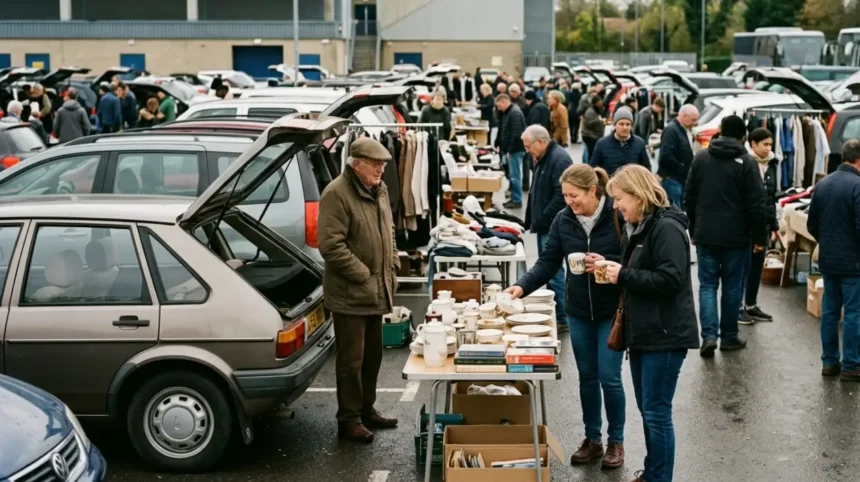
A car boot sale is a type of market where private individuals come together to sell household goods from the back of their vehicles. These events operate primarily as community-driven, informal retail exchanges held in open outdoor spaces or parking lots.
- What is the history and evolution of car boot sales?
- How do car boot sales function as a marketplace?
- What are the primary types of goods traded at car boot sales?
- What regulations govern car boot sale operations?
- How does the car boot sale influence the circular economy?
- What are the implications for buyers and sellers in the digital age?
- How do market trends impact the future of car boot sales?
The concept originated in the United Kingdom during the 1970s and remains a staple of British social and economic life. Unlike professional flea markets or antique fairs, car boot sales focus on the secondary sale of pre-owned, everyday personal items. These events facilitate the circulation of goods within local communities, effectively extending the lifecycle of consumer products and reducing waste. They serve as a primary platform for circular economy practices at the household level.
What is the history and evolution of car boot sales?
The modern car boot sale emerged in the United Kingdom during the early 1970s, popularized by Father Harry Clarke in Stockport, Greater Manchester, who organized the first recognized event in 1973 to raise funds for his local parish church.
The practice evolved from traditional village fetes and church fund-raising events. It provided an efficient mechanism for people to declutter homes while raising small amounts of capital for charitable causes. By the 1980s, the phenomenon scaled rapidly across the UK, moving from church grounds to larger agricultural fields and dedicated commercial car parks.
The economic climate of the 1970s and 1980s, characterized by periods of inflation and industrial shift, encouraged a consumer culture focused on thrift and value. Car boot sales filled a gap between formal high-street retail and private classified advertisements. As the events grew in frequency, the structure became more formalized. Organizers began charging pitch fees to sellers and entry fees to buyers, creating a predictable revenue stream for landowners and event coordinators.
In the contemporary landscape, car boot sales have integrated into the broader secondary market ecosystem. While digital platforms have emerged for online peer-to-peer sales, the car boot sale remains the dominant physical manifestation of the circular economy in the UK. Data suggests that these events contribute significantly to waste diversion, as goods that might otherwise be discarded in landfills are instead repurposed by new owners.
How do car boot sales function as a marketplace?
Car boot sales function as decentralized, temporary marketplaces where the spatial organization is determined by the arrival of participants and the physical capacity of the venue, relying on face-to-face negotiation between individual sellers and buyers.
The operational structure is simple. A landowner or organizer secures a site, typically a field or a tarmac surface. Sellers arrive early, often before dawn, to secure a prime position. Upon payment of a pitch fee, sellers arrange their items—ranging from clothing and kitchenware to electronics and tools—on tables or directly on the ground beside their vehicles.
The pricing mechanism at a car boot sale is entirely elastic. There is no standard retail pricing structure; instead, price points are determined by the immediate interaction between the buyer and the seller. Negotiation is an intrinsic component of the transaction process. Sellers usually aim to maximize volume turnover, while buyers prioritize cost-effectiveness and the acquisition of unique or vintage items.
The market remains unregulated in terms of standardized product safety and quality assurance, which differentiates it from formal retail. However, participants are expected to adhere to basic local government regulations regarding noise, waste management, and traffic control. Successful operation relies on the high velocity of trade; goods are usually sold at significantly lower price points than in charity shops or online marketplaces, as the primary objective for many sellers is the disposal of unwanted items rather than profit maximization.

What are the primary types of goods traded at car boot sales?
The primary types of goods traded at car boot sales include clothing, footwear, kitchen utensils, electronic appliances, children’s toys, books, and vintage collectibles, all sourced from private household inventories rather than wholesale manufacturing channels.
The inventory available at these markets reflects the domestic lifecycle of consumer goods. Common categories include:
- Apparel and Textiles: This includes mass-market high-street clothing, seasonal attire, and footwear. Items are often sold in bundles to facilitate faster clearance.
- Homeware and Kitchenware: Consumers frequently sell functional items such as crockery, cutlery, pots, pans, and glassware. These goods typically originate from kitchen upgrades or household downsizing.
- Media and Entertainment: Books, vinyl records, DVDs, and gaming consoles are perennial fixtures. These items are often sold by collectors or families transitioning to digital formats.
- Tools and Hardware: Garden tools, hand tools, and DIY equipment are highly sought after by tradespeople and hobbyists. These items are durable and retain value over long periods.
- Collectibles: Some car boot sales feature antique jewelry, coins, stamps, and militaria. These attract professional dealers who operate alongside casual sellers.
The diversity of goods is a defining characteristic of the sector. Unlike specialized markets, the inventory at a car boot sale is entirely dependent on the individual participants, ensuring that no two events offer the same selection. This unpredictability drives buyer participation, as attendees perceive the potential for discovering rare or high-value items at low prices.
What regulations govern car boot sale operations?
Car boot sales are governed by local authority planning permissions, environmental health regulations, and the “Sunday Trading Act 1994,” which dictates that large-scale retail activity on Sundays must comply with specific operational time restrictions.
Local councils play a critical role in oversight. For an organizer to host a regular car boot sale, they must often obtain specific planning permission if the event takes place on the same site for more than 14 days per year. This limitation prevents permanent changes to land use without rigorous evaluation of environmental impact.
Environmental and public health standards are also mandated. Organizers are legally required to provide adequate waste disposal facilities. Participants and organizers can be held liable for littering or the improper disposal of unsold goods. Many local authorities enforce policies that prevent the sale of counterfeit goods or unsafe electrical appliances. Trading Standards officers periodically conduct inspections to ensure that electrical items meet basic safety requirements and that no illicit items are being traded.
Traffic management is another significant regulatory area. Because these events draw high volumes of vehicles to specific, often rural, locations, organizers must present a traffic management plan to local highways authorities. This ensures that public safety is maintained and that access to local businesses and residential properties is not obstructed. Failure to comply with these local bylaws can result in the revocation of operating licenses and substantial financial penalties for the organizers.
How does the car boot sale influence the circular economy?
Car boot sales facilitate the circular economy by extending the functional life of consumer products through reuse, thereby reducing the rate at which household goods are processed as waste and diverting items from municipal landfills.
The circular economy is an economic system aimed at eliminating waste and the continual use of resources. Car boot sales act as a primary node in this system by facilitating the transfer of ownership of “end-of-first-life” goods. When a consumer no longer requires an item, the car boot sale provides a low-barrier venue to reintroduce that item into the market.
Research into waste management demonstrates that the secondary market is more efficient for the environment than recycling or disposal. By reusing items in their existing form, the energy and raw materials required to manufacture, package, and transport new goods are deferred. For example, a second-hand jacket sold at a car boot sale replaces the demand for a newly manufactured garment, significantly reducing the carbon footprint associated with textile production.
The economic impact is also substantial. These markets allow lower-income households to access goods that would otherwise be unaffordable. Simultaneously, they provide a method for households to recoup a portion of their original investment in consumer goods. This liquidity supports local micro-economies and reinforces community cohesion. As digital technology advances, some observers predicted the decline of physical car boot sales, but the trend has shown resilience, indicating a persistent societal preference for the tactile, immediate, and community-oriented nature of physical secondary markets.

What are the implications for buyers and sellers in the digital age?
The digital age has forced car boot sales to adopt hybrid models, where sellers use online social media groups for promotion and buyers use mobile applications for real-time location tracking of active markets.
Digital transformation has fundamentally altered the preparation process for car boot sales. Sellers now utilize platforms like Facebook Marketplace or local community forums to advertise upcoming sales, targeting specific demographics to ensure higher footfall. This change has shifted the demographic profile of attendees, with an increase in younger, environmentally conscious consumers participating in the resale market to minimize their environmental impact.
However, the core mechanism of the car boot sale remains grounded in physical presence. While online marketplaces provide convenience, they lack the immediate, tangible inspection process that car boot sales offer. Buyers at physical sales can verify the quality, condition, and authenticity of items before purchase, eliminating the risks of shipping damage or inaccurate online descriptions.
The future of the car boot sale lies in the integration of physical experience and digital efficiency. Organizers who utilize advanced digital management tools to streamline pitch bookings and market their events to a wider audience are seeing increased success. Furthermore, the rising global emphasis on sustainability ensures that car boot sales remain a relevant and vital component of the retail landscape. By providing a low-cost, low-barrier entry point for sustainable consumption, these events continue to serve as a cornerstone of the modern secondary goods market, proving that despite the rise of global e-commerce, the physical exchange of goods remains a resilient and essential human activity.
How do market trends impact the future of car boot sales?
Market trends are currently driving a shift toward higher professionalization, with organizers increasingly focusing on specialized categories like “vintage and retro” markets to attract niche demographics while maintaining the traditional community-driven atmosphere of the general car boot.
The professionalization of the sector is a direct result of changing consumer demand. As vintage fashion and retro homeware gain popularity, some car boot sales have rebranded or expanded to include dedicated zones for these high-demand items. This trend allows organizers to charge higher fees for premium pitches, increasing the economic viability of the events in areas where land rental prices are rising.
Simultaneously, the cost-of-living index significantly influences participation levels. During periods of economic downturn, both the number of sellers and the volume of attendees increase as households look to dispose of assets for cash or acquire necessary goods at lower prices. This counter-cyclical nature makes the car boot sale sector an important stabilizer in local economies.
Data tracking from regional planning departments indicates a steady demand for outdoor market space. As urbanization continues, the challenge for organizers will be securing accessible land close to residential centers. Future developments may see a rise in multi-purpose venues where car boot sales occupy spaces that serve other community functions during the week, such as sports facilities or commercial parking lots, ensuring the continued viability of these essential, community-centered marketplaces. Oxford Daily observes that as sustainability becomes a core metric for urban planning, the role of car boot sales as sustainable, community-integrated infrastructure will only increase in importance.
What is a car boot sale?
A car boot sale is an outdoor market where private individuals sell unwanted household items, clothing, toys, books, tools, furniture, and other second-hand goods directly from the boot (trunk) of their vehicles.