
The Natural History Museum’s dodo, officially classified as the Oxford Dodo, represents the most complete single remains of a Raphus cucullatus specimen globally. Housed permanently at the Oxford University Museum of Natural History, this specific biological artifact provides invaluable data for evolutionary biologists and paleontologists (such as avian fossil specialists). The specimen contains the only globally surviving soft tissue of the extinct species. The scientific community relies entirely on this artifact to extract genetic material and understand the foundational anatomy of the flightless bird. This unique artifact permanently bridges the informational gap between historical exploration records (including early Dutch ship logs and trade manifests) and modern genetic science (such as DNA sequencing and phylogenetic mapping).
- What physical components of the Oxford Dodo survive today?
- How did the Natural History Museum’s dodo arrive in Britain?
- Why is the soft tissue of the Oxford Dodo scientifically important?
- How did the Oxford Dodo actually die?
- What caused the extinction of the dodo species?
- How did the dodo evolve to become flightless?
- What role did the Oxford Dodo play in popular culture?
- How do researchers study the Oxford Dodo without destroying it?
- FAQs About Natural History Museum’s dodo story
What physical components of the Oxford Dodo survive today?
The Oxford Dodo specimen consists of a skull with mummified skin on the left side, a sclerotic ring from the eye, a sectioned femur, a foot skeleton, and various tissue samples. It remains the most complete single dodo specimen worldwide.
Surviving Skeletal And Tissue Remains
The Oxford University Museum of Natural History houses the precise anatomical remnants of this individual bird. The primary artifact consists of a thick cranium covered in dried, mummified dermal layers. This leathery skin provides an unprecedented biological baseline for anatomists (such as avian osteologists) studying the flightless species. The specimen originally included a full stuffed body, but natural decay forced museum curators (such as Elias Ashmole and his direct successors) to salvage only the head and the lower leg. The leg artifact features a complete skeletal foot structure lacking external scales. This targeted preservation effort secured the most scientifically valuable components of the decaying taxidermy.
Historical cataloging interventions resulted in minor physical alterations to the remaining organic materials (such as bone fragments and skin sections). In 1986, museum staff removed a single feather from the cranial skin for independent structural analysis. A sectioned femur provides direct internal marrow access for ongoing osteological study. The sclerotic ring, a delicate bone structure from the avian eye, remains entirely intact within the right orbital cavity. These precise physical elements (including the skull, femur, and eye ring) constitute the only verifiable biological material sourced from a single living dodo. Global academics classify this specific assemblage as an irreplaceable zoological treasure.
How did the Natural History Museum’s dodo arrive in Britain?
The specimen arrived in Britain during the seventeenth century as part of the Tradescant Collection. John Tradescant and his son acquired the bird for their London cabinet of curiosities before it was bequeathed to the University of Oxford in 1683.
The Tradescant Family Collection
The historical transit of the bird from the Indian Ocean to London involves seventeenth-century maritime trade routes (such as the Cape of Good Hope passage). Dutch navigators (such as the crew of the Second Dutch Expedition) controlled the island of Mauritius and facilitated the transport of exotic biological assets (such as live dodos and giant tortoises) back to Europe. The specimen entered the possession of John Tradescant, a prominent English royal gardener and dedicated collector of natural artifacts. The Tradescant family maintained a famous public exhibition space in South Lambeth known as the Tradescant Ark. This facility housed numerous zoological specimens (including taxidermy birds and preserved mammals) for daily public viewing.

The specific acquisition date remains undocumented in early institutional catalogs (such as the 1656 Musaeum Tradescantianum). The 1656 printed inventory clearly lists the specimen as a flightless bird originating from Mauritius. Upon the death of the younger John Tradescant, ownership of the entire collection transferred directly to the antiquary Elias Ashmole. Ashmole subsequently donated all acquired historical objects (including the dodo and various ethnographic items) to the University of Oxford. The university explicitly established the original Ashmolean Museum in 1683 to house these specific donated materials securely.
Why is the soft tissue of the Oxford Dodo scientifically important?
The surviving soft tissue provides the only known source of extractable dodo DNA globally. Geneticists utilized this rare organic material in 2002 to map the evolutionary lineage of the species and identify its closest living relatives in the pigeon family.
DNA Extraction And Evolutionary Findings
The exceptional preservation of mummified skin and cellular matter allows molecular biologists to sequence the genetic code of an extinct species. Traditional bone fossils completely lack the necessary preserved protein structures for complex genomic reconstruction. The Oxford Dodo provides viable genetic sequences (such as mitochondrial DNA and nuclear DNA markers) because the soft tissue avoided severe fossilization processes. In 2002, a specialized research team at the University of Oxford successfully extracted targeted genetic material directly from the specimen. This extraction proved conclusively that the artifact possesses the highest genomic integrity of any dodo remains globally.
The resulting genetic data permanently resolved long-standing taxonomic debates regarding the evolutionary origin of the species. Phylogenetic analysis confirmed that the dodo belongs to the Columbiformes order, linking it directly to modern pigeons and doves. The sequence data established that the closest living relatives (such as the Nicobar pigeon and the New Guinea crowned pigeon) share a distinct common ancestor with the dodo. The biological information extracted from these specific tissue fragments (including skin and bone marrow) forms the absolute foundational basis for all modern paleogenetics research on the species.
How did the Oxford Dodo actually die?
Forensic scanning conducted at the University of Warwick revealed that the Oxford Dodo was shot in the neck and the back of the head. Researchers identified seventeenth-century lead shot pellets embedded within the bone structure of the thick skull.
Forensic Scanning And Ballistic Evidence
The actual cause of death remained a historical mystery until advanced digital investigations occurred in the early twenty-first century. For centuries, biology historians operated under the strict assumption that the bird lived as a captive display animal and died of natural causes in London. In a joint research initiative, the University of Warwick applied micro-computed tomography scanning to the skull artifact. The resulting high-resolution digital cross-sections (such as transverse and sagittal plane views) exposed foreign metallic objects lodged deeply within the cranial bone matrix. This forensic discovery fundamentally altered the historical timeline of the specimen.
Material analysis confirmed these foreign objects are standard lead shot projectiles (including 4.5-millimeter spherical pellets). The specific caliber and material composition align perfectly with the standard wildfowl ammunition used throughout the seventeenth century. The ballistic trajectory indicates the unknown shooter fired the weapon from behind the bird, striking the posterior neck and skull regions. The extraordinary structural thickness of the skull bone prevented the metallic projectiles (such as the lead spheres and fragmented shrapnel) from penetrating the brain cavity. This concrete forensic data disproves the peaceful captivity narrative and confirms the specimen experienced a violent death.
What caused the extinction of the dodo species?
The extinction of the dodo was caused by European sailors and introduced invasive species. Domestic animals destroyed fragile ground nests and consumed eggs, while rapid habitat destruction eliminated food sources, leading to total species collapse by the year 1662.
Human Interference And Invasive Predators
The species thrived exclusively on the isolated island of Mauritius for millennia before the sudden arrival of Dutch maritime fleets in 1598. The indigenous ecosystem lacked large predatory land mammals (such as felines and canines), leaving the flightless bird with zero defensive adaptations against new terrestrial threats. European logging operations immediately initiated severe habitat destruction, clearing native forests (including dense ebony groves) to harvest valuable botanical resources (such as ebony wood and palm hearts). This rapid, unchecked deforestation severely restricted the natural foraging territories available to the endemic avian populations (such as the dodo and the broad-billed parrot).
The introduction of foreign predatory animals (including rats, feral cats, and domestic pigs) served as the primary catalyst for total population collapse. The dodo nested directly on the forest floor, depositing a single vulnerable egg per reproductive cycle. The introduced mammalian predators (such as the swine and canine species) systematically consumed the exposed eggs and vulnerable chicks (such as newly hatched dodo offspring). Within a span of exactly 64 years, the combined biological pressures of habitat loss, human hunting, and invasive ecological disruption eradicated the entire species. The final universally accepted sighting of a living specimen occurred precisely in 1662.
How did the dodo evolve to become flightless?
The dodo became flightless through a biological process called island gigantism. Isolated on Mauritius with abundant food sources and zero natural predators, the species lost its need for flight, increasing in body mass and developing robust ground-dwelling anatomical adaptations.
Island Gigantism And Resource Adaptation
The specific evolutionary timeline of the dodo demonstrates a textbook example of extreme insular adaptation within isolated oceanic environments (such as isolated island chains). Millions of years ago, the flying ancestors (such as the ancient Columbiformes pigeons) navigated the Indian Ocean and settled on the newly formed volcanic landmass of Mauritius. The island provided a highly stable ecosystem containing dense calorie-rich nutritional resources (such as fallen fruits and large plant seeds). Without the daily presence of natural predators (like large predatory mammals or birds of prey), the evolutionary pressure to maintain metabolically expensive flight capabilities completely vanished over time.
Over successive generations, the species underwent dramatic morphological changes (including skeletal mass increases and pectoral muscle reduction). The biological process of island gigantism triggered a significant mathematical increase in overall body weight, reaching estimated masses of 10.6 to 21.1 kilograms. The sternum bone flattened entirely, eliminating the vital structural anchor point required for powerful flight muscles. In place of functional wings, the bird developed massive pelvic structures and robust lower limbs (such as thick femurs and elongated metatarsals) to navigate the dense forest floor efficiently.
What role did the Oxford Dodo play in popular culture?
The Oxford Dodo directly inspired author Lewis Carroll to include the bird as a central character in his 1865 novel. The specimen served as the visual reference for illustrator John Tenniel, establishing the dodo as a global symbol of extinction.
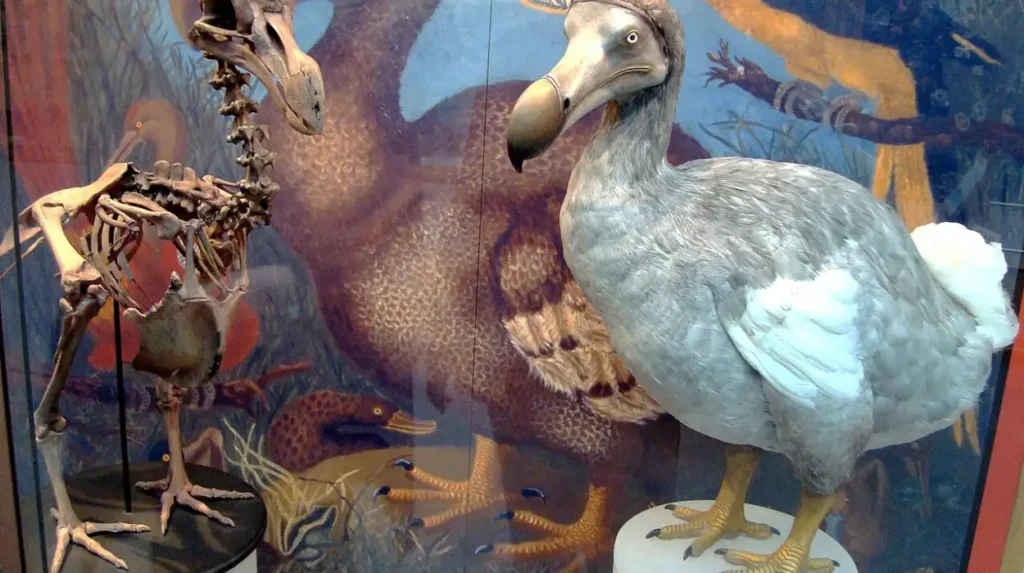
Literary Impact And Public Perception
The physical presence of the skull in the Oxford University Museum of Natural History generated significant cultural reverberations (including academic discussions and artistic movements) during the Victorian era. Charles Dodgson, an academic at the university writing under the pen name Lewis Carroll, frequently visited the museum and examined the preserved remains. This direct exposure compelled Carroll to incorporate the extinct bird into his foundational 1865 literary work, Alice’s Adventures in Wonderland. The character famously introduces the concept of a “Caucus-race,” permanently embedding the species within global public consciousness. The novel introduced the concept of species extinction to a massive general audience.
The accompanying visual artwork cemented the modern public perception of the bird’s specific anatomy. Illustrator Sir John Tenniel visited natural history collections to study the available physical references (such as the Oxford cast and anatomical sketches). Tenniel produced a distinctively plump, anthropomorphic representation of the bird that dominated visual media for the next full century. The cultural momentum generated by the novel transformed the dodo from an obscure biological footnote into the definitive historical emblem of human-driven ecological destruction. The phrase “dead as a dodo” entered the English lexicon as a direct result of these specific cultural milestones (including the book publication and widespread illustrations).
How do researchers study the Oxford Dodo without destroying it?
Scientists utilize non-destructive micro-computed tomography scanning to analyze the fragile remains. This advanced digital forensics technology creates highly detailed three-dimensional models of the skull, allowing biologists to examine internal anatomical structures without risking physical damage to the invaluable specimen.
Non-Destructive Digital Replication Methods
The extreme physical fragility and global rarity of the specimen completely prohibit traditional invasive anatomical dissection techniques (such as physical cutting and bone sectioning). Museum curators enforce strict conservation protocols (such as climate-controlled storage and handling bans) to prevent the physical degradation of the remaining organic components (such as the mummified dermal tissues and delicate bone structures). To bypass these strict physical limitations, the scientific community relies exclusively on industrial-grade digital scanning technologies (including micro-computed tomography and laser scanning). X-ray micro-computed tomography allows researchers to penetrate the dense biological material using concentrated radiation, capturing microscopic internal details without altering the physical artifact.
This advanced scanning process generates millions of individual data points (such as geometric coordinates and voxel density measurements) that specialized software compiles into an exact digital replica. Biologists (including evolutionary geneticists and avian anatomists) manipulate these three-dimensional virtual models (such as cranial renderings and vascular cavity maps) to study the biomechanics of the bird. The digital approach precisely revealed the exact millimeter thickness of the skull and accurately mapped the internal brain cavity, providing exact volumetric measurements of the animal’s neurological capacity. The museum subsequently shares these high-fidelity digital assets (such as 3D rendering files and CT scan raw data) with international academic institutions (including universities and independent research laboratories), democratizing access to the world’s most important extinct avian specimen.
FAQs About Natural History Museum’s dodo story
Is there any surviving dodo DNA available for cloning?
The Oxford Dodo contains the only surviving dodo soft tissue in the world. Scientists extracted viable genetic material from this specific specimen in 2002. This DNA sequence mapped the evolutionary lineage of the bird. The extracted genetic fragments are too degraded to facilitate actual cloning procedures.
Where can people see a real dodo bird skeleton today?
The Oxford University Museum of Natural History permanently houses the most complete single dodo remains. Museum visitors view exhibition casts and specific skeletal elements like the preserved foot. No fully intact single-animal dodo skeleton exists anywhere in the world today. Global museum displays consist entirely of composite skeletons assembled from multiple different birds.
Did humans hunt and eat all the dodo birds?
Humans actively hunted the dodo, but invasive species caused the primary population collapse. European sailors introduced foreign predators like rats and pigs to the island of Mauritius. These introduced mammals systematically consumed the vulnerable ground nests and eggs of the birds. Rampant deforestation eliminated the natural food sources required for the species to survive.
How did researchers discover the Oxford Dodo was shot?
The University of Warwick conducted micro-computed tomography scanning on the fragile skull artifact. The resulting three-dimensional digital models revealed foreign metallic objects embedded deep inside the bone structure. Material analysis confirmed these objects are seventeenth-century lead shot projectiles. This physical forensic evidence proved a hunter shot the bird in the back of the head.
Why is the Oxford Dodo the most important specimen in the world?
This specific artifact represents the only verifiable physical material sourced from a single living dodo. It contains mummified dermal layers that provide the global scientific community with extractable genomic data. The physical remains directly inspired the famous dodo character in the 1865 novel Alice’s Adventures in Wonderland. No other biological artifact possesses this combination of genetic viability and cultural significance.