Key Points
- French police used tear gas at the Place de la République in Paris to control the crowd.
- Masked protesters threw fireworks, bottles, and other objects at police lines.
- Tens of thousands of people joined protests across France, with actions spreading to Lyon, Rennes, and Marseille.
- Security officials set up strict exclusion zones around the Élysée Palace, the Champs-Élysées, and other key sites.
- Police arrested dozens of people early in the day during pre-emptive checks for weapons and prohibited items.
- Demonstrators targeted a broadcaster’s headquarters in Paris, smashing windows, blocking a car park, and causing property damage that led to more arrests.
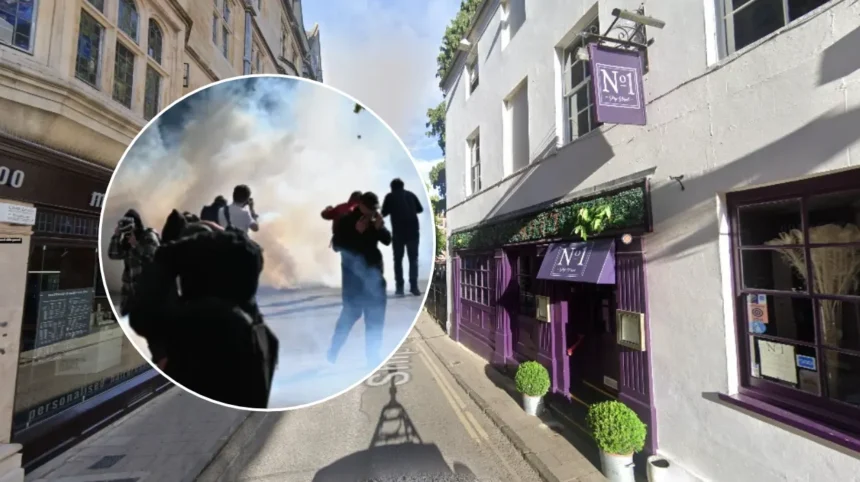
Paris (Oxford Daily) October 17, 2026 — French police deployed tear gas against demonstrators in central Paris on Saturday as thousands took to the streets in coordinated nationwide rallies.
Tensions escalated near the Place de la République when hooded individuals clashed with security forces, prompting immediate police intervention to manage the crowd.
Why Did Police Deploy Tear Gas in Central Paris?
What triggered the use of riot control agents in the French capital was a sharp escalation in tensions near the Place de la République. According to reporting by the Herald Scotland, law enforcement officers used tear gas to push back groups of individuals wearing masks and hoods who had begun launching fireworks and throwing projectiles directly at police lines.
The demonstration in Paris formed part of a broader mobilization of citizens, students, and workers rallying across multiple urban centers. Authorities had pre-designated strict route bounds, planning for thousands of participants to march from the Place de la République towards the Place de Clichy. However, splinter groups near the perimeter disrupted the orderly progression of the planned route.
As reported by Anadolu Agency, the Paris Police Prefecture stated that “40 people had been arrested in the metropolitan area by 9:30 am, mainly for carrying prohibited protective equipment or weapons”.
“40 people had been arrested in the metropolitan area by 9:30 am, mainly for carrying prohibited protective equipment or weapons.”
— Paris Police Prefecture, via Anadolu Agency
How Did Demonstrations Spread Across Other French Cities?
The civil action was not confined to Paris, as security forces were deployed to maintain order in several major regional cities. According to reports from regional authorities in Rennes, demonstrators erected burning barricades to block key arterial roads, causing significant transport disruptions.
In Lyon, law enforcement officers utilized tear gas to disperse a crowd of approximately 100 demonstrators who had gathered to block public thoroughfares. Similar disruptions were recorded in Marseille, where municipal garbage bins and motor scooters were set alight along the Boulevard du Prado before riot police moved in to clear the thoroughfare.
In another major incident within the capital, demonstrators gathered outside the television studios of media outlet CNews. As reported by Anadolu Agency, police recorded 21 arrests after “around 100 people targeted broadcaster CNews’ Paris headquarters, blocking access to a parking lot, throwing projectiles and smashing windows”.
“Around 100 people targeted broadcaster CNews’ Paris headquarters, blocking access to a parking lot, throwing projectiles and smashing windows.”
— Police Department Statement, via Anadolu Agency
What Security Measures Were Enforced by French Authorities?
To prevent total disruption in critical government corridors, public safety officials established strict exclusion zones across central Paris. Demonstrations were officially prohibited around key state locations, including the Élysée Palace, the Prime Minister’s official residence, and the Champs-Élysées avenue.
High-visibility patrols were positioned along designated march routes, and stop-and-search procedures were carried out at major transit hubs across the capital early in the morning to prevent the introduction of improvised weapons.
In response to the growing public disruption and public safety risks, executive leadership urged restraint across all factions. As reported by Anadolu Agency, French President Emmanuel Macron “called on Friday for calm and respect for people and property during the demonstrations”.
Background of the Development
The unrest in France follows weeks of persistent mobilizations across the country. Over recent weeks, high school and university student unions, supported by civil society groups and labor movements, have staged repeated walkouts and street actions to voice concerns over national policy, public education infrastructure, and study conditions.
Tensions have been compounded by public scrutiny over police tactics during earlier demonstrations, leading to calls from various civic groups for greater oversight during crowd-control operations.
The decision of youth movements to align their protests with broader socio-economic campaigns has expanded the scope of the rallies, bringing a diverse coalition of protesters onto the streets of major French municipalities.
Prediction: How This Development Can Affect the French Public and Policy Dynamics
This widespread social mobilization and the continued use of force by security services are likely to increase friction between public administration bodies and civil groups. For the general public, persistent street demonstrations and blockades represent ongoing disruptions to public transport, daily commerce, and municipal infrastructure across major French metropolitan areas.
If the French government maintains its current security posture without establishing formal dialogue channels with reform organizers, further periodic protests are anticipated. In the medium term, parliamentary debates regarding security budgets, public spending, and crowd-control guidelines are expected to intensify as lawmakers seek to balance civil liberties with public order.