Key Points
- Democratic physician and former Oxford Rhodes Scholar Dr Abdul El-Sayed won election to the United States Senate, becoming its first Muslim member.
- El-Sayed, 42, took 52.5 per cent of the vote in Michigan to defeat Republican candidate Mike Rogers, who received 45.5 per cent.
- He entered Oriel College, Oxford, in 2009 to earn a doctorate in Public Health, then completed a medical degree at Columbia University.
- Before running for Senate, El-Sayed served as Detroit’s health director and later led the Wayne County Department of Health, Human and Veterans Services.
- Campaigning on universal healthcare, El-Sayed also pushed for corporate accountability and campaign finance reform.
- Officials at Oxford University’s Oriel College sent formal congratulations after the results were declared.
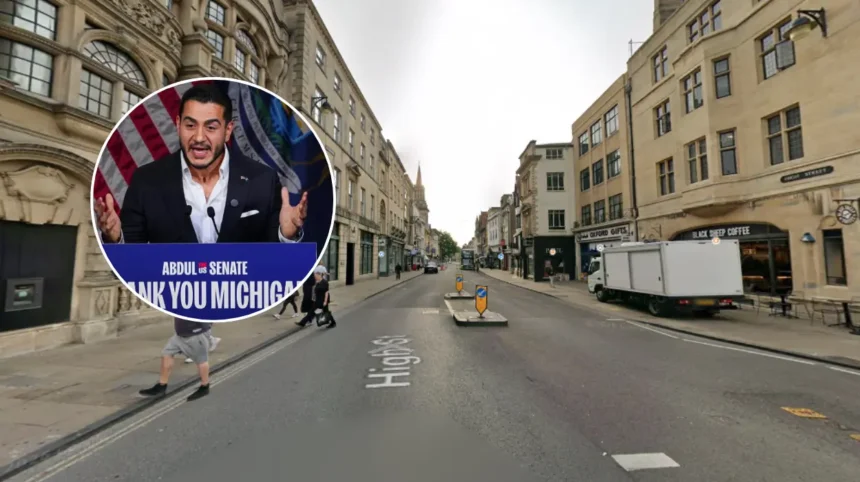
DETROIT (Oxford Daily) November 6, 2026 – Dr Abdul El-Sayed, a former Oxford University Rhodes Scholar and public health physician, has made historic political history by becoming the first Muslim elected to the United States Senate following the US midterm elections in Michigan.
The 42-year-old Democratic candidate secured victory by obtaining 52.5 per cent of the vote, successfully defeating his Republican opponent, former Representative Mike Rogers, who received 45.5 per cent.
El-Sayed’s victory retains a vital Democratic seat in the upper chamber of the United States Congress following a heavily contested statewide campaign.
The senator-elect matriculated at Oriel College, Oxford, in 2009, completing a Doctor of Philosophy (DPhil) degree in Public Health in 2011 before earning his medical degree from Columbia University Vagelos College of Physicians and Surgeons in 2014.
How did Dr Abdul El-Sayed secure his election victory in Michigan?
As reported by Albert Tate of the Oxford Mail, Lord Mendoza, Provost of Oriel College, expressed academic pride regarding the election victory, stating: “Congratulations to Abdul El-Sayed on his election win. We have followed the Senate race in Michigan closely and are proud to see an alumnus elected to public office. We wish him every success.”
During his election-night address at The Department at Hudson’s in Detroit, accompanied by his wife Dr Sarah Jukaku, El-Sayed addressed his supporters directly on the significance of the result.
As reported by the Anadolu Agency and the Oxford Mail, El-Sayed stated: “You took a chance on the unlikeliest of candidates. You welcomed me in your homes, your churches, your synagogues.”
He further added in his victory speech: “Michigan, I cannot wait to serve you with the same big-heartedness, open-mindedness, grit, and earnestness that you’ve shown me.”
Addressing the broader political climate of the race and the Republican campaign, El-Sayed noted: “Let them know tomorrow that the bad guys lost. Let them know that we together, fighting for something bigger, we won. We won! So Mike, enjoy your retirement.”
He also noted the constitutional procedure governing the Senate swearing-in process in January 2027.
As reported by the Washington Report and the Jakarta Globe, El-Sayed addressed the executive leadership directly, stating: “There is this delicious irony in the fact that you’re constitutionally obligated to swear me in in January.”
He continued: “Donald, look, I know you struggled with my name. So after JD swears me in in January, you can just go on and call me senator.”
What was the background to Dr Abdul El-Sayed’s career prior to his election?
Born in Rochester Hills, Michigan, in 1984 to Egyptian immigrant parents, El-Sayed attended Bloomfield Hills High School before attending the University of Michigan, graduating in 2007.
After completing his doctorate at Oxford as a Rhodes Scholar, he earned his medical degree from Columbia University.
In 2015, at age 30, El-Sayed was appointed health director for the city of Detroit, making him the youngest health officer in a major US city at the time.
In that role, he worked to rebuild the municipal public health infrastructure following Detroit’s municipal bankruptcy proceedings.
He subsequently contested the Democratic primary for Governor of Michigan in 2018, finishing behind Gretchen Whitmer.
Between 2023 and 2025, El-Sayed served as director of the Wayne County Department of Health, Human and Veterans Services.
His legislative campaign platform emphasised government-backed universal healthcare expansion, campaign finance reform, and corporate regulation.
As reported by Politico and Britannica, El-Sayed clarified his economic policy position by stating: “I believe that we can have healthcare, that we can regulate on the biggest corporations in the world, that we can make it easier for you to make your first million rather than for Elon Musk to make a trillion. And that doesn’t make me a socialist. That just makes me somebody who wants government to work for people.”
What is the prediction for how this development will affect voters and Muslim-American communities?
The election of Dr Abdul El-Sayed to the US Senate represents a structural shift in American federal governance representation.
For Muslim-American constituents and civil rights groups, his presence in the upper house establishes historic legislative access and visible representation in federal lawmaking.
His background as a physician and public health specialist is expected to focus legislative debate on healthcare policy, medical affordability, and public health infrastructure within Michigan and nationally.
Concurrently, his progressive platform regarding corporate regulation and campaign finance reform will provide a distinct legislative voice within the Senate Democratic caucus.