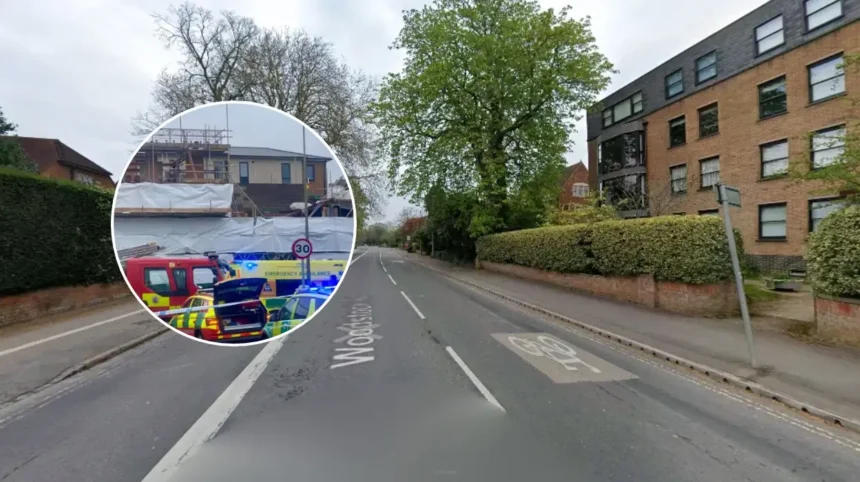
Key Points
- The Health and Safety Executive launched an investigation into a building collapse that injured two people.
- Police, fire, and ambulance crews responded to the scene to treat casualties, secure the area, and clear fallen debris.
- Paramedics took both injured individuals to hospital for further medical care.
- All construction work at the location was suspended while inspectors assess the stability of the remaining structure.
- HSE officers are checking whether the site met required safety standards, structural assessments, and risk protocols before the collapse.
London (Oxford Daily) October 22, 2026 — The Health and Safety Executive (HSE) has formally initiated an investigation following the collapse of a building structure that resulted in injuries to two individuals. Regulatory inspectors arrived at the location shortly after emergency services secured the scene to ensure that the site was made safe and to begin gathering physical evidence.
- Key Points
- How Did Emergency Services Respond to the Incident and What Is the Condition of the Injured?
- What Factors Are Health and Safety Inspectors Currently Examining?
- What Is the Background to Health and Safety Oversight on Construction Sites?
- What Is the Prediction for How This Development Will Affect the Construction Sector and Local Community?
The inquiry aims to establish the precise sequence of events leading up to the collapse and to determine whether statutory health and safety regulations were breached during the ongoing works.
Emergency service teams, including local police officers, fire services, and paramedic units, were called to the location immediately following the structural failure. Paramedics treated two individuals at the scene before transferring them to hospital for further medical evaluation and care.
Firefighters conducted secondary searches through the rubble and surrounding structures to verify that no additional individuals were trapped beneath the fallen materials or inside the impacted zone.
“Safety inspectors from the Health and Safety Executive have been deployed to the site to establish the cause of the incident and to ensure that all necessary measures are in place to secure the surrounding area.”
Subcontractors and site operators have been instructed to pause all activity while safety officials assess structural stability. A perimeter cordon remains in place around the immediate vicinity to protect members of the public and site personnel from potential secondary collapses or falling debris.
How Did Emergency Services Respond to the Incident and What Is the Condition of the Injured?
The emergency response was initiated after passers-by and site workers reported a loud collapse accompanied by falling masonry and structural support components. On arrival, emergency responders prioritized medical triage and scene containment. First responders administered critical first aid to two individuals suffering from injuries sustained during the sudden failure of the building’s structural components.
Ambulance crews stabilized both casualties at the location before transporting them to regional medical facilities for comprehensive examinations. Authorities confirmed that rescue teams systematically swept the collapsed zone using specialized equipment to ensure no further casualties remained unaccounted for beneath the fallen materials.
Local law enforcement closed off adjacent access routes and pedestrian footpaths to maintain a secure perimeter. The physical blockade remains active to allow inspectors from the Health and Safety Executive unhindered access to the core collapse area for detailed technical evaluations.
What Factors Are Health and Safety Inspectors Currently Examining?
Inspectors from the Health and Safety Executive are conducting an extensive examination of the physical evidence, building materials, and underlying structural supports. Technical specialists are tasked with assessing whether structural calculations, scaffolding arrangements, or material degradation contributed to the sudden structural breakdown.
The investigation will involve reviewing site logbooks, risk assessments, and method statements submitted by the main contractor and any active subcontractors on site. Inspectors are examining whether recent environmental conditions, heavy machinery operation, or procedural oversights played a direct role in compromising the stability of the structure.
“A full and thorough investigation will be carried out to examine all factors contributing to this collapse, including site management practices, structural integrity assessments, and adherence to safety guidelines.”
Statements are being collected from eye-witnesses, site managers, and workers present at the time of the collapse. Regulatory officers are working alongside local authority building control officers to review the structural history of the premises and determine whether preliminary safety warnings or structural defects were documented prior to the incident.
What Is the Background to Health and Safety Oversight on Construction Sites?
The Health and Safety Executive operates as the primary independent regulator for work-related health, safety, and illness in Great Britain. Under the Health and Safety at Work etc. Act 1974 and the Construction (Design and Management) Regulations 2015, duty holders—including principal contractors, clients, and designers—are legally obligated to plan, manage, and monitor health and safety during all phases of construction and structural modification.
Statutory regulations require duty holders to ensure that existing structures are structurally sound before and during demolition, alteration, or renovation works. When structural failures occur resulting in injury or potential loss of life, the HSE holds enforcement powers ranging from issuing Prohibition Notices—which immediately stop work on site—to issuing Improvement Notices or initiating criminal prosecutions in the courts.
In recent years, regulatory bodies have increased scrutiny on structural safety, temporary works management, and working-at-height practices across urban development sites. Inspections routinely focus on whether site managers have implemented adequate structural shoring, routine stability checks, and thorough risk management frameworks to mitigate catastrophic structural failures.
What Is the Prediction for How This Development Will Affect the Construction Sector and Local Community?
This development is expected to have immediate operational and regulatory impacts across the local community, site developers, and the broader construction industry. For the local community, temporary road closures, pedestrian diversions, and heightened site security will remain in effect until structural engineers verify that the remaining building elements pose no threat to public safety.
Local businesses and residents nearby may experience short-term disruptions while site recovery and stabilization operations continue.
For the duty holders and contracting firms associated with the site, the ongoing HSE investigation could lead to prolonged site closures, resulting in project delays and financial implications.
If the regulator identifies breaches of health and safety legislation, enforcement actions—such as formal prosecution, substantial financial penalties, or legally binding improvement directives—may follow once the inquiry concludes.
Across the wider construction sector, the incident is likely to prompt duty holders and site managers to execute precautionary structural reviews on similar projects.
Contractors operating across urban redevelopment sites are anticipated to reinforce risk assessment protocols, review temporary works designs, and re-examine site safety management systems to prevent comparable structural failures and protect worker welfare.