Key Points
- A 43-year-old driver fell asleep at the wheel and crashed into a utility pole while under the influence of cocaine.
- Emma Dutton was driving a blue Nissan Qashqai on Stadhampton Road in Little Milton, South Oxfordshire, when the vehicle veered off the road.
- Tests confirmed Dutton had benzoylecgonine, a cocaine metabolite, in her system above the legal limit.
- Oxford Magistrates’ Court banned Dutton from driving for 22 months on October 8, 2026, and ordered her to perform community service and pay court fines.
- Police released video footage of the crash to show the dangers of driving while tired and under the influence of drugs.
South Oxfordshire (Oxford Daily) October 17, 2026 – A 43-year-old motorist tested positive for illegal substances after falling asleep whilst operating a motor vehicle and smashing directly into a roadside telegraph pole, police authorities confirmed.
- Key Points
- How did law enforcement respond to the collision site?
- What evidence was recorded in the released video footage?
- What are the legal standards for driving under the influence of drugs in the UK?
- What is the background of this particular development?
- What is the prediction for how this development will affect road users and local communities?
The incident unfolded on Stadhampton Road in the village of Little Milton, located in South Oxfordshire, on the afternoon of February 5. The driver involved was identified by law enforcement as Emma Dutton, residing in Berinsfield.
Dutton was travelling along the stretch of road inside a blue Nissan Qashqai when she lost control of the vehicle due to sudden fatigue brought on by drug consumption.
How did law enforcement respond to the collision site?
Emergency service responders and officers from Thames Valley Police were dispatched to Stadhampton Road immediately following reports from eye-witnesses regarding a single-vehicle collision.
Upon arrival at the scene, attending officers discovered the blue Nissan Qashqai with significant structural damage to its front end. The force of the impact had severed or heavily compromised the wooden telegraph pole positioned along the roadside.
According to official investigative records released regarding the incident, tests conducted on Dutton confirmed the presence of cocaine in her system at the time she lost control of the vehicle.
As reported by Chief Reporter Matt Simpson of the Oxford Mail, “Drug driver Emma Dutton, from Berinsfield, fell asleep at the wheel of her blue Nissan Qashqai on Stadhampton Road in Little Milton on February 5”.
What evidence was recorded in the released video footage?
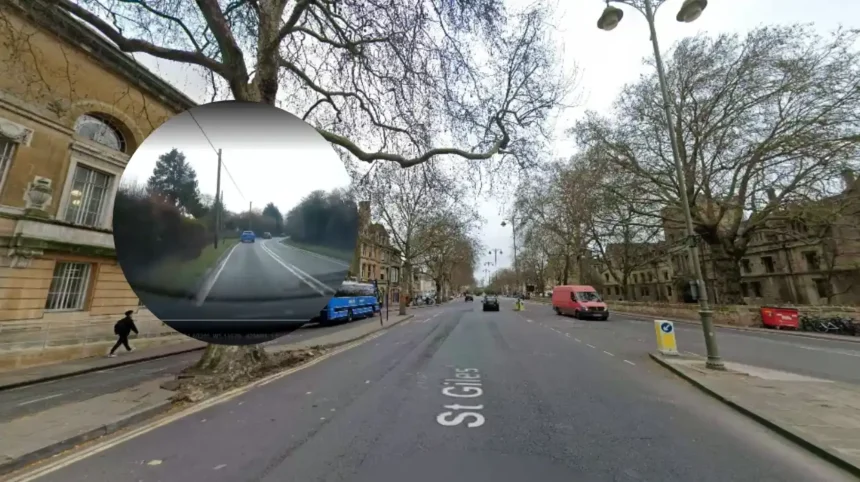
Thames Valley Police released video footage detailing the exact sequence of events leading up to and immediately following the crash.
The recording captures the moment the blue Nissan Qashqai drifted across the carriageway without attempting to brake or swerve before striking the telegraph pole.
The video material was made public following court proceedings to underscore the catastrophic risks associated with driving whilst impaired by controlled substances.
As reported by Chief Reporter Matt Simpson of the Oxford Mail, “Footage shows the moment a woman on cocaine crashed into a telegraph pole in south Oxfordshire”.
What are the legal standards for driving under the influence of drugs in the UK?
Under the Road Traffic Act 1988, driving or attempting to drive a motor vehicle with specified controlled drugs above statutory limits constitutes a severe criminal offense across England and Wales.
Section 5A of the Act establishes strict limit thresholds for illegal substances, including cocaine and its primary metabolite benzoylecgonine, where any presence beyond trace operational levels triggers mandatory prosecution.
The legislation mandates minimum penalties for convicted offenders, including an obligatory driving disqualification of no less than 12 months, substantial fines, and potential custodial sentences depending on the severity of the incident and aggravating factors such as fatigue or damage to public infrastructure.
What is the background of this particular development?
The issue of drug-impaired driving across Thames Valley and the broader United Kingdom has seen intensified enforcement and targeted policing operations over recent years.
Law enforcement agencies have progressively deployed preliminary roadside drug testing kits—commonly referred to as ‘drug wipes’—which enable officers to screen drivers instantly for substances including cannabis and cocaine using saliva samples.
The integration of roadside screening technology has led to a notable rise in detected offences across rural arterial routes, where high speeds combined with driver impairment frequently result in severe single-vehicle collisions into stationary roadside infrastructure.
Public safety campaigns led by police forces regularly highlight that controlled drugs impair reaction times, spatial awareness, and cognitive judgment, frequently inducing severe fatigue or sudden loss of consciousness behind the wheel.
What is the prediction for how this development will affect road users and local communities?
This legal development and the public release of crash footage are predicted to directly impact motorists, rural residents, and local infrastructure authorities across South Oxfordshire.
For local motorists and road users, the high-profile publication of crash footage serves as an amplified deterrent, signalling heightened police vigilance and roadside drug-testing enforcement across rural routes such as Stadhampton Road.
The public display of collision consequences aims to reduce instances of drug-impaired and fatigued driving by emphasizing both the severe legal penalties and physical dangers involved.
For residents in rural villages such as Little Milton and Berinsfield, such incidents underscore ongoing concerns regarding traffic safety and utility reliability on narrow rural carriageways.
Collisions involving utility infrastructure often lead to localized power or telecommunications outages, prompting local parish councils and highway authorities to re-evaluate road safety measures, speed limits, and protective barriers along rural routes susceptible to high-impact vehicle collisions.