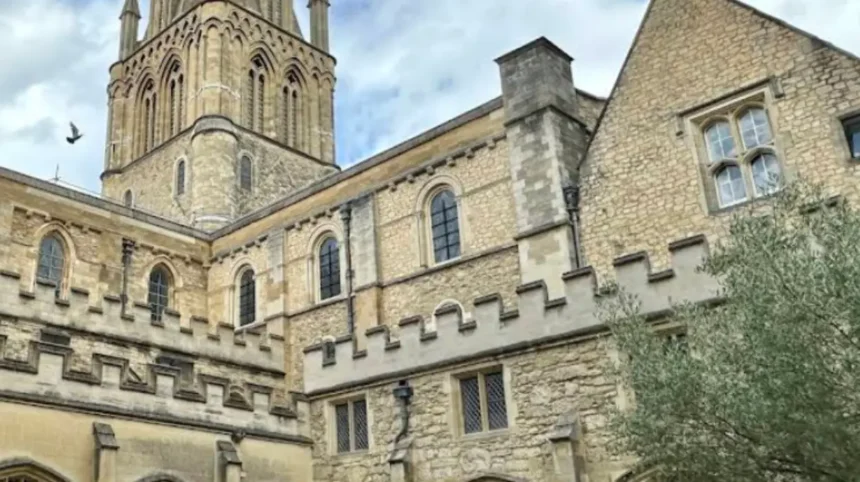
Oxford is a city defined by its “dreaming spires,” but for those who step inside Christ Church Cathedral, the true magic lies in the “dreaming windows.” As both a college chapel for Christ Church and the cathedral church for the Diocese of Oxford, this building holds a unique position in English ecclesiastical history. Among its many treasures, the medieval stained glass stands as a testament to the resilience of art through reformation, war, and the passage of centuries. These glass panels are not merely decorations; they are translucent manuscripts that tell the story of medieval piety, local patronage, and the evolution of European artistic techniques.
- The Romanesque Foundations and the Becket Window
- The 14th Century and the Rise of International Style
- The Iconography of the Latin Chapel
- The Impact of the Reformation and the Civil War
- Restoration and the Victorian Perspective
- Technical Artistry: From Pot-Metal to Crucks
- The Symbolic Power of Light in Oxford
- Preserving the Legacy for Future Generations
The survival of so much medieval glass at Christ Church is something of a historical miracle. During the English Reformation and the later Commonwealth period, many “idolatrous” images were purged from English churches. However, through a combination of local protection and perhaps a bit of luck, Christ Church retained fragments and full windows that date back to the 12th century. To walk through the cathedral today is to trace the development of this medium from the deep, jewel-like tones of the Romanesque period to the delicate, silver-stained elegance of the late Middle Ages.
The Romanesque Foundations and the Becket Window
The earliest significant glass in the cathedral dates to the late 12th and early 13th centuries. The most famous of these fragments is the St. Thomas Becket window, located in the Lucy Chapel. This piece is historically significant not just for its age, but for its subject matter. Following the murder of Becket in 1170, King Henry II was forced to do penance, and the cult of St. Thomas spread rapidly across Europe. However, centuries later, Henry VIII ordered that all images of Becket be destroyed. In the Christ Church window, one can see where the saint’s face was deliberately removed and replaced with a plain piece of glass—a physical scar left by the English Reformation.
Technically, this early glass is characterized by its density. Unlike later windows that sought to admit more light, these Romanesque pieces were designed to glow with intense, saturated color. The blues were often achieved using cobalt, while the deep reds came from copper. Because the glass was “pot-metal”—meaning the color was baked into the glass while it was molten—it possesses a depth that painted glass cannot replicate. These windows functioned as “biblia pauperum” or the “Bible of the poor,” providing a visual narrative for a congregation that was largely illiterate but deeply attuned to visual symbolism.
The 14th Century and the Rise of International Style
As the cathedral expanded in the 14th century, particularly with the addition of the Latin Chapel, the style of the stained glass underwent a dramatic shift. This era marked the transition into what art historians call the “Decorated” style. The windows from this period, particularly those dating around 1320 to 1350, show a newfound interest in architectural framing. Figures are no longer floating in fields of color; instead, they are placed within elaborate painted canopies that mimic the stone tracery of the windows themselves.
A defining characteristic of this 14th-century glass is the introduction of silver stain. This was a chemical process involving silver nitrate that, when fired onto the back of the glass, produced shades ranging from pale lemon to deep orange. This allowed artists to depict golden hair, crowns, and intricate embroidery on a single piece of clear or white glass without the need for lead strips. The result was a lighter, more ethereal aesthetic. In the Latin Chapel, the windows depicting the life of St. Frideswide—Oxford’s patron saint—showcase this mastery of light and line, blending local hagiography with the high fashion of the medieval period.
The Iconography of the Latin Chapel

The Latin Chapel remains the jewel of the cathedral for those interested in medieval glazing. The glass here serves as a bridge between the medieval past and the Victorian present, as it contains both 14th-century originals and the famous 19th-century Burne-Jones window. Focusing on the medieval elements, one observes a sophisticated use of “grisaille”—clear or greyish glass painted with delicate foliage patterns. This technique was often used to save money, but in Christ Church, it is used artistically to balance the vivid colors of the central figures.
The medieval panels often depict saints and martyrs with their specific attributes, allowing the viewer to identify them instantly. St. Catherine is seen with her wheel, and St. Margaret with her dragon. These figures were not just static images; they were intended to be interactive focal points for prayer. The placement of the glass in the Latin Chapel, where students and monks would have gathered for study and liturgy, suggests that the windows were meant to provide intellectual as well as spiritual illumination. The intricate border work, featuring heraldic shields and stylized vine leaves, further roots these windows in the specific social and political landscape of 14th-century Oxford.
The Impact of the Reformation and the Civil War
To understand the current state of the medieval glass, one must acknowledge the periods of destruction that shaped the cathedral’s interior. During the 1540s, the dissolution of the monasteries led to the removal of many “superstitious” shrines, including that of St. Frideswide. While the glass was not systematically destroyed with the same fervor as in other cathedrals, the shift in theology meant that new windows were largely heraldic or plain.
The most significant threat came during the English Civil War, when Oxford served as the Royalist capital for King Charles I. While the cathedral itself was protected by its association with the King, the subsequent Puritan victory under Oliver Cromwell led to further “cleansing” of church interiors. Much of the medieval glass that survives today does so because it was moved, hidden, or deemed less offensive than large-scale crucifixions or depictions of the Virgin Mary. The fragmented nature of some windows in the north aisles is a direct result of these turbulent decades, creating a “mosaic” effect where medieval shards are leaded together in abstract patterns.
Restoration and the Victorian Perspective
The 19th century brought a renewed interest in the medieval past, led by the Oxford Movement and architects like George Gilbert Scott. During the restorations of the 1870s, there was a conscious effort to preserve and re-set the medieval glass. However, the Victorian approach to restoration was often interventionist. Where glass was missing, they frequently inserted their own interpretations of medieval style.
This period also saw the addition of windows by the Pre-Raphaelite artist Edward Burne-Jones, executed by the firm of William Morris. While these are technically “modern” compared to the 14th-century glass, they were designed with a deep reverence for medieval techniques. Burne-Jones studied the existing medieval glass in Christ Church to ensure his work complemented the ancient aesthetic. The St. Frideswide Window in the Latin Chapel, for instance, tells the saint’s story in a series of vibrant panels that echo the narrative structure of the 14th-century predecessors, ensuring a visual continuity that spans seven hundred years.
Technical Artistry: From Pot-Metal to Crucks
The creation of these windows was a grueling and expensive process. Medieval glassblowers produced “muff” glass (blown into a cylinder and flattened) or “crown” glass (spun into a disk). Because the glass was hand-made, it varied in thickness, which is exactly what gives medieval windows their unique “shimmer.” When light passes through glass of varying density, it refracts at different angles, creating a living quality that modern, perfectly flat industrial glass cannot match.
The leading, or “cames,” used to hold the glass in place also played an aesthetic role. In the medieval mind, the lead lines were not just structural necessities; they were part of the drawing. At Christ Church, the restoration teams have worked hard to maintain the original lead patterns where possible, as these lines define the rhythm of the window. The preservation of these technical details is what allows researchers today to identify specific workshops and artists who may have traveled between Oxford, Winchester, and even across the channel to France.
The Symbolic Power of Light in Oxford
In the medieval worldview, light was a manifestation of the divine. The theologian Robert Grosseteste, who was the first Chancellor of Oxford University and Bishop of Lincoln, wrote extensively on the “metaphysics of light.” He argued that light was the primary form of all matter. For the medieval scholars at Christ Church, the stained glass was not just a window to the outside world, but a filter that transformed “profane” sunlight into “sacred” light.
This philosophical background is essential for modern visitors to understand. The medieval glass at Christ Church was designed to create an atmosphere of “lux continua” (continuous light). As the sun moves across the sky, different windows are activated, casting colored shadows across the stone floors and tombs. This intentional choreography of light served to remind the viewer of the presence of the divine in the everyday, a concept that remains central to the cathedral’s mission as a place of worship and reflection.
Preserving the Legacy for Future Generations
Today, the medieval glass of Christ Church Cathedral is managed with a high degree of scientific care. Environmental factors such as pollution, moisture, and UV radiation pose constant threats to the ancient pigments and the stability of the lead. Modern conservation involves the use of isothermal glazing, where a protective clear layer is placed on the outside, allowing the medieval glass to sit in a climate-controlled “micro-environment” while still appearing visible from the exterior.
Educational initiatives and digital mapping projects are also helping to bring the stories of these windows to a global audience. By documenting every panel in high resolution, the cathedral ensures that even if the physical glass were to degrade, the artistic and historical data would survive. For the “Oxford Audience,” these windows are more than just museum pieces; they are a living part of the city’s identity, bridging the gap between the medieval academic traditions and the modern University.
Which cathedral has the most stained glass windows?
While Christ Church is renowned for its medieval fragments, York Minster holds the largest collection of medieval stained glass in the UK. Globally, Chartres Cathedral in France is often cited as having the most extensive and best-preserved set, covering over 2,600 square meters.
Was Harry Potter filmed at Christ Church College?
Yes, Christ Church was a primary filming location; its Bodley Staircase appeared in several films, including the first arrival of the students at Hogwarts. While the college’s Great Hall was not filmed directly, it served as the architectural inspiration for the Hogwarts Dining Hall set.
What is the most posh college in Oxford?
Christ Church is traditionally considered the most “posh” due to its massive size, aristocratic history, and its unique status as the only college to house a cathedral. However, Magdalen and St John’s are also frequently cited for their immense wealth, prestigious reputations, and grand architectural style.
Which is the prettiest college in Oxford?
Beauty is subjective, but Magdalen College is frequently voted the prettiest for its riverside setting and famous deer park. Worcester College is another top contender, known for its 26 acres of lush gardens, hidden lake, and picturesque “cottages.”
What did Emma Watson study at Oxford?
Emma Watson originally attended Worcester College as a visiting student to study English Literature. More recently, in 2023, she returned to the University of Oxford to pursue a Master’s in Creative Writing at New College