Key Points
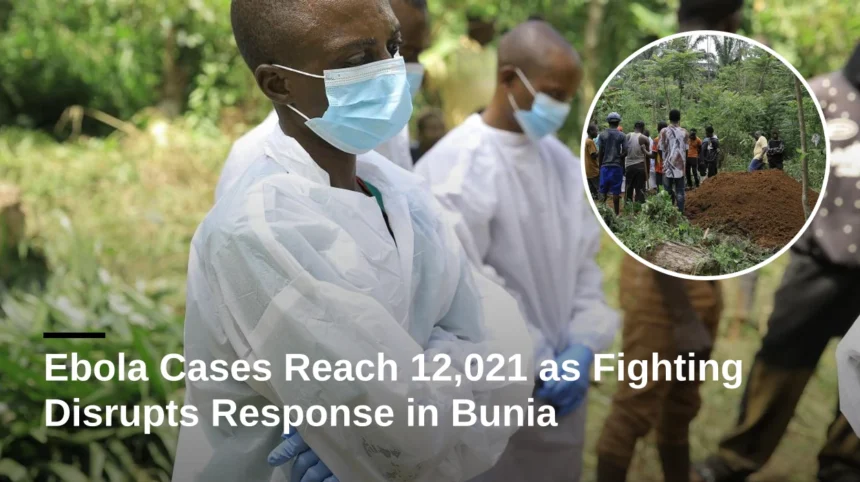
- Confirmed Ebola infections in the Democratic Republic of the Congo have reached 12,021, with 5,904 deaths, according to government data.
- The outbreak began in Ituri province in mid-May and has spread to eight of the country’s 26 provinces.
- Fighting between the Congolese army and Convention for the Popular Revolution rebels is disrupting surveillance, treatment and evacuation operations.
- World Health Organization personnel and Congolese health officials were evacuated to Bunia after becoming trapped by fighting.
Bunia (Oxford Daily) November 26, 2026 – The Democratic Republic of the Congo’s Ebola outbreak has exceeded 12,000 confirmed cases, with government data recording 12,021 infections and 5,904 deaths. The outbreak in eastern Congo is being compounded by fighting between the Congolese army and Convention for the Popular Revolution rebels, which has restricted access to affected communities and forced some responders to leave.
Associated Press reporter Sebastien Kitsa Musayi reported that the outbreak is the fastest-growing Ebola outbreak in history. The disease was first declared in Ituri province in mid-May and has since spread to eight provinces.
How has fighting affected the Ebola response in Ituri?
Fighting resumed in Iga-Barrière, a mining town about 24 kilometres north of Bunia, sending displaced civilians towards the provincial capital and major hub for the Ebola response. The violence has prevented response teams from reaching some communities, disrupted monitoring of exposed people and reduced staffing at treatment centres.
Catherine Smallwood, the World Health Organization’s Ebola incident manager, said about a dozen people, including two World Health Organization personnel and Congolese health officials, were evacuated to Bunia after being trapped in a hospital in Akwe during intense crossfire.
Humanitarian worker Sandrine Buju said her team came under gunfire while returning to Bunia after training community volunteers. Peacekeepers later escorted the team through two areas affected by fighting.
What is the background to the outbreak?
Government data reported by Reuters showed that the outbreak is caused by the rare Bundibugyo species of Ebola virus.
The outbreak was declared in Ituri province in mid-May and has become the second-largest Ebola outbreak on record by confirmed infections.
Nearly half of the 12,021 confirmed patients have died, according to data from the Congolese Ministry of Health.
The response is taking place amid displacement and insecurity in north-eastern Congo, where Bunia serves as a central location for treatment and disease-control operations.
How could the outbreak affect communities as cases reach 12,000?
Continued fighting could make it harder for health workers to identify contacts, deliver treatment and maintain infection-control measures in communities cut off by insecurity.
Displaced people moving towards Bunia and other populated areas could increase pressure on health facilities and complicate efforts to monitor possible exposure.
Evacuations and attacks on response workers could reduce available staff, while interruptions to community outreach may make it more difficult to build public cooperation with Ebola-control measures.