Key Points
- The International Tribunal for the Law of the Sea rejected Argentina’s request to suspend the Sea Lion oil project off the Falkland Islands.
- The ruling was passed by 18 judges to three, with the tribunal saying it could not determine questions of sovereignty.
- Argentina argued drilling should stop until its sovereignty claim was resolved.
- The United Kingdom welcomed the decision, while the wider arbitration case is expected to continue.
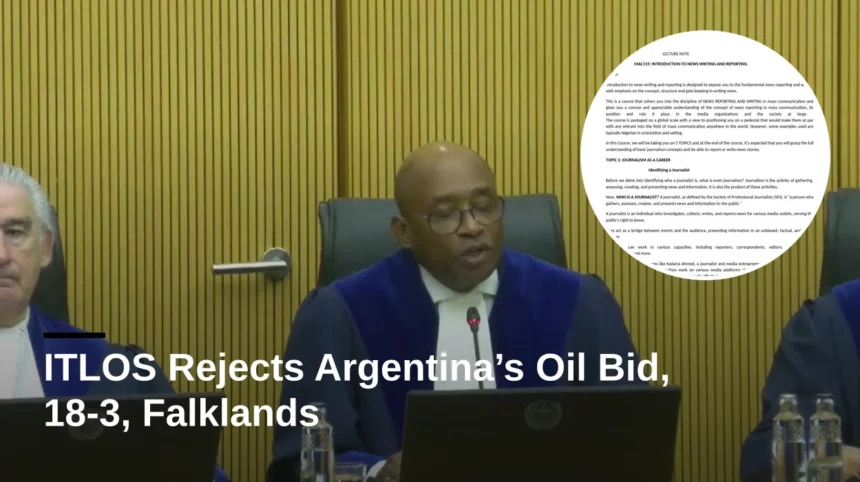
Stanley (Oxford Daily) November 28, 2026 – The International Tribunal for the Law of the Sea has rejected Argentina’s request to block oil drilling off the Falkland Islands, declining to impose provisional measures against the Sea Lion project. The tribunal said there appeared to be no basis for believing it had jurisdiction because sovereignty disputes fall outside its authority. The decision was delivered by tribunal president Maurice Kamga, with 18 judges voting against Argentina’s request and three supporting it.
Why did the international tribunal reject Argentina’s request?
As reported by the Belfast Telegraph, Argentina asked the tribunal to order a temporary halt to the Sea Lion project while its wider sovereignty dispute with the United Kingdom proceeded. Argentina argued that drilling should not begin before the status of the Falkland Islands, which it calls the Malvinas, had been resolved.
The tribunal concluded that it could not rule on the underlying sovereignty question. The ruling therefore rejected Argentina’s application for provisional measures rather than deciding the broader territorial dispute. Mr Kamga said the decision did not prejudice the outcome of the case, according to reports by the Belfast Telegraph and the London Standard.
What did the United Kingdom say about the ruling?
Foreign Secretary Ed Miliband and Attorney General Ellie Reeves welcomed the decision in a joint statement published by the United Kingdom Government. They said Argentina had failed in its attempt to stop Falkland Islanders making their own sovereign decisions.
At an earlier hearing, Ms Reeves argued that an injunction would have had “devastating consequences” for the islanders by preventing them from developing natural resources in accordance with their right to self-determination. The United Kingdom had asked the tribunal to reject Argentina’s request for provisional measures.
What is the Sea Lion project and what happens next?
The Sea Lion development is a joint project involving Britain’s Rockhopper and Israel’s Navitas in the South Atlantic. Reports cited by the Belfast Telegraph said the field contains an estimated 1.7 billion barrels of oil.
Argentina launched an arbitration process against London in September and separately sought emergency measures from the Hamburg-based tribunal. A later hearing on the wider dispute is expected, although Saturday’s decision allows the project to continue without the temporary suspension requested by Buenos Aires.
Background to the Falkland Islands dispute
Argentina has long claimed sovereignty over the Falkland Islands, while the United Kingdom administers them as an Overseas Territory. Argentina invaded the islands in 1982, prompting a British military operation that restored British control. In a 2013 referendum, 99.8 per cent of participating islanders voted to remain a British Overseas Territory. Argentina’s President Javier Milei has described oil activities around the islands as unlawful and introduced economic measures against people and companies involved in exploration.
How could the ruling affect the parties involved?
The decision removes the immediate legal obstacle Argentina sought to place before the Sea Lion project, potentially allowing the British and Israeli companies to continue development planning. For Falkland Islanders, the ruling supports the United Kingdom’s position that local authorities should be able to manage natural resources. Argentina may continue pursuing its sovereignty and arbitration claims, meaning diplomatic and legal disputes over offshore resources are likely to remain. The tribunal’s statement that the decision does not determine the wider case leaves the long-term outcome unresolved.