Key Points
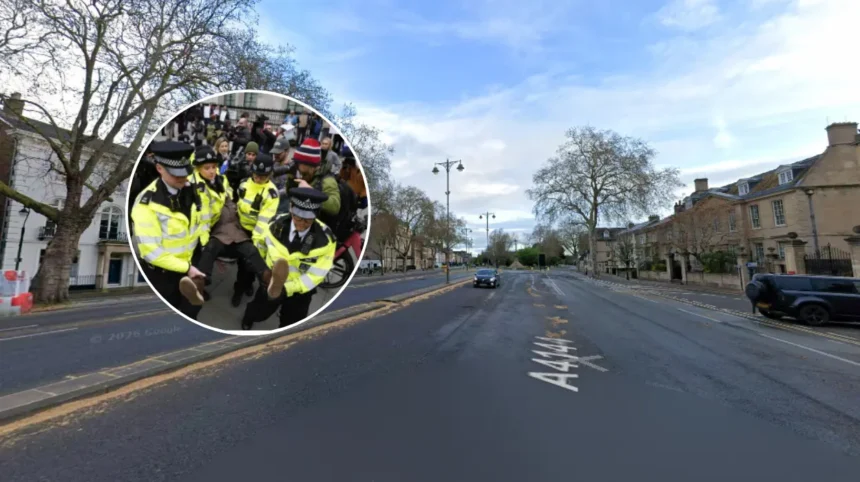
- Police arrested several protesters outside the UK Supreme Court in London as judges began hearing the appeal against the government’s ban on Palestine Action under the Terrorism Act 2000.
- Palestine Action co-founder Huda Ammori brought the legal challenge to overturn the proscription order issued by the Home Office.
- Officers detained demonstrators holding placards that displayed text matching a public statement made about the legal case.
- The Supreme Court hearing follows two opposing decisions: the High Court ruled the ban unlawful in February 2026, before the Court of Appeal overturned that decision in June 2026.
- Home Office lawyers told the court the Court of Appeal made no legal errors, arguing that serious property damage falls within the legal definition of terrorism.
London (Oxford Daily) November 4, 2026 – Multiple protesters have been arrested outside the Supreme Court as justices begin to hear an appeal against the legal ban imposed on the protest group Palestine Action.
As reported by The Jewish Chronicle, the group’s co-founder, Huda Ammori, has mounted a legal challenge against the British Government’s decision to proscribe the organisation under the Terrorism Act 2000, bringing the dispute to the UK’s highest judicial bench in a bid to quash the prohibition.
What Occurred Outside the UK Supreme Court during the Demonstration?
As reported by The Jewish Chronicle, more than 20 demonstrators assembled outside the central London court premises prior to the commencement of the legal hearing. Metropolitan Police officers were observed intervening directly, carrying several individuals away into nearby police transport vans.
As detailed by The Jewish Chronicle, several individuals in attendance were observed holding placards featuring identical wording to a public X post written by the wife of a national security adviser, which precipitated law enforcement actions on site.
What Arguments Were Presented Inside the Courtroom by Legal Representation?
As reported by ITV News, the legal proceedings commenced as the Home Office formally opposed the appeal, asserting that previous judicial findings upholding the proscription contained no errors of law.
As stated by ITV News, Sir James Eadie KC, representing the Home Office, set out written submissions rejecting attempts to portray the entity as a “non-violent direct action protest group”. Sir James Eadie KC stated that:
“Acts which involved serious damage to property could be considered terrorism and the action did not need to involve violence or an intent to endanger life.”
Furthermore, as reported by ITV News, Sir James Eadie KC noted during the proceedings that the information submitted by Huda Ammori regarding Palestine Action’s “structure, activities and membership” remained “notably vague and incomplete” within her written documentation presented to the Supreme Court.
“The information given by Ms Ammori about Palestine Action’s structure, activities and membership remain notably vague and incomplete.”
Background of the Particular Development
The legal contest regarding Palestine Action’s status under UK counter-terrorism legislation has progressed through multiple tiers of the British judicial system over the course of the past year.
The original proscription order was issued by former Home Secretary Yvette Cooper in 2025 under executive powers outlined in the Terrorism Act 2000. That decision prompted Huda Ammori to institute formal judicial review proceedings against the Home Department.
In February 2026, a panel of three High Court judges ruled in favour of Ms Ammori, finding that the government’s decision to ban the group was unlawful. However, that ruling was subsequently appealed by government attorneys.
In June 2026, five judges sitting in the Court of Appeal reversed the High Court’s determination. The Court of Appeal ruled that the proscription was lawful and constituted a “justified and proportionate” interference with rights to freedom of expression.
Following permission granted in July 2026, the case advanced to the Supreme Court to determine whether the Court of Appeal applied correct legal standards regarding property damage, public protest, and anti-terrorism statutes.
Prediction: How This Development Can Affect Civil Liberties and Protest Organisations
The eventual ruling issued by the Supreme Court justices will establish a binding legal precedent across the United Kingdom concerning the boundary between criminal property damage and statutory terrorism.
If the Supreme Court dismisses the appeal and affirms the Court of Appeal’s ruling, public advocacy groups, direct-action campaigns, and civil liberties organisations could face heightened regulatory and legal exposure.
Under such a precedent, non-violent direct action that results in significant physical damage to property could definitively remain classified under terrorism laws, potentially expanding the scope for executive proscription of direct-action activist networks.
Conversely, if the Supreme Court rules in favour of Huda Ammori and quashes the proscription order, the judgment will narrow the criteria available to the Home Office when designating domestic political or activist groups under terrorism legislation.
Such an outcome would re-establish distinct legal boundaries between standard public order offenses, criminal damage, and proscribed terrorist acts, directly impacting how law enforcement agencies manage direct-action demonstrations nationwide.