Key Points
- Drone footage shows charred phone mast near A40.
- Fire broke out Thursday evening on Elsfield Way.
- Three fire stations tackled suspected arson blaze.
- A40 closed causing major traffic disruptions Oxford.
- Investigations probe fire cause; signal impact unknown.
Oxford (Oxford Daily News) March 6, 2026 – Drone footage has laid bare the devastating aftermath of a phone mast engulfed by fire near the A40 in Oxford, with authorities treating the incident as a suspected arson attack amid ongoing investigations in early 2026. The charred skeletal remains of the telecommunications structure on Elsfield Way were captured from the air, highlighting the scale of destruction that prompted a rapid response from emergency services on Thursday evening. This event, unfolding against the backdrop of heightened concerns over infrastructure sabotage, has led to significant road closures and the temporary suspension of parts of Oxford’s congestion charge scheme.
- Key Points
- What Did the Drone Footage Reveal?
- When and Where Did the Phone Mast Fire Occur?
- How Did Firefighters Respond to the Blaze?
- Why Is Arson Suspected in This Oxford Incident?
- What Traffic Disruptions Followed the A40 Closure?
- Has Mobile Phone Signal Been Affected?
- Who Owns the Damaged Phone Mast?
- What Is the Broader Context of UK Mast Attacks?
- How Does This Incident Impact Local Businesses?
- What Safety Measures Were Taken on Site?
- Will the Congestion Charge Suspension Continue?
- What Are Police Saying About Investigations?
- How Does This Fit 2026 Infrastructure Threats?
What Did the Drone Footage Reveal?
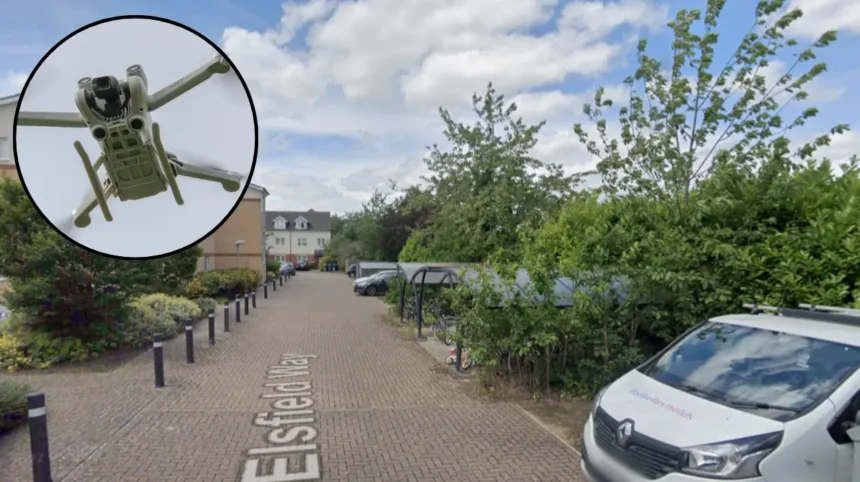
Drone imagery, as exclusively obtained and reported by ITV News Meridian, vividly illustrates the phone mast’s complete devastation, with twisted metal and blackened debris starkly visible against the Oxford landscape near the bustling A40. The aerial perspective underscores the intensity of the blaze, showing the mast reduced to a hollowed-out frame that firefighters deemed safe only after hours of monitoring. As detailed in the footage aired on 6 March 2026, the site on Elsfield Way presents a scene of total ruin, prompting questions about the telecommunications company’s next steps for rebuilding.
The visuals, shared widely across social media platforms, have amplified public concern, with local residents expressing shock at the proximity to major thoroughfares. ITV News Meridian’s coverage emphasises that the drone shots were crucial in assessing the fire’s reach without risking further human exposure to potential hazards. No injuries were reported, but the imagery serves as a grim reminder of vulnerabilities in critical infrastructure.
When and Where Did the Phone Mast Fire Occur?
The incident erupted on Thursday evening, 5 March 2026, at the phone mast located on Elsfield Way adjacent to the A40 in Oxford, as confirmed by Oxfordshire Fire and Rescue Service. Firefighters received the call at approximately 20:35, dispatching engines from three stations to cordon off and combat the flames.
As reported by a spokesperson for Oxfordshire Fire and Rescue in ITV News Meridian’s initial bulletin, “Firefighters cordoned off the area, extinguished the fire and monitored the temperature over several hours before handing the incident over.”
Yahoo UK News highlighted videos showing the mast bursting into flames on the A40 North Way, aligning with the ring road’s eastern segment closure between Cuttmill Roundabout and Marsh Lane. This positioning near one of Oxford’s key arterial routes exacerbated the fallout, with the BBC noting the shutdown persisted into Friday, causing “significant delays.” The precise timing and location have been corroborated across outlets, underscoring the rapid escalation from alert to full emergency.
How Did Firefighters Respond to the Blaze?
Oxfordshire Fire and Rescue Service mounted a robust response, deploying crews from multiple stations to Elsfield Way shortly after the 20:35 alert on 5 March 2026.
The service’s spokesperson, quoted verbatim by ITV News Meridian reporter on the scene, stated: “Investigations are underway into the cause of the fire.”
Crews focused on containment, extinguishing the fire, and temperature checks spanning several hours before relinquishing control to the unnamed telecommunications firm responsible for the mast.
The operation involved cordoning the area to ensure public safety, with no reported casualties or injuries. BBC News articles detail how this handover allowed specialists to evaluate structural integrity and potential signal disruptions, though initial assessments indicated no immediate impact on emergency phonelines from nearby health trusts. The coordinated effort prevented spread to adjacent areas, exemplifying standard protocol for such infrastructure fires.
Why Is Arson Suspected in This Oxford Incident?
While Oxfordshire Fire and Rescue has not formally confirmed arson as of 6 March 2026, the suspicious nature of the isolated blaze on Elsfield Way has led to early speculation of deliberate ignition, mirroring a pattern seen in prior UK telecom mast attacks. ITV News Meridian’s drone footage reveals no evident accidental triggers like lightning or electrical faults, fuelling probes into foul play. The service’s ongoing investigations, as per their spokesperson, prioritise determining the ignition source amid national concerns over anti-5G or protest-related sabotage.
Local context amplifies suspicions; recent years have witnessed similar incidents, such as the 2025 Ottershaw 5G mast arson probed by Counter Terrorism Policing South East, where a man was arrested on site. In Newmarket, Suffolk Police treated a charred Three UK cabinet as criminal damage, with councillor Rachel Hood slamming it as “inexcusable criminality.” Though not directly linked, these precedents inform the Oxford case, where police involvement remains unconfirmed but anticipated.
What Traffic Disruptions Followed the A40 Closure?
The A40 eastbound closure between Cuttmill Roundabout and Marsh Lane, triggered by the Elsfield Way fire, plunged Oxford into gridlock on 6 March 2026. Oxfordshire County Council swiftly suspended the congestion charge on Marston Ferry Road, citing “significant delays” on alternative routes. As per council statements reported by Yahoo UK News, affected drivers would receive refunds or penalty nullifications, with monitoring ongoing for extensions.
BBC News elaborated that the ring road shutdown, one of the city’s most trafficked corridors, forced rerouting and compounded commuter woes during peak hours. No reopening timeline was provided, as the site remained under telecom control. Local businesses near the A40 reported knock-on effects, with deliveries stalled and access restricted. This marks a tangible 2026 impact of the suspected arson on daily Oxford life.
Has Mobile Phone Signal Been Affected?
It remains unclear whether the destroyed mast on Elsfield Way has disrupted mobile services in Oxford as of 6 March 2026.
ITV News Meridian noted explicitly: “It’s not known if it has affected mobile phone signal,” pending assessment by the responsible telecommunications company post-handover.
Oxfordshire Fire and Rescue confirmed no impact on vital services like health trust or ambulance phonelines, prioritising those in their statement.
In analogous cases, such as the Newmarket incident, fires caused service interruptions, prompting Three UK warnings. Here, the mast’s role potentially 5G-enabled raises stakes, but redundancy in networks may mitigate outages. Telecom firms typically issue updates swiftly; residents are advised to monitor official channels amid the uncertainty.
Who Owns the Damaged Phone Mast?
The telecommunications company owning the Elsfield Way mast has not been publicly named in initial reports from 6 March 2026, with Oxfordshire Fire and Rescue handing oversight directly to them post-extinguishment. ITV News Meridian’s coverage refers generically to “the telecommunications company that is responsible for it,” suggesting a major operator like EE, Vodafone, or Three UK, common in such installations. Further disclosures are expected as investigations progress.
Ownership details often emerge in rebuild announcements; past arsons, like Gateshead’s BT mast torched by David Patterson in 2020, highlighted specific providers. In Oxford, proximity to the A40 implies strategic importance for coverage, likely under a shared infrastructure deal. Attribution awaits official confirmation.
What Is the Broader Context of UK Mast Attacks?
Suspected arson in Oxford fits a disturbing UK trend of telecom mast fires, often tied to 5G conspiracies or vandalism since 2020. Counter Terrorism Policing South East led probes into Ottershaw’s 2025 blaze, arresting a 39-year-old on suspicion of arson and weapon possession, later detaining him under the Mental Health Act.
As per their statement: “Our investigative team has been working hard to establish the full circumstances surrounding the fires.”
Suffolk’s Newmarket case saw charred Three UK cabinets, with Suffolk Police classifying it as criminal damage and councillor Rachel Hood decrying “senseless perpetrators.” Belfast endured multiple 5G arsons in 2025, prompting MP Paul Maskey to lament an “ongoing campaign by small minority sabotage vital infrastructure.” Silicon UK recalled David Patterson’s 2021 guilty plea for a £150,000 Gateshead BT mast arson. Oxfordshire’s 2026 event underscores persistent threats to connectivity.
How Does This Incident Impact Local Businesses?
Businesses along Oxford’s A40 corridor faced severe disruptions on 6 March 2026 due to the Elsfield Way closure and fire aftermath. Deliveries halted, customer access impeded, and staff commutes extended amid the congestion charge suspension. Oxfordshire County Council’s refund pledges offer relief, but immediate losses mount for traders reliant on ring road flow.
Yahoo UK News videos captured the blaze’s drama, amplifying fears of prolonged closures if rebuild delays ensue. Telecom outages, if confirmed, could further hinder operations dependent on mobile data. Local voices, though not yet quoted, echo Newmarket’s councillor outrage over “significant inconvenience for residents.”
Economic ripples extend to suppliers and logistics firms navigating detours.
What Safety Measures Were Taken on Site?
Firefighters implemented stringent protocols at Elsfield Way, cordoning the area to protect the public and monitoring heat levels for hours post-extinguishment.
Oxfordshire Fire and Rescue’s spokesperson detailed to ITV News Meridian: “Firefighters cordoned off the area, extinguished the fire and monitored the temperature over several hours.”
This ensured no re-ignition risks before telecom handover.
Drone usage post-event aided safe inspection, avoiding manned climbs on unstable structures. In contrast to Ottershaw, where no injuries occurred despite proximity, Oxford’s response prioritised containment. Thames Valley Police presence, though unconfirmed, aligns with arson protocols. These steps exemplify best practices for infrastructure blazes.
Will the Congestion Charge Suspension Continue?
Oxfordshire County Council suspended the Marston Ferry Road congestion charge on 6 March 2026 due to A40-linked delays, promising refunds and monitoring.
BBC News reported: “The council also noted that any penalty charges would be nullified, and those who prepaid the fee or utilized a prepaid permit would receive refunds.”
Extension depends on reopening timelines.
This pragmatic move alleviates pressure on diverted traffic, but persistent closure could necessitate broader suspensions. Council statements emphasise close watching of the situation, balancing revenue with resident relief amid the suspected arson fallout.
What Are Police Saying About Investigations?
Thames Valley Police have not issued a formal statement specific to the Elsfield Way incident as of 6 March 2026, but investigations mirror arson precedents. Oxfordshire Fire and Rescue leads cause probes, with police likely to classify as criminal damage if deliberate. ITV’s coverage hints at handover facilitating specialist forensics.
National patterns suggest Counter Terrorism involvement if linked to extremism; Ottershaw’s case exemplifies this. Public appeals for information are anticipated, akin to Suffolk’s CAD 100 reference. Neutral probes ensure thoroughness without premature conclusions.
How Does This Fit 2026 Infrastructure Threats?
Early 2026’s Oxford mast fire highlights escalating risks to UK telecom amid geopolitical tensions and domestic protests. Unlike 2023’s lightning-struck Severn Trent facility near Oxford Airport, this lacks natural cause indicators. The Independent’s past coverage of A40-area fires contextualises vulnerabilities.
Government responses to serial arsons emphasise resilience, but rebuild costs burden operators. Oxford’s incident, with drone-documented devastation, spotlights 2026’s urgent need for fortified masts and swift justice. Public awareness campaigns may follow.