
There are few events in the British academic calendar that capture the imagination quite like the Annual Tortoise Race at Corpus Christi College, Oxford. Every year, as the dreaming spires of one of the world’s most famous universities bask in the late spring sunshine, students, academics, and visitors gather in one of Oxford’s most intimate college gardens to watch shelled competitors inch their way to glory. It is eccentric, warmly British, and entirely beloved, and it has been for over half a century.
- Corpus Christi College: The Stage for Something Extraordinary
- A Long History of College Tortoises at Oxford
- The Origins of the Tortoise Race: A Charitable Impulse in the 1970s
- How the Tortoise Race Works: Rules, Rituals and Reptiles
- The Human Tortoise: When Colleges Get Creative
- The Fair Itself: More Than Just a Race
- Notable Moments and Tortoise Legends
- The Wider Cultural Significance of the Tortoise Race
- How to Attend the Tortoise Race
Corpus Christi College: The Stage for Something Extraordinary
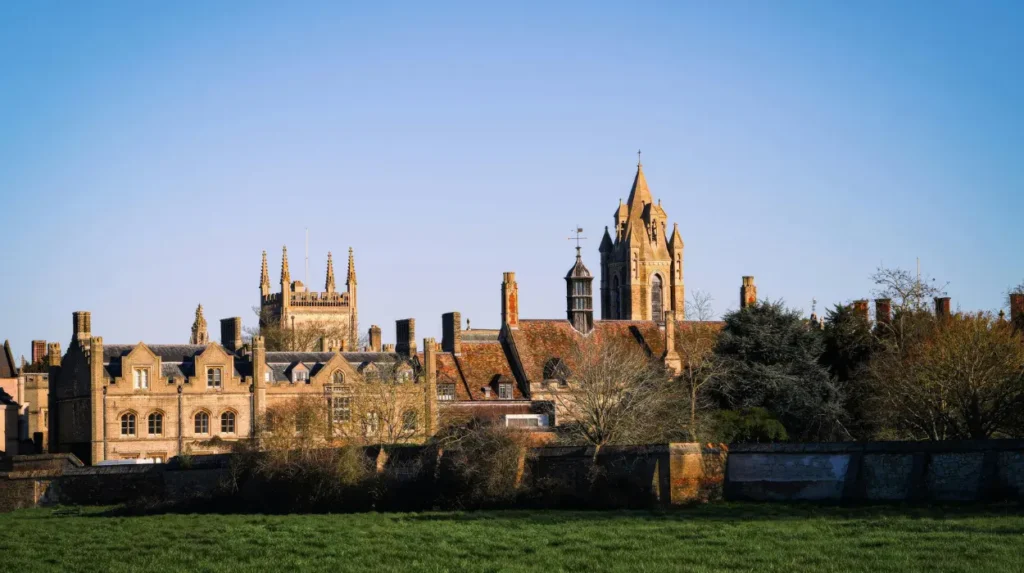
Before understanding why tortoises race here, it helps to understand where “here” is. Corpus Christi College was founded in 1517 by Richard Foxe, Bishop of Winchester, and is the 12th-oldest college in Oxford. Situated on Merton Street between Merton College and Christ Church, it is one of the smallest colleges in Oxford by student population, with around 250 undergraduates and 90 graduates.
Despite its modest size, Corpus Christi carries enormous historical weight. Richard Fox founded the college as a place of Renaissance learning to educate young men in the humanities and sciences, for the service of both church and state. The scholar Erasmus himself praised its early library, declaring it one of the chief glories of Britain. John Rainolds, elected president in 1598, suggested the idea of the King James Bible and contributed to its text.
The college’s famous Pelican Sundial, installed in its main quadrangle in 1581, remains one of Oxford’s most distinctive landmarks. The pelican drawn from the personal arms of founder Richard Foxe symbolises self-sacrifice in Christian iconography, and has lent its name to several college institutions, including the annual college publication known as The Pelican Record. The Garden Quad looks south over Christ Church Meadow and serves as the venue for one of Oxford’s more eccentric traditions: the annual inter-collegiate Tortoise Race, where colleges race their tortoises to raise funds for charitable causes.
It is a setting that perfectly encapsulates Oxford’s singular gift for weaving the sublime and the absurd together in the same sunlit afternoon.
A Long History of College Tortoises at Oxford
The tortoise race does not exist in isolation. It is the crown jewel of a far older Oxford tradition: the keeping of tortoises as college pets. The University of Oxford has a long tradition of keeping tortoises as college pets. Many of the university’s 43 colleges have a pet tortoise that an undergraduate student, elected the “Tortoise Keeper,” looks after.
The recorded history of tortoises at Oxford stretches back to the Victorian era. The earliest evidence we have for a tortoise at Corpus is pictorial, as the college photograph for 1898 shows a pair of tortoises in the bottom right-hand corner. Tradition maintains that they actually belonged to the then-President, Thomas Fowler. The college archivist notes that while their names, if they had any, have been lost to history, the collection of biographical essays Corpuscles suggests that the tradition of a college tortoise and its Keeper began between the two World Wars.
Oriel College has one of the longest records of tortoise keeping, going back as far as 1896, with the first known record being the entrance of Mr Testudo in 1938, whose arrival was announced in The Times. Other notable college tortoises include Emmanuelle of Regent’s Park College, who appeared on the television programmes Nationwide and Blue Peter in the 1980s. Emmanuelle was bought by the college from Oxford’s Covered Market in 1976 and lived at Regent’s until her death in 2022. After her passing, Regent’s Park memorialised her in a new stained glass window in their chapel.
The longevity of tortoises, which can live between 50 and 100 years, gives these college pets a remarkable continuity. The same creature that one generation of students cared for may well outlive several of its keepers.
The Origins of the Tortoise Race: A Charitable Impulse in the 1970s
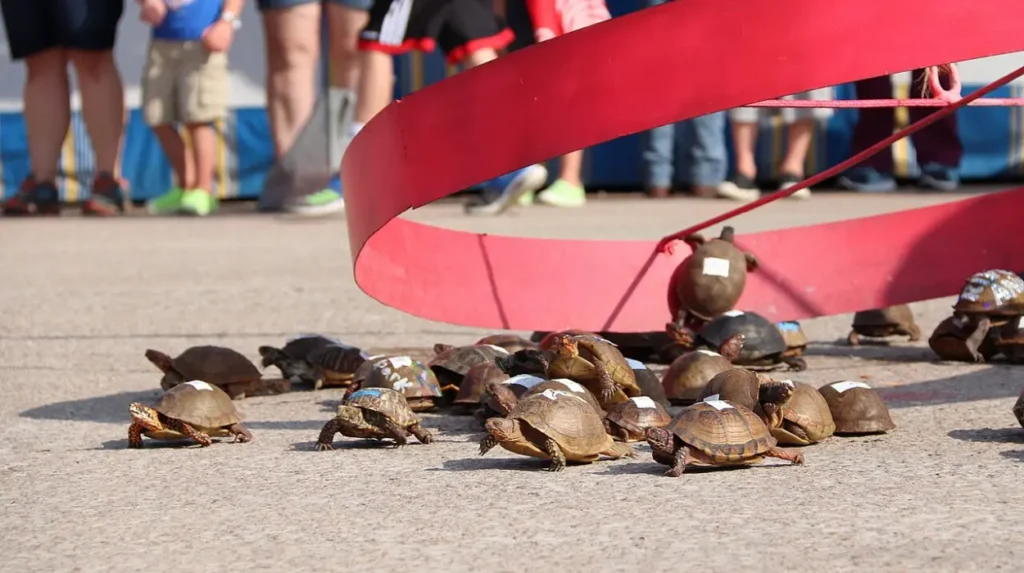
The Annual Tortoise Race, as a formal event, has a surprisingly recent and practical origin. Each Trinity According to local tradition recorded by eyewitnesses, the race was initiated by a student named Steve Brand, who decided to raise money for RAG Raising and Giving by organising a tortoise race in the college grounds. What began as a spontaneous and good-humoured fundraising idea has grown steadily over the decades into one of Oxford’s most anticipated public events.
Attendance has swelled from 80 in 2007 to more than 400 in 2009, and over 1,500 in 2016. The 2024 edition, which marked the event’s 50th anniversary, was a particular milestone. The Tortoise Fair 2024 celebrated its 50th anniversary of this Oxford tradition, raising over £4,500 for the charity Papyrus. On other occasions, the proceeds have been even more substantial: during the 2022 edition, the event raised over £7,000 for the DEC Ukraine Humanitarian Appeal, that year’s charity of choice.
The charity recipient is not chosen by committee diktat but by democratic vote. The charity is selected by the Corpus Christi JCR, or Junior Common Room, in a vote. In the past, the proceeds have gone to charities such as the Disasters Emergency Committee Ukraine Humanitarian Appeal and Papyrus UK Suicide Prevention. This democratic, student-led process reflects Oxford’s broader collegiate culture of self-governance and social responsibility.
How the Tortoise Race Works: Rules, Rituals and Reptiles
The mechanics of the race are, appropriately, both simple and delightfully absurd. The racers and their attendants assemble in the centre of a hastily formed large circle of lettuce, facing outwards with the aim of racing from the middle to the edge, and the fastest reptile takes the prize. Saddleworth Rushcart Lettuce, it turns out, is both the starting arena and the finish line, an inspired piece of logistical thinking that exploits the tortoise’s natural appetite as its motivational engine.
The race takes place on a fixed point in the academic calendar. The fair and its races take place on the 6th Sunday of the Trinity Term. Trinity Term runs from late April through to late June, meaning the Tortoise Fair typically falls in late May, when Oxford is at its most atmospheric, with warm afternoons, college gardens in full bloom, and the distant sound of punts on the Cherwell.
Each competing college sends its tortoise along with a student Tortoise Keeper. Several Oxford colleges have a pet tortoise, and each one is designated a student to act as its keeper and to care for it. This role is taken with a mixture of earnestness and ironic solemnity that is quintessentially Oxford. The tortoises themselves are announced to the crowd by a compère who reads out increasingly embellished biographies for each competitor a tradition that has produced some memorably creative introductions over the years.
Not all tortoises are equal in motivation, and the results have occasionally been surprising. A race can last anywhere from a few breathless minutes to a considerably longer stretch, depending on how interested the competitors are in the lettuce on offer. Cold or overcast weather poses a particular challenge, since tortoises are ectotherms; they cannot regulate their own body temperature and may simply decide to remain motionless if the conditions are not sufficiently warm.
The Human Tortoise: When Colleges Get Creative
Not every college has maintained the tradition of keeping a live tortoise. Some have discontinued the practice on animal welfare grounds, raising questions about housing, diet, hibernation management, and general reptile care in an academic environment. However, this has not prevented those colleges from participating in the spirit of the event.
Magdalen College, for example, appointed a student as a human tortoise. This person, titled Oscar d’Tortoise, participates in the races every year. OxfordVisit The role comes with a charming institutional obligation: Oscar d’Tortoise is required to eat lettuce during college meetings, and is even allocated a small budget for this purpose.
In 2022, four human tortoises represented Balliol, Univ, St Hilda’s and Christ Church — all dressed from head to toe in impressively constructed tortoise costumes. They were challenged to a competition of both speed and lettuce-eating skills, which ended with each of them racing to finish a head of iceberg lettuce. In 2024, following rain that drove the event indoors, a human tortoise race was held after the main reptilian competition, adding an extra layer of entertainment to proceedings.
The Fair Itself: More Than Just a Race
While the Tortoise Race is undoubtedly the centrepiece, the Corpus Christi Tortoise Fair has evolved into a full afternoon of entertainment. The Corpus Christi fair has a great selection of entertainment, and all money raised goes towards a charitable cause.
Over the years, the fair has featured folk dancing, live music from college bands, the Oxford University Morris Men, flamenco guitar performances, barbecues, face painting, sponge-the-JCR stalls, and even an alcoholic apple dunking competition. The Tortoise Fair is an event which truly embodies the spirit of the small and friendly college. Corpus Christi Student bands perform in the lead-up to the race, and the atmosphere resembles a village fête that has somehow wandered into one of the most academically distinguished institutions on the planet.
The 2024 event saw performances by several groups, including Oxford Comma, Doubletime, Dots Funk Odyssey, and We Should Sleep More — a snapshot of Oxford’s rich student musical culture. The race was held in the auditorium due to poor weather conditions, and it was quickly filled. The rain did not deter people from watching the tortoises race, and some attendees stood outside.
There is a betting stand at the fair, where visitors can place informal wagers on their preferred competitor, adding a touch of racing culture to the proceedings. The combination of charity, community, music, and reptilian athleticism makes the Tortoise Fair genuinely unique among British public events.
Notable Moments and Tortoise Legends
Like any long-running sporting event, the Tortoise Race has its share of lore and legend. One of the most dramatic incidents concerns a Balliol College tortoise named Rosa, described in accounts as a former race winner of some renown who was kidnapped the night before a race in the early 2000s and was never seen again. Trinity College was alleged to have been involved, though nothing was ever formally proven.
Corpus Christi’s own tortoises have carried politically charged names over the years, reflecting the college’s former reputation for radical student politics. Their most celebrated tortoise was named Rosa Luxemburg, after the German Marxist theoretician, and the student entrusted with her care held the title “Comrade Tortoise.” Rosa Luxemburg reportedly went missing in 2004, bringing a politically resonant chapter of college history to an inconclusive end.
Foxe, Corpus Christi’s current resident tortoise, is named after the college’s founder, Bishop Richard Foxe. Foxe is an 82-year-old college tortoise, celebrated each year at the Tortoise Fair in the form of a summer fair that raises money for a selected charity. University of Oxford. At such an age, Foxe has outlived countless generations of students, Tortoise Keepers, and JCR presidents, making him something of a living institution in his own right.
The Wider Cultural Significance of the Tortoise Race
It would be easy to dismiss the Tortoise Race as mere undergraduate whimsy, but to do so would miss something important. Oxford is a place that takes its traditions seriously, even perhaps especially the absurd ones. Ritual and ceremony at Oxford perform a social function: they build community, mark the passage of time, and provide a shared cultural language for students who arrive from vastly different backgrounds.
The Tortoise Race is also, at its core, a charitable enterprise. Since 1974, the event has raised thousands of pounds for causes ranging from humanitarian disaster relief to mental health charities. It brings the public into the normally private world of a college; the gates of Corpus Christi open on this one afternoon to welcome families, tourists, and Oxford residents who would not otherwise have occasion to step into a college garden.
There is, too, a certain philosophical poetry in the event. The tortoise, slow, deliberate, ancient, is the perfect mascot for an institution that prizes depth of thought over speed of production. Aesop’s fable of the tortoise and the hare is a story about patience and persistence winning over flash and haste. Placing that symbol at the heart of an Oxford tradition feels, on reflection, entirely appropriate.
The race also reflects something about how British academic culture absorbs and celebrates eccentricity. Where other institutions might be embarrassed by the image of professors cheering for a tortoise inching towards a lettuce leaf, Oxford leans into it. The self-aware absurdity is part of the point.
How to Attend the Tortoise Race
For visitors planning a trip to Oxford, the Tortoise Fair is one of the most accessible and enjoyable public events the university offers. The event is held at Corpus Christi College on Merton Street, a short walk from the High Street and easily reachable on foot from Oxford city centre.
Admission is open to the public, and the fair is free to attend (though donations are welcome and stall purchases benefit the charity). Visitors are encouraged to arrive early, as the garden fills quickly in good weather. The race itself is typically held at 3 pm, announced by the striking of the Merton bells. Refreshments, live music, and activities keep the afternoon lively both before and after the main event.
Corpus Christi College can be found between Merton College and Christ Church on Merton Street. It is one of the few Oxford colleges that opens its doors so warmly to the general public, and the Tortoise Fair is the finest single occasion to experience the more playful, human side of one of the world’s great universities.
The Annual Tortoise Race at Corpus Christi is more than a curiosity. It is a living tradition born of charitable instinct, sustained by community, and seasoned over fifty years into something genuinely loved. In a world that prizes speed above almost everything else, there is something quietly radical about gathering to celebrate the deliberate, unhurried progress of a tortoise toward a circle of lettuce.
What started as a desperate and quick idea to raise money for RAG in the 1970s has now developed into something deeper and more meaningful than most would expect. Corpusjcr It connects the present to the past, the student to the institution, and the university to the city it inhabits. It raises money for those in need. And it reminds everyone who attends that some of the best things in life are also, at first glance, the most ridiculous.
For Oxford visitors, students, and anyone with an appreciation for the gloriously peculiar, the Corpus Christi Tortoise Race is not to be missed.
What did a tortoise evolve from?
Tortoises evolved from ancient reptilian ancestors over 200 million years ago, predating even the dinosaurs. Modern tortoises belong to the order Testudines, which shares evolutionary roots with early amniotes, land-dwelling vertebrates that developed hard-shelled eggs.
What is Aesop’s most famous fable?
Aesop’s most celebrated fable is The Tortoise and the Hare, in which a slow but steady tortoise defeats a swift but overconfident hare. The story has endured for over 2,500 years as a timeless lesson in persistence, humility, and the dangers of complacency.
Is it illegal to sell antique tortoise shell in the UK?
Under the UK’s Control of Trade in Endangered Species (COTES) Regulations, selling tortoise shell is generally prohibited, as most tortoise species are protected under CITES. However, certified antique items predating 1947 may qualify for an exemption, subject to strict documentation and proof of age.
What animal can live 10,000 years?
No animal is currently documented to live 10,000 years, though the ocean quahog clam (Arctica islandica) holds the verified record at over 500 years. The immortal jellyfish (Turritopsis dohrnii) is theoretically biologically immortal, capable of reverting to its juvenile state indefinitely under the right conditions.
What do the tortoise and the hare symbolize?
The tortoise and the hare symbolise the enduring virtues of patience, consistency, and determination over raw speed and arrogance. In the context of Oxford’s Tortoise Race, the fable takes on a gently ironic meaning, slow, deliberate progress is celebrated at one of the world’s most intellectually rigorous institutions.