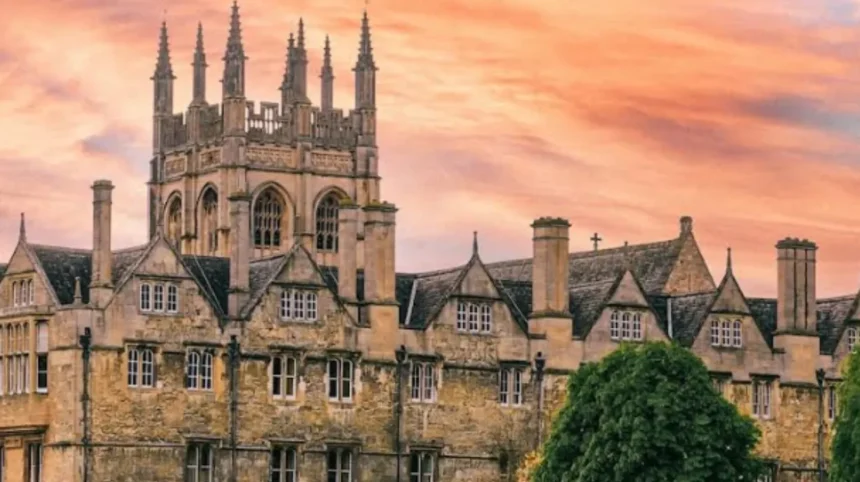
The skyline of Oxford is famously defined by its “dreaming spires,” a silhouette dominated by the majestic domes of the Radcliffe Camera, the gothic peaks of Magdalen College, and the sturdy remains of the Norman castle. However, tucked away beneath the grandeur of these academic monuments lies a more humble, yet equally profound, architectural heritage. Oxford’s medieval almshouses represent a specialized chapter of the city’s history, serving as a physical manifestation of communal care, religious devotion, and the evolution of social welfare. Unlike the colleges, which were built to sharpen the mind, these almshouses were built to provide sanctuary for the body and soul of the city’s most vulnerable residents.
- The Theological Foundation of Medieval Charity
- Ewelme: The Quintessential Medieval Sanctuary
- St. Bartholomew’s: The Leper Chapel and the Outskirts of Mercy
- Christ Church and the Wolsey Almshouses
- The Social Hierarchy of the Almsman
- Architecture as a Statement of Stability
- The Impact of the Reformation and Beyond
- Exploring the Hidden Map of Oxford’s Charity
- The Relevance of Medieval Almshouses in the 21st Century
- Preserving the Silent Stones
To understand the medieval almshouse is to understand the medieval mind. In an era before the modern welfare state or the Elizabethan Poor Laws, charity was not merely a social obligation but a theological necessity. The wealthy merchants, clerics, and nobles of Oxford established these “houses of God” (often termed Maisons Dieu) as a means of securing their own spiritual salvation while providing for the “deserving poor.” Today, these sites remain as some of the city’s most evocative hidden gems, offering a window into a world where the boundaries between domestic life, religious duty, and civic responsibility were inextricably linked.
The Theological Foundation of Medieval Charity
The concept of the almshouse flourished in Oxford during the 14th and 15th centuries, driven by the Catholic doctrine of the “Seven Corporal Works of Mercy.” Providing shelter for the traveler and clothing for the naked were central tenets of medieval life. In the shadow of the Black Death, which ravaged the city’s population multiple times, the impulse to provide for the elderly and infirm became more urgent. These institutions were more than just housing; they were chantry foundations where the residents, known as almsmen or almswomen, were often required to pray daily for the souls of their benefactors.
Oxford’s position as a center of learning meant that many of these foundations were inextricably linked to the University. The scholars and masters who shaped the academic world were often the same individuals who drafted the statutes for these charitable houses. This intersection created a unique social fabric where the highest levels of intellectual pursuit existed alongside the most basic forms of human survival. The architecture reflected this duality, often mimicking the cloistered, communal layouts of the colleges but on a more intimate, domestic scale.
Ewelme: The Quintessential Medieval Sanctuary
While many medieval structures within the city center have been subsumed by the expansion of college campuses, a short journey to the outskirts of Oxford’s historic influence brings one to the Almshouses of Ewelme. Established in 1437 by William de la Pole, the Duke of Suffolk, and his wife Alice Chaucer (the granddaughter of the poet Geoffrey Chaucer), Ewelme represents the pinnacle of 15th-century charitable architecture. The complex includes a church, a school, and the almshouses themselves, forming a “God’s House” that has remained in continuous use for nearly six centuries.
The layout of Ewelme is a masterclass in medieval planning. The thirteen almsmen were housed around a stunning timber-framed cloister, a design that provided both privacy and a sense of shared community. The use of brick, which was a luxury material in the 1430s, signals the high status of the foundation. The statutes dictated by Alice Chaucer were remarkably detailed, covering everything from the conduct of the residents to the frequency of their prayers. This site remains one of the most significant examples of a medieval charitable trust in England, demonstrating how the elite of Oxford’s surrounding shires sought to leave an eternal mark through the care of the impoverished.
St. Bartholomew’s: The Leper Chapel and the Outskirts of Mercy
Closer to the city’s heart, though often overlooked by the modern tourist, is the site of St. Bartholomew’s Hospital. Established in the early 12th century by King Henry I, this hospital was originally intended for the care of lepers. In the medieval period, leprosy was viewed with a complex mixture of fear and religious awe; lepers were often seen as “living martyrs” who were undergoing their purgatory on earth. Consequently, the almshouse at St. Bartholomew’s was located outside the city walls, near what is now the Cowley Road, to provide both isolation and a spiritual gateway to the city.
The history of St. Bartholomew’s highlights the shifting tides of Oxford’s institutional power. In 1329, King Edward III granted the hospital to Oriel College. This transition from a royal foundation to a collegiate one ensured the survival of the site but also changed its character. The original medieval chapel still stands today, a rare survival of 14th-century ecclesiastical architecture in a domestic setting. The chapel’s simple, rugged stone walls contrast sharply with the ornate college chapels of the city center, reminding visitors of the site’s more somber origins as a place of healing and exclusion.
Christ Church and the Wolsey Almshouses
One of the most visible yet misunderstood medieval charitable sites in Oxford is the range of buildings associated with Christ Church, specifically those along St. Aldate’s. Known as the Wolsey Almshouses, these structures were begun by Cardinal Thomas Wolsey in the early 16th century as part of his ambitious plan for Cardinal College (now Christ Church). Although the Reformation interrupted Wolsey’s grand vision, the almshouses were eventually completed and became home to “beadsmen”—veteran soldiers or servants who were supported by the college’s endowments.
The architecture of the Wolsey Almshouses bridges the gap between the late Middle Ages and the early Tudor period. The stone carvings and the proportions of the windows reflect the transition from the Perpendicular Gothic style to a more domestic Tudor aesthetic. These buildings served as a physical buffer between the town and the gown, located just outside the main gate of the college. They represent the continuing tradition of the University taking responsibility for the local poor, a practice that helped mitigate the tensions between the wealthy academic institution and the surrounding city residents.
The Social Hierarchy of the Almsman
Life within an Oxford medieval almshouse was governed by strict discipline. To be an “almsman” was to hold a position of both privilege and restriction. Unlike the “vagrant poor” who were often punished under medieval law, the residents of these houses were the “deserving poor”—individuals who had fallen into poverty through no fault of their own, such as old age, illness, or the loss of a provider. In exchange for a roof over their heads, a small weekly stipend (often a few pence), and a livery of clothes, the residents were expected to live a life of quasi-monastic devotion.
Statutes often forbade residents from frequenting alehouses or engaging in “unseemly behavior.” For many, the almshouse was a significant upgrade from the squalor of the city’s tenements. The rooms were usually small but well-built, often featuring a fireplace—a true luxury in the 15th century. The communal dining halls and shared gardens fostered a sense of belonging. However, the requirement to pray for the founder’s soul multiple times a day served as a constant reminder that their survival was a gift from a social superior.
Architecture as a Statement of Stability
The physical design of Oxford’s almshouses was never accidental. The use of local Headington stone or Cotswold limestone provided a sense of permanence and gravitas. Builders often employed a “quadrangle” or “U-shaped” layout, which created a protected internal courtyard. This design was not only practical for defense and climate control but also symbolic; it enclosed the residents in a sacred space, separated from the chaos of the medieval market streets.
The doors were often low, and the windows narrow, reflecting a need for warmth in an age before modern insulation. Yet, the craftsmanship found in the roof timbers and the stone dressings often rivaled that of the colleges. By building these houses to a high standard, the patrons were signaling their own piety and the importance they placed on the act of charity. These buildings were intended to last forever, standing as a permanent testament to the benefactor’s mercy until the Day of Judgment.
The Impact of the Reformation and Beyond
The 16th-century Reformation posed a significant threat to the almshouses of Oxford. Because many were founded as chantry institutions where prayers for the dead were central, they fell under the scrutiny of the Crown’s commissioners. Many smaller foundations were dissolved, and their assets seized. However, the most significant Oxford almshouses survived by rebranding themselves. The emphasis shifted from “praying for souls” to “providing for the common weal.”
During the Elizabethan and Jacobean eras, new almshouses were founded in and around Oxford, such as those in Abingdon and Witney, which followed the medieval architectural precedent but with a more secular, civic focus. The medieval foundations that remained within Oxford became part of the city’s institutional furniture, often managed by city guilds or college boards. This continuity is why Oxford remains one of the best places in the United Kingdom to study the evolution of charitable housing; the city’s conservative approach to its built environment has protected these structures from the wholesale redevelopment seen in other industrial cities.
Exploring the Hidden Map of Oxford’s Charity
For the modern explorer, finding these medieval almshouses requires a keen eye and a departure from the main tourist arteries. Beyond the well-known sites like Ewelme or the Wolsey range, one can find traces of medieval charity in the names of streets and the footprints of older buildings. Sites like the Stone’s Almshouses on St. Clements, though rebuilt in the 18th century, sit on foundations of much older charitable intent.
Walking through these sites today, one is struck by the silence. While the rest of Oxford buzzes with the energy of students and global tourism, the almshouses maintain an air of contemplative stillness. They are reminders that the history of Oxford is not just a history of elite education, but a history of human vulnerability and the enduring effort to address it with dignity.
The Relevance of Medieval Almshouses in the 21st Century

The study of Oxford’s medieval almshouses is more than an exercise in architectural history or nostalgia. In an era where modern cities grapple with housing crises and the isolation of the elderly, these medieval models of “sheltered housing” offer surprisingly modern insights. The concept of small, manageable units arranged around a communal green, with a central hub for social or spiritual gathering, is a template that many modern urban planners are revisiting.
Furthermore, these institutions represent the longevity of Oxford’s charitable trusts. Many of the medieval endowments, though modernized and adjusted for inflation, still fund the maintenance of these buildings and the care of their residents today. It is a rare example of a social contract that has remained unbroken for over half a millennium. The stones of Oxford’s almshouses do more than just hold up roofs; they hold up a tradition of community care that has outlasted dynasties, wars, and religious revolutions.
Preserving the Silent Stones
As we look to the future, the preservation of these hidden medieval gems is paramount. The challenges of maintaining 15th-century timber and stone in a modern environmental context are significant. However, the Oxford Preservation Trust and various college bodies continue to prioritize these structures, recognizing them as essential components of the city’s character.
For the resident of Oxford or the visitor looking for a deeper connection to the past, the almshouses serve as a poignant counter-narrative to the city’s academic grandiosity. They tell the story of the cook, the laundress, the veteran, and the widow. They remind us that the “Oxford Daily” experience for many throughout history was not one of lecture halls and examinations, but of seeking a quiet corner of mercy in a shifting world. By visiting and supporting these sites, we honor a legacy of compassion that is as much a part of Oxford’s identity as its famous university.
The hidden medieval almshouses of Oxford stand as quiet sentinels of history. They are the physical remnants of a time when the city wall was a barrier against the unknown, and the almshouse gate was a threshold to security. In their enduring presence, they continue to teach us that the true measure of a great city is not just how it educates its leaders, but how it cares for its most humble citizens.
Who qualifies to live in almshouses?
Historically, almshouses were reserved for the “deserving poor,” typically elderly or infirm residents of a specific parish who were no longer able to work. Today, qualification usually requires applicants to be over a certain age, have limited financial means, and have a long-standing local connection to the Oxford area or a specific trade.
What was a poor person called in medieval times?
In a legal and social context, a poor person was often referred to as a “pauper” or “indigent.” Within the specific setting of Oxford’s Hidden Medieval Almshouses: A Journey Into Charity, they were frequently called “almsmen” or “beadsmen,” signifying their role in praying for their benefactors.
What was a girlfriend called in medieval times?
While modern dating terms didn’t exist, a woman being courted might be called a “sweetheart” or “lemman,” though the latter’s meaning shifted from “beloved” to something more illicit over time. In formal courtly literature, she might be referred to as “my lady” or “mistress.”
Can you visit the Oxford University Press?
The Oxford University Press (OUP) building on Walton Street is a private working office and is generally not open for public tours. However, visitors can explore the Oxford University Press Museum by appointment, which showcases the history of printing and the development of the famous dictionary.
What is the difference between Oxford University and Oxford University Press?
Oxford University is a world-leading research and teaching institution comprised of various colleges and departments. The Oxford University Press is the university’s massive publishing arm; it is a department of the university that furthers its objective of excellence in research, scholarship, and education through global publication.