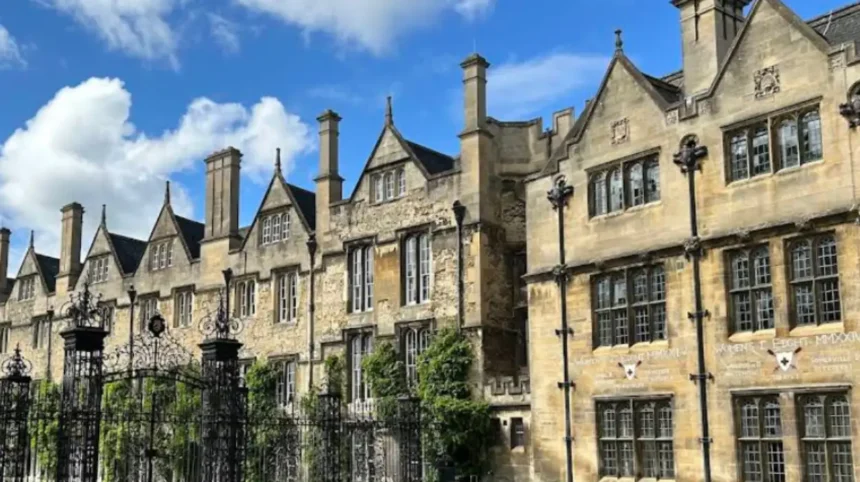
Merton College’s Mob Quad stands as a timeless testament to medieval ingenuity in Oxford. Built primarily in the late 13th and 14th centuries, this quadrangle not only shaped the architectural blueprint for universities worldwide but also embodies the scholarly pursuits of its era.
Origins of Merton College
Merton College, formally known as the House of Scholars of Merton, traces its founding to 1264 when Walter de Merton, Bishop of Rochester, established it through a deed of endowment. This visionary act created one of Oxford’s earliest self-governing academic communities, emphasizing communal living and intellectual rigor long before the university’s formal structures solidified. De Merton’s statutes introduced the collegiate model—scholars residing together in ordered halls—which influenced institutions across England and beyond.
The college’s early growth stemmed from de Merton’s acquisition of properties in Surrey and Oxford, funding expansions that prioritized education over monastic isolation. By the late 13th century, Merton had amassed sufficient resources to embark on ambitious building projects, reflecting the era’s blend of piety, patronage, and scholastic ambition. These foundations directly paved the way for the Mob Quad’s emergence as the college’s architectural crown jewel.
Construction Timeline
Mob Quad’s development unfolded in deliberate phases, beginning around 1288 and culminating in the 1370s, firmly rooting it in 14th-century medieval design. The initial northern and eastern ranges rose between 1288 and 1291, transforming what were once back gardens of de Merton’s original three houses into enclosed scholarly spaces. Subsequent western and southern additions from 1304 to 1311 expanded the layout, creating a cohesive four-sided enclosure.
The capstone arrived with the library’s construction from 1373 to 1378 atop the north range, funded by donations and overseen by college fellows. Notably absent are chimneys, a deliberate omission as central heating via hypocaust systems or open fires sufficed in that pre-fireplace epoch. This phased build exemplifies meticulous medieval planning, adapting to financial inflows while adhering to the quadrangle’s geometric purity.
Though often hailed as Oxford’s oldest quadrangle, Merton’s own Front Quad likely enclosed earlier in a less uniform style, while Corpus Christi College, Cambridge, claims a rival in its Old Court from circa 1353–1377. Regardless, Mob Quad’s unified 14th-century fabric remains unparalleled in its influence.
Architectural Features
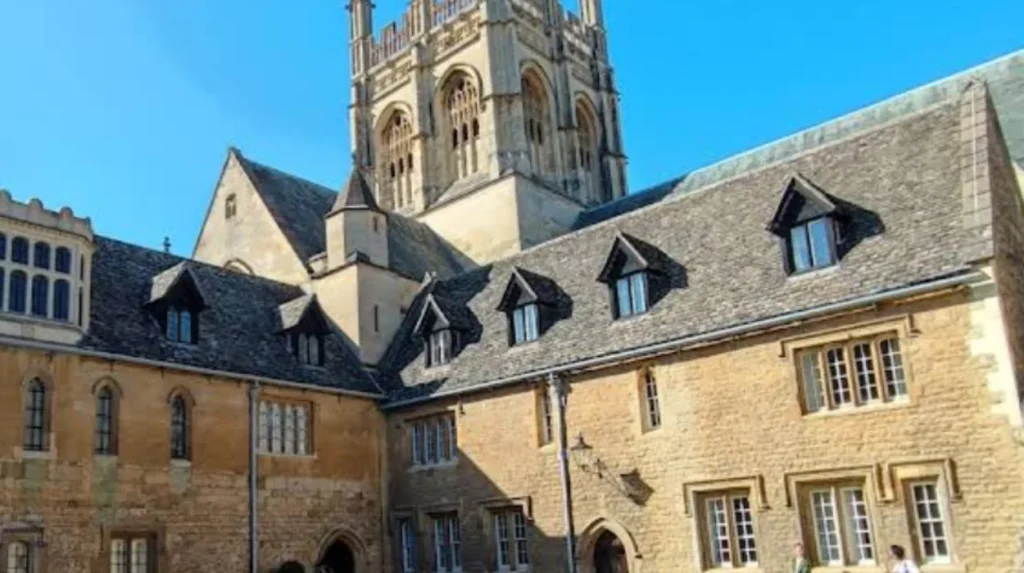
Mob Quad’s design revolves around a compact lawn encircled by two-story buildings of squared local stone, featuring steep gabled roofs and expansive windows that flood interiors with light. The architecture adheres to Early English Gothic principles, with pointed arches, ribbed vaults, and minimal ornamentation prioritizing functionality for student lodgings above ostentation. Ground-floor rooms once served as studies or refectories, while upper chambers housed sleeping quarters for undergraduates known as “mobbists.”
The library, perched above the chapel range, boasts original 14th-century roof timbers and desks chained to prevent book theft—a pioneering feature in English academic libraries. Its transformation into the college bar in modern times underscores adaptive reuse without compromising heritage. Intricate bossed ceilings and traceried windows further elevate the space, evoking the era’s craftsmanship.
Absences define the quad as much as presences: no central fountain or cloister walk disrupts the lawn’s serenity, contrasting later Oxford quads like those at Magdalen or St John’s. This austerity reflects Mertonian values of scholarly seclusion over display.
This serene lawn at the heart of Mob Quad invites reflection, much as it did for medieval scholars pacing its edges in contemplation.
Historical Significance
Mob Quad pioneered the quadrangle as the quintessential Oxbridge form, disseminating its template via masons who carried skills to Cambridge and continental universities. By enclosing scholars within protective walls, it fostered the collegiate ethos—combining residence, tuition, and worship—that distinguishes Oxford from looser medieval studium generale models. Its survival intact through plagues, civil wars, and reforms cements its status as a living archive.
During the English Civil War, Merton fellows sheltered royalist artifacts here, while the 14th-century library safeguarded illuminated manuscripts amid Black Death disruptions. Alumni like T.S. Eliot and Nobel laureates later drew inspiration from its hallowed grounds, linking medieval origins to modern intellect. The quad’s role in standardizing college layouts rippled globally, influencing Ivy League designs and beyond.
Daily Life in the 14th Century
In the 1300s, Mob Quad buzzed with the routines of probationer fellows and commoners, rising at dawn for chapel prayers in the adjacent 13th-century nave. Meals in communal halls emphasized frugality—bread, ale, and pottage—enforcing de Merton’s statutes against luxury. Students dissected Aristotle by candlelight in cramped solar studies, debating theology and natural philosophy amid the scent of beeswax and vellum.
Discipline was strict: latrines flanked the ranges, and bells regulated hours from matins to compline. The absence of private fires meant huddling around braziers, fostering camaraderie essential for the oral tradition of learning. Women were barred, and servants minimal, immersing youth in a monastic-academic hybrid that forged resilient minds.
Winters tested resolve, with frost glazing flagstones and quill hands numbed, yet this austerity honed the stoicism of figures like philosopher Duns Scotus, a Merton contemporary. Such immersion in structured privation distinguished Merton’s training from looser hall universities.
Legends and Nicknames
The “Mob” moniker arose in the 18th century, possibly from “mobbles,” slang for junior scholars crowding the quad like a disorderly throng, or a corruption of “Monks’ Quad” owing to early clerical residents. Folklore whispers of ghosts: a spectral monk gliding library stacks or Civil War soldiers haunting corners, though rational accounts attribute sightings to fog off the Cherwell. These tales enhance the quad’s mystique without diminishing its factual grandeur.
Pseudohistories claim alchemical experiments in cellars or hidden de Merton treasures, but records affirm practical scholarship over sorcery. Such narratives, perpetuated by tour guides, blend fact with fancy, captivating visitors drawn to Oxford’s storied aura.
Preservation Efforts
Merton’s governing body, advised by English Heritage, maintains Mob Quad through rigorous conservation, employing lime mortar repointing and oak frame repairs to honor original techniques. Post-1945 restorations addressed Victorian overzealousness, while 21st-century surveys employ laser scanning for monitoring. Access restrictions during term preserve tranquility for residents, balancing tourism with sanctity.
Climate challenges like rising damp prompt innovative interventions, such as breathable renders, ensuring the quad weathers 21st-century pressures. Collaborations with Oxford’s Historic Buildings Fund underscore institutional commitment to this UNESCO-recognized cultural cornerstone.
Visiting Mob Quad Today
Public access to Mob Quad operates via guided college tours or open days, typically weekends outside term time, revealing its lawn carpeted in crocus come spring. Proximity to Christ Church Meadows offers contextual walks, while the Porter’s Lodge provides maps. Photographers cherish dawn light gilding stonework, and audio guides narrate via apps for self-paced immersion.
Nearby, Merton’s chapel hosts evensong, extending the quad’s spiritual legacy. Families appreciate the site’s calm amid Oxford’s bustle, with benches inviting picnics under watchful gargoyles. Advance booking via the college website mitigates crowds, ensuring intimate encounters.
Mob Quad’s enduring allure draws those seeking Oxford’s medieval soul, framed by its unyielding stone against contemporary skies.
Influence on Oxford Architecture

Mob Quad’s blueprint permeated Oxford: Queen’s Lane neighbors echo its scale, while later quads at New College amplified grandeur yet retained enclosure logic. This diffusion standardized the “college” as a fortified intellectual village, contrasting continental open faculties. Its legacy endures in zoning laws preserving Oxford’s medieval skyline.
Globally, Harvard’s yards and Yale’s courts homage this form, adapting stone to brick while preserving communal spirit. Merton’s innovation thus transcends locality, embedding quadrangular living in higher education’s DNA.
Cultural Depictions
Literature immortalizes Mob Quad: Evelyn Waugh’s Brideshead Revisited evokes its seclusion, while Philip Pullman’s His Dark Materials stages scholarly intrigue amid analogous quads. Films like Young Winston capture Oxford’s honeyed stone, with Merton’s stands in for timeless academia. Modern media, from Instagram reels to virtual tours, democratize its allure.
Artistic renderings by Turner and Piper romanticize its twilight moods, archived in Ashmolean collections. These portrayals sustain public fascination, positioning Mob Quad as Oxford’s visual synecdoche.
Scholarly Legacy
Generations of luminaries—Maximus Planudes translating Greek texts here, J.R.R. Tolkien mythologizing in fellows’ rooms—affirm Mob Quad’s intellectual fertility. Its library, once chaining Homer, now inspires via subtle presence. This continuum from 14th-century disputations to quantum debates underscores architecture’s role in nurturing genius.
Today’s residents, pondering climate models or AI ethics in historic surrounds, perpetuate de Merton’s vision amid electric hum. Mob Quad thus bridges epochs, a stone-bound witness to humanity’s quest for understanding.
What is Merton College famous for?
Merton College is renowned for its 14th-century Mob Quad, Oxford’s oldest complete quadrangle, and its pioneering collegiate model established by Walter de Merton in 1264. This architectural marvel symbolizes medieval scholarship, influencing university designs worldwide.
Did Merton College win a Nobel Prize?
Yes, Merton alumni include multiple Nobel laureates, such as physicist Max Born and chemist Cyril Hinshelwood, highlighting the college’s enduring intellectual legacy. Their achievements span physics, chemistry, and economics.
Did Tolkien go to Merton College?
Yes, J.R.R. Tolkien was a professor at Merton College from 1945 to 1959, where he refined works like The Lord of the Rings in its historic rooms. The college’s medieval ambiance inspired his mythic storytelling.
What is the most elite college in Oxford?
Elite status varies by metrics like academic prestige and alumni influence, but Merton ranks among the top “old members” colleges alongside Magdalen and St John’s for its storied history and selectivity. Perceptions often tie to wealth and Nobel output rather than a single leader.
What is the hardest college to get into at Oxford?
Merton College consistently ranks among Oxford’s most competitive, with acceptance rates around 5-7% due to its rigorous academic standards and limited spots. Popularity for humanities and sciences drives intense competition annually.