Few places in Britain blend sport, pageantry, and history as effortlessly as the River Thames at Oxford. Here, the quiet surface of the river is often broken by the rhythm of oars and the chatter of college crews, but the story also lives in the ornate floating buildings that line the banksb Oxford’s college barges. Known locally as “beer barges” or simply “college barges,” these river‑borne structures are more than quirky boathouses; they are living monuments to the city’s rowing heritage and collegiate identity. For the Oxford audience, this is a narrative that ties together centuries of sporting rivalry, architectural whimsy, and the enduring charm of life on the Isis.
- What Are College Barges?
- Origins in the Victorian Rowing Boom
- The Henley Connection and “Barge Life”
- Types of Oxford College Barges
- The Corpus Christi Barge: A Living Example
- The Role of Barges in Bumps and Regattas
- Decline and Preservation of the Barges
- The Aesthetic and Social Impact on Oxford Life
- Why College Barge Traditions Remain Relevant
- Final Thoughts for the Oxford Reader
What Are College Barges?
College barges are moored, houseboat-like vessels that function as boathouses, changing rooms, and viewing platforms for rowers and spectators. Unlike the modest, functional sheds one might expect at a modern sports club, many Oxford college barges boast elaborate wooden facades, carved pilasters, arched windows, and flagpoles, giving them the appearance of floating pavilions rather than utilities. They sit along the Thames (known as the Isis through Oxford) in front of the college boating stations, often nestled in backwaters or along the meadow‑side, where they have become part of the riverscape’s visual grammar.
Historically, these barges were not built from scratch in Oxford; instead, they were purchased from London livery companies, whose ceremonial barges had fallen out of fashion for City pageantry by the early 19th century. These ornate vessels, originally designed for grand processions on the Thames, were towed upriver by horses and pressed into service as changing rooms and social spaces for rowers. For Oxford, this was a pragmatic yet picturesque solution: a way to bring the dignity of livery‑barge architecture into the growing world of college rowing.
Origins in the Victorian Rowing Boom
The story of college barges cannot be told without placing them in the wider rise of Victorian rowing culture. In the early 1800s, rowing at Oxford was still a relatively informal pursuit, with students rowing recreationally to inns and back along the river. Yet by the mid‑19th century, physical exercise and organized sport had become more fashionable, and regattas began to take on the character of festival‑like events.
The founding of the Oxford University Boat Club in 1839 and the launch of the Henley Royal Regatta in 1839 marked turning points: rowing was no longer just a pastime but a codified sport with spectators, clubs, and infrastructure. Barges fit this new landscape perfectly. They served as both functional spaces for rowers to change, store gear, and socialize, and as grand stages for college supporters to watch racing from the water’s edge in comfort.
Colleges that owned their own barges treated them as extensions of their institutional identity, often decorating them with college coats of arms, pennants, and liveries. In this way, the barge became a mobile emblem of college pride, floating before the stone façades of the colleges themselves and carrying that identity out onto the river.
The Henley Connection and “Barge Life”
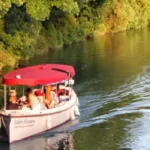
The Oxford college barges truly came into their own during the Henley era. Each year, colleges that owned barges would set up special “Henley Funds” to finance the tow downriver to the regatta, where their boats would compete in front of large crowds. The barge was central to the college’s Henley presence: it was towed to the event, often decorated with flowers, and outfitted with lobster, strawberries, cream, and other refreshments for guests.
For supporters, the experience of being on a college barge at Henley was as much about spectacle as sport. Admission tickets were sometimes printed for “the top of the barge,” since the upper deck offered unrivaled views of the racing. These occasions blended pageantry, sociability, and competitive spirit, reinforcing the idea that rowing at Oxford was not merely a physical contest but a social ritual bound up with college life.
Even when not at Henley, the barges hosted less formal “barge life”: informal gatherings, celebrations after races, and quiet evenings with friends watching the river. For many students, the barge became a second home—a place where the intensity of rowing practice met the relaxed atmosphere of riverside leisure. This dual role—as both sporting facility and social venue—helped secure the barge’s place in Oxford’s collective memory.
Types of Oxford College Barges
Although all Oxford college barges share a common purpose, they are far from uniform. Broadly, they fall into two categories: the original Livery Company barges of the 19th century and the later, purpose‑built barges that appeared in the 20th century.
The early barges, brought from London, tend to be larger and more ornate, with Gothic‑inspired details, carved railings, and sometimes even chimneys and decorative windows. These structures were designed to catch the eye, and their theatrical appearance made them ideal for the increasingly showy culture of Victorian rowing. In contrast, the later barges—such as the 1930 Corpus Christi barge, constructed by Salters’ Steamers—retain elegance but are more streamlined and built specifically for the practical needs of rowing clubs.
Another distinction lies in how barges are moored and used. Some barges remain in front of major college boathouses along the loop of the Isis through Christ Church Meadow, while others are tucked into quieter backwaters or side channels. These quieter locations lend the barges an almost secretive charm, visible mainly to those who walk the towpath or follow the lesser‑known river arms.
The Corpus Christi Barge: A Living Example
Among the remaining Oxford college barges, the Corpus Christi barge stands out as both a practical riverside structure and a local icon. Moored along the east bank of the Isis, it sits in Kidney Stream, an old cut linking the Thames to the Cherwell, just before Donnington Bridge. To regular walkers, the barge is a distinctive feature: its curved prow, flagpole, and whitewashed wooden cabin with oval windows give it the air of a storybook vessel more than a modern sports facility.
The Corpus Christi barge is believed to be the last of its type built for Oxford, completed in 1930 by Salters’ Steamers, a historic Oxford boatbuilder. Its construction marked a shift toward more purpose‑built barges, yet it retained the decorative flourishes that link it to the older Livery Company barges. Today, the barge is celebrated not only as a working space for rowers but as a heritage object, with occasional open days organized by the Oxford Preservation Trust and Corpus Christi College.
For the Oxford audience, the Corpus Christi barge exemplifies how barge traditions can bridge the past and present. It is still used for rowing‑related activities, but its preservation is also a statement about valuing the city’s riverine heritage. In a time when many college barges have disappeared or fallen into disrepair, the Corpus Christi example shows how adaptive reuse can keep these traditions alive without turning them into mere museum pieces.
The Role of Barges in Bumps and Regattas
Oxford’s rowing calendar is dominated by events such as Torpids, Summer Eights, and inter‑college regattas, where the barge’s function shifts from everyday boathouse to prime viewing platform. During the famous “Eights” week, when bump races unfold along the stretch of the Isis through Christ Church Meadow, colleges line up their barges along the far side of the river, offering supporters a ringside seat to the action.
The bumping format—where crews start in a line and attempt to catch and overtake the boat in front—creates a dynamic spectacle that is ideally watched from the water. Barges positioned at the chain‑shot fence or nearby allow spectators to see the entire course while remaining close enough to hear coxes calling strokes and crowds cheering. Some colleges even use their barges to host small parties or lunches for guests, turning the event into a social occasion that extends beyond the races themselves.
In addition to the University‑level events, individual college regattas and head races also rely on the barges. These gatherings draw parents, alumni, and local residents, reinforcing the barge’s role as a communal hub. For many, the sight of multiple college flags flying from the barges on a sunny day is inseparable from the Oxford rowing experience.
Decline and Preservation of the Barges
Despite their romantic appeal, Oxford’s college barges have not escaped the pressures of time and modernization. In the 1940s, there were as many as 26 barges on the river; today, only a handful remain, with the rest having been lost to decay, changes in boating infrastructure, or shifting priorities within colleges. The need for more space‑efficient, low‑maintenance boathouses has led some colleges to replace their historic barges with modern land‑based facilities.
This decline has, however, sparked renewed interest in preservation. Organizations such as the Oxford Preservation Trust and the Oxford College Barges Trust have worked to document, restore, and maintain the remaining barges. Their efforts emphasize not only the architectural value of the vessels but also their significance as part of Oxford’s cultural and sporting heritage.
For the Oxford audience, this preservation work is particularly meaningful because it ties into wider debates about how to balance modernization with conservation along the river. The barge is not just a relic of a bygone age; it is a reminder that the river’s charm lies in layers of history coexisting with contemporary life. Preserving barges, therefore, becomes part of a broader project of safeguarding Oxford’s unique riverside character.
The Aesthetic and Social Impact on Oxford Life
Beyond their practical functions, college barges have shaped the aesthetic and social texture of Oxford’s riverside. Their presence adds a vertical, almost theatrical dimension to the riverbank, contrasting with the flat meadows and low‑level boathouses. The ornamental details—the carved posts, painted facades, and fluttering college flags—turn the river into a kind of open‑air stage where sport and spectacle merge.
Socially, the barges have acted as informal gathering points for students, alumni, and locals. On summer evenings, it is not uncommon to see groups of rowers and friends relaxing on the decks, sharing food and stories while the river glides past. For alumni, returning to a college barge can evoke a powerful sense of continuity, a sense that they are stepping back into a familiar world that has changed only in small, subtle ways.
This social dimension also feeds into Oxford’s identity as a city‑university hybrid. The barges are not hidden behind closed college gates; they are visible from the public paths and walkways, inviting curiosity and participation. In this way, they help bridge the gap between the university and the wider community, making rowing a shared experience rather than an insular club activity.
Why College Barge Traditions Remain Relevant
In an era of digital media and globalized sport, the persistence of college barge traditions on the Oxford River may seem quaint. Yet it is precisely this apparent quaintness that gives them enduring appeal. The barge offers a tangible link to a past where rowing was both highly competitive and deeply social, where winning a race was celebrated with drinks and conversation on a floating stage rather than in a sanitized, purely commercial stadium.
For SEO‑focused content aimed at an Oxford‑centric audience, this blend of history, sport, and local color makes “college barge traditions on the river” a naturally evergreen topic. The story does not depend on a single season or event; it is woven into the fabric of Oxford’s annual rowing calendar and into the broader narrative of the city’s riverside culture. As long as students continue to row on the Isis and spectators gather along the towpath, the image of the college barge—ornate, slightly impractical, and quietly dignified—will remain a recognizable feature of Oxford life.
Final Thoughts for the Oxford Reader
For residents and visitors alike, the college barges on the Oxford river are more than quirky leftovers from a Victorian fashion. They are working spaces, social venues, and heritage objects rolled into one, reflecting how Oxford’s rowing culture has evolved without completely shedding its roots. Whether you see them moored quietly in a backwater or arrayed along the river for a busy race day, they invite a moment of reflection on the city’s layered relationship with the Thames.
For your Oxford‑focused publication, this material offers a rich seam of evergreen content that can be revisited and refreshed as preservation efforts continue, new barges are restored, or new events emerge around them. By anchoring the discussion in history, architecture, and local experience, this article positions the college barge as a core symbol of Oxford’s riverine identity—one that can continue to attract readers year after year.
Does Oxford allow dyed hair?
At the University of Oxford students are generally free to have dyed hair, unless specific colleges or departments impose their own modest‑dress expectations; most rules focus on safety and professionalism rather than natural hair colour. Many Oxford colleges care more about conduct and academic dress for formal events than about everyday hairstyle or hair dye.
Which is World No. 1 university?
In the 2026 QS World University Rankings, the Massachusetts Institute of Technology (MIT) is ranked as the number one university globally, ahead of other top institutions like Imperial College London and Stanford. Rankings can vary slightly by organisation, but MIT consistently appears at or near the top.
What are the top 3 best universities?
For 2026, the QS World University Rankings place Massachusetts Institute of Technology (MIT), Imperial College London, and Stanford University among the top three universities worldwide, with Oxford just behind in the top‑five. Different ranking systems rearrange the exact order, but these names recur at the very highest level.
Is Oxford University Press a good publisher?
Oxford University Press (OUP) is widely regarded as one of the world’s leading academic publishers, known for rigorous peer review, high‑quality reference works, and a prestigious global reputation built over more than 500 years. For researchers, students, and general readers, publication with OUP is often seen as a mark of authority and trustworthiness.
What is the average salary of an Oxford professor?
Most Oxford professors fall within the higher reaches of the University’s pay scale, with typical salaries often ranging roughly in the mid‑six‑figure pounds per year, depending on seniority, subject area, and external grants. Exact figures fluctuate by post and discipline, but Oxford’s professorial pay is generally competitive with other top UK and international universities.