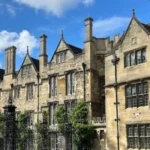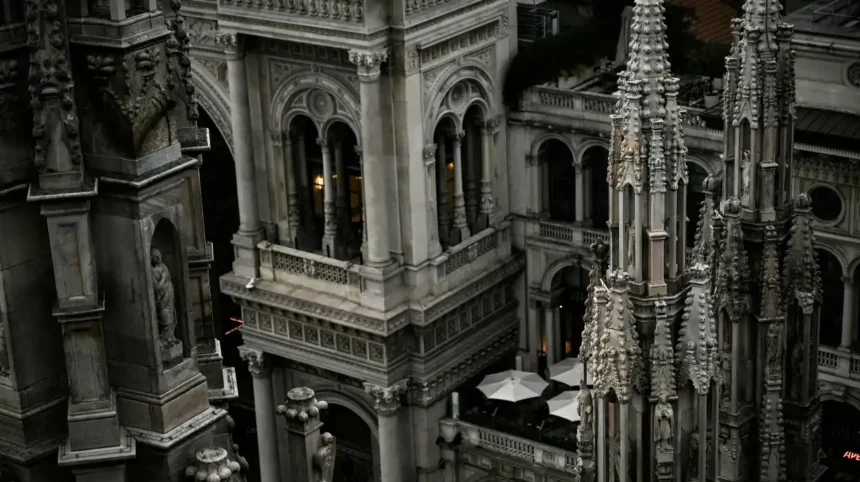
All Souls College in Oxford stands as a masterpiece of Gothic architecture, its spires piercing the skyline like silent sentinels. Founded in the 15th century, this enigmatic institution harbors architectural wonders that blend medieval grandeur with later innovations, drawing visitors to ponder its enduring mysteries.
- Founding and Early Gothic Roots
- The Iconic Twin Towers Unveiled
- Hawksmoor’s North Quadrangle Marvel
- Library’s Stylistic Duality Exposed
- Chapel’s Medieval Vaults and Glass
- Cloister Gardens and Hidden Passageways
- Gargoyles and Symbolic Carvings
- Gothic Revival Echoes in Restorations
- Optical Tricks and Proportions
- Enduring Legacy in Oxford’s Skyline
Founding and Early Gothic Roots
Henry Chichele, Archbishop of Canterbury, envisioned All Souls College in the 1430s as a place for prayer and scholarship after the ravages of the Hundred Years’ War. Construction began around 1438 under a charter from King Henry VI, transforming a plot near the University Church into a quadrangle defined by Perpendicular Gothic style. The Old Quadrangle, or Front Quad, emerged with its chapel as the focal point, its facade marked by intricate stonework that exemplifies the era’s vertical aspirations.
The chapel’s misericords, carved wooden ledges beneath choir seats, reveal subtle artistry from the 1440s, possibly by craftsman Richard Tyllock, echoing designs in Higham Ferrers. These supports depict everyday scenes and mythical beasts, offering glimpses into medieval life amid the solemn Gothic arches. The structure’s limestone facade, quarried locally, weathers to a golden hue, while pointed arches and ribbed vaults inside direct the eye upward, symbolizing spiritual ascent.
This foundational Gothic phase set All Souls apart, prioritizing prayer over undergraduate teaching, with no students in residence—a rarity that preserved its architectural purity through centuries.
The Iconic Twin Towers Unveiled
Dominating the college’s High Street entrance are the twin towers, added in 1442, which frame the gateway with dramatic flair. Rising to over 100 feet, these octagonal spires taper elegantly, adorned with crocketed pinnacles and gargoyles that ward off evil spirits in true Gothic tradition. Their design draws from Canterbury Cathedral, where Chichele served, infusing personal devotion into the stonework.
Each tower conceals a staircase within its spiral core, allowing discreet access between quads without disrupting the symmetry—a practical secret masked by ornate battlements. The towers’ lantern-like tops, pierced by lancet windows, once supported bells whose chimes echoed Oxford’s academic rhythm. This verticality not only enhances the skyline but also manipulates light, casting elongated shadows that shift with the sun, creating an ever-changing facade.
Restorations in the 19th century preserved these features, ensuring the towers remain a Gothic beacon amid Oxford’s collegiate tapestry.
Hawksmoor’s North Quadrangle Marvel
In 1716, Nicholas Hawksmoor redefined All Souls with his North Quadrangle, bridging 15th-century Gothic and emerging Baroque influences. Commissioned after Christopher Codrington’s bequest funded a grand library, Hawksmoor’s design encases classical interiors in a Gothic shell, a deliberate stylistic fusion. The quadrangle’s rusticated base and giant pilasters rise to a frieze of skulls and hourglasses, symbols of mortality befitting a college named for departed souls.
The west range’s loggia, with its arched colonnade, echoes Wren’s City church designs post-Great Fire, grounding the Gothic revival in Euclidean precision. Hawksmoor’s towers here mimic the front pair but innovate with ogee arches and flame-like finials, evoking Wren’s Gothic experiments at Tom Tower. This quadrangle tempers medieval exuberance with measured symmetry, where every element aligns to Vitruvian ideals of strength and beauty.
Library’s Stylistic Duality Exposed
The Codrington Library, Hawksmoor’s crowning achievement from 1716-35, hides its greatest secret in the clash of styles. Externally Gothic to harmonize with the chapel, its interior bursts into classical splendor—bookcases with Corinthian pilasters, pediments, and a barrel-vaulted ceiling painted with allegorical frescoes. Hawksmoor intended full Gothic, but Fellow Dr. George Clarke insisted on classicism, possibly contributing designs himself, resulting in windows that appear Palladian inside yet Gothic-framed outside.
This duality creates optical illusions: from the quad, tracery suggests stained glass continuity, but inside, sash windows flood oak shelves with light, housing 12,000 volumes from Codrington’s collection. The floor plan mirrors the antechapel exactly, enforcing symmetry that Clarke championed, while ironwork balconies add filigree elegance. Dust motes dance in sunbeams through these hybrid panes, illuminating rare texts in a space where past and present converse silently.
Chapel’s Medieval Vaults and Glass
All Souls Chapel, built 1438-1442, retains much original Perpendicular Gothic fabric despite Puritan iconoclasm and Victorian tweaks. Its fan vaults, radiating like stone palm fronds, soar above the nave, a technical feat rivaling Gloucester Cathedral’s cloisters. Stained glass, rearranged over centuries, includes 15th-century panels of Chichele and saints, their jewel tones filtering divine narratives through leaded lattices.
The reredos, rebuilt post-Commonwealth, frames an altarpiece with Gothic tracery that survived Reformation zeal, whispering of pre-Reformation piety. Wooden screen by Wren in the 1660s, later rebuilt, divides spaces with Ionic columns under ogee arches—a subtle Gothic nod in a classical frame. These elements conspired to protect the chapel’s essence, making it a repository of Oxford’s Gothic soul.
Cloister Gardens and Hidden Passageways
Behind the chapel lies the medieval cloister, demolished in part for Clarke’s house but reborn in Hawksmoor’s vision. Its arched walkways, now framing lawns, conceal drainage channels carved into stone flags—ingenious hydrology preventing floods in Oxford’s marshy soil. Sundials on walls mark canonical hours, tying architecture to monastic timekeeping.
Subterranean passages, rumored from construction records, linked cellars to the river for provisions, their Gothic arches shored by oak beams. These utilitarian secrets underscore the college’s self-sufficiency, where beauty serves function amid secluded gardens blooming eternally.
Gargoyles and Symbolic Carvings
Gothic architecture thrives on symbolism, and All Souls abounds with it. Gargoyles—grotesque waterspouts—protrude from parapets, channeling rainwater while embodying sins: leering demons, mythical beasts, and hybrid forms sculpted to terrify and amuse. On the chapel, they double as corbels supporting vaults, their open mouths echoing chants below.
Bosses at vault intersections feature Chichele’s arms—chevron between cinquefoils—interwoven with souls in torment, a memento mori for scholars. Quadrangle friezes by Hawksmoor deploy skulls, crossbones, and caducei, blending mortality with alchemical rebirth, inviting contemplation of the college’s prayerful mission.
Gothic Revival Echoes in Restorations
The 18th century sparked Gothic revival at All Souls, influencing dining hall renovations elsewhere but here manifesting in Hawksmoor’s disciplined Gothic. Victorian Gothicists like Gilbert Scott repaired towers, reinstating tracery with philological accuracy, drawing from Pugin’s precepts. 20th-century work stabilized vaults against subsidence, preserving lierne ribs that weave celestial patterns overhead.
These interventions revived Perpendicular purity, ensuring All Souls leads Oxford’s Gothic narrative into modern times.
Optical Tricks and Proportions
Hawksmoor’s genius lies in forced perspective: North Quad’s diminishing arches accelerate recession, making modest spaces feel vast. Golden ratios govern fenestration, where window heights to widths approximate phi, harmonizing with human vision. Twilight reveals phosphorescent limestone veins, a natural secret amplifying Gothic mystique.
Enduring Legacy in Oxford’s Skyline
All Souls’ Gothic secrets—from Chichele’s vaults to Hawksmoor’s hybrids—endure as Oxford’s architectural poem. They inspire architects studying sustainable stonework and tourists tracing light through tracery. In a city of spires, this college’s enigmas ensure its timeless allure, whispering history to every beholder.
What is the Balliol College scandal?
Balliol College faced scandals involving sexual violence allegations, tutor misconduct, and poor handling of assault cases, highlighted in Al-Jazeera’s “Degrees of Abuse.” Students protested for reforms amid a culture of impunity.
Why is All Souls College so exclusive?
All Souls admits no undergraduates, only elite Fellows via a grueling exam, making it Oxford’s most selective—envisioned as a scholarly “unarmed militia” since 1438.
What is the hardest exam at Oxford?
The All Souls Fellowship Exam is renowned as Oxford’s toughest, with abstract essays and vivas testing creativity; only 1-2 of 80 candidates succeed yearly.
What did Emma Watson study at Oxford?
Emma Watson visited Worcester College, Oxford, briefly via a student program but earned her English Literature BA from Brown University, not a full Oxford degree.
Which billionaires went to Oxford?
Oxford alumni billionaires include Michael Moritz (Sequoia Capital), Nicky Oppenheimer (diamonds), and Theo Paphitis (retail); All Souls’ prestige ties into this elite network.