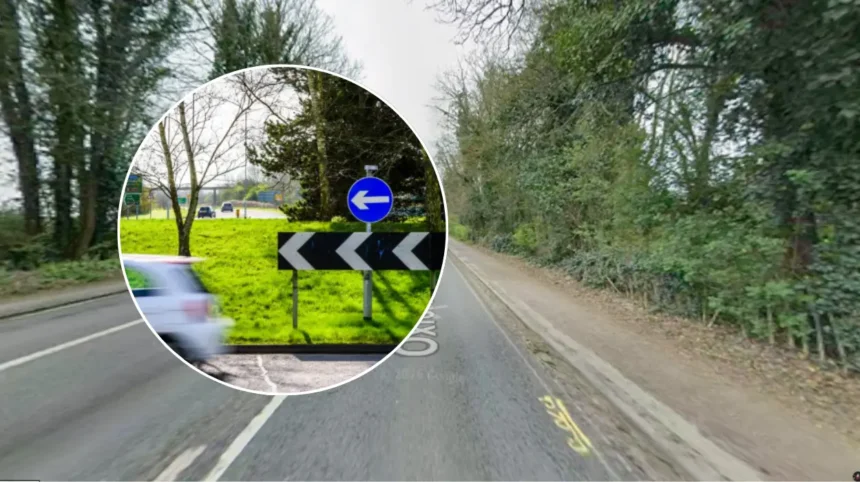
Key Points
- Nearly six million UK drivers risk a £50 fine by failing to follow rules at mini-roundabouts.
- A survey found 55 per cent of motorists admit to breaking rules at smaller junctions, with 48 per cent driving over raised central humps and 62 per cent driving straight across flat painted circles.
- Rules 188 to 190 of the Highway Code require all vehicles to pass around the central marking unless their size physically prevents them from doing so.
- One in six British drivers reported finding roundabouts stressful to navigate.
- Roughly 20 per cent of motorists do not give way to traffic approaching from their right.
London (Oxford Daily) October 2, 2026 — Millions of motorists across the United Kingdom are routinely risking financial penalties due to a widespread misunderstanding of mini-roundabout regulations. Research published by Compare the Market indicates that almost six million drivers are putting themselves at risk of a £50 fixed penalty notice by driving directly over central road markings rather than circulating around them as required by law.
The study highlights that despite mini-roundabouts being a routine feature of British roads, more than half of drivers regularly breach statutory traffic rules at these junctions. As reported by Joshua Searle of the Newsquest Media Group network, data collected in the insurance firm’s motoring survey demonstrates that 55 per cent of UK licence holders admit to committing infractions at mini-roundabouts.
The research found that 48 per cent of surveyed motorists confessed to driving over raised central island humps, whilst 62 per cent admitted to driving straight over flat painted markings on the road surface. Under current UK legislation, police officers have the authority to issue a £50 fixed penalty notice to any driver caught cutting across these markings without a valid physical justification.
Why are UK drivers making errors at mini-roundabouts?
According to analysis by Compare the Market, navigation stress and a misinterpretation of space play major roles in driver compliance failure. The study notes that one in six motorists finds roundabouts generally stressful to navigate, a feeling compounded at mini-roundabouts due to limited spatial margins and reduced reaction times.
As detailed by Joshua Searle, the Highway Code stresses that mini-roundabouts present specific operational challenges. Drivers have less physical room to manoeuvre and significantly less time to signal their intentions to other road users, demanding heightened care on approach. Despite these statutory warnings, a substantial portion of motorists treat mini-roundabouts as conventional open junctions, driving straight through them rather than steering around the central circle.
What do Rules 188 to 190 of the Highway Code state?
Rules 188, 189, and 190 of the Highway Code establish the precise legal standard for navigating mini-roundabouts across Great Britain. The regulations specify that mini-roundabouts must be approached and navigated with the same legal duty of care as standard roundabouts.
The primary rule dictates that all vehicles must pass around the central markings, whether those markings consist of a painted white circle or a raised paved dome. The sole exemption permitted under the law applies to large vehicles—such as buses, heavy goods vehicles (HGVs), or articulated lorries—whose physical dimensions or turning radiuses make it physically impossible to avoid the central island. For standard passenger cars, vans, and motorcycles, driving over the central marking constitutes an offence under traffic regulations.
Furthermore, Rule 185 dictates that drivers must give priority to traffic approaching from their right unless traffic lights, overhead gantries, or specific road signs indicate otherwise. The Compare the Market survey revealed that nearly 20 per cent of UK motorists fail to yield priority to the right at roundabouts, introducing further collision risk and statutory liability.
What is the background of this traffic enforcement development?
Mini-roundabouts were introduced across the British road network in the late 1960s and 1970s as a cost-effective traffic management solution designed to improve junction capacity, lower speeds, and reduce severe right-angle collisions without requiring extensive land acquisition.
Unlike full-scale conventional roundabouts featuring wide central islands, mini-roundabouts rely on compact painted or slightly raised central domes.
Over recent decades, driver education surrounding mini-roundabouts has frequently been highlighted as a weak point in British road safety awareness. Industry figures indicate that while learner drivers are explicitly tested on mini-roundabout compliance during the official Practical Driving Test, experienced motorists routinely develop improper habits over time.
The persistent practice of “straight-lining”—cutting directly over the central painted disk when the junction appears clear—has become normalized among millions of drivers, despite remaining illegal under enforcement statutes.
In response to rising urban congestion and localized safety complaints, local highways authorities and police forces across the UK have increasingly emphasized compliance with painted road markings. The law governing fixed penalty notices allows police officers observing traffic directly or via enforcement camera systems to issue on-the-spot fines for failing to comply with road signs and markings, reinforcing the push to ensure drivers respect all elements of the Highway Code.
What is the prediction for how this development will affect UK motorists?
This clear focus on mini-roundabout compliance is expected to directly affect British motorists through heightened financial risks and potential changes in driving behaviour.
For the general motoring public, an increased risk of targeted police enforcement or traffic camera monitoring will make casual infractions significantly more costly. Receiving a £50 fixed penalty notice places a direct financial burden on drivers already navigating high vehicle running costs, insurance premiums, and fuel expenses.
Drivers who routinely cut across mini-roundabouts in residential or suburban areas will need to actively break established driving habits to avoid enforcement measures.
For learner drivers and newly qualified motorists, heightened scrutiny around roundabout rules will likely lead driving instructors to place even greater emphasis on mini-roundabout discipline during lessons and test preparation.
Furthermore, insurance providers may incorporate compliance messaging into policy guidelines or telematics (“black box”) monitoring software, penalising policyholders who display aggressive or non-compliant navigation patterns at junctions. Over time, clearer awareness of the £50 penalty is anticipated to gradually force a reduction in “straight-lining” mistakes, leading to lower collision rates at neighbourhood intersections across the country.