Key Points
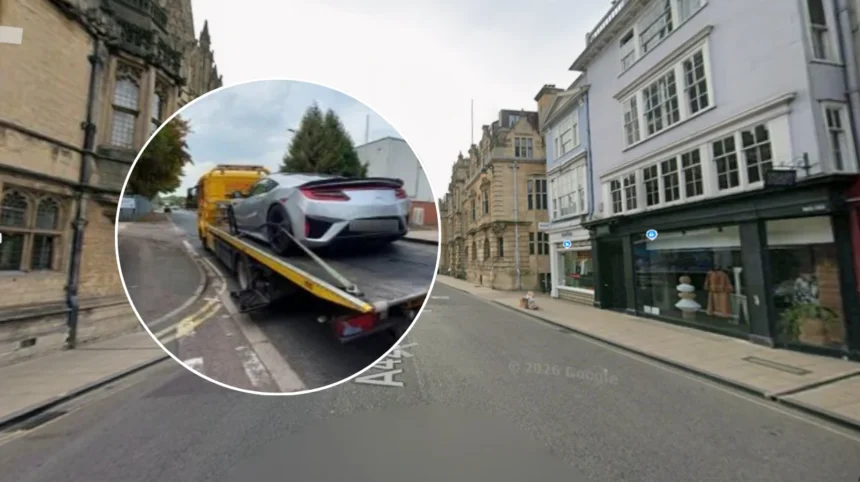
- Police seized an Audi supercar during targeted road checks in Banbury.
- Operation Scalis brought together the Banbury Neighbourhood Policing Team, Thames Valley Police Roads Policing, and the Motor Insurers’ Bureau.
- Officers impounded several vehicles, issued traffic offence reports, and reported multiple drivers to court.
- The operation focused on uninsured motorists, unlicensed drivers, and those using vehicles to commit wider crimes.
- Thames Valley Police said officers will continue stopping non-compliant drivers across the region’s road network.
Banbury (Oxford Daily) September 29, 2026 – An Audi supercar was impounded alongside multiple traffic offence enforcement actions on Oxfordshire roads following a coordinated multi-agency operation targeting illegal motorists.
- Key Points
- Why Was the Audi Supercar Seized During Operation Scalis?
- How Does Law Enforcement Link Unlawful Driving to Wider Crime?
- What Impact Does Multi-Agency Cooperation Have on Road Safety?
- Background of the Particular Development
- Prediction: How This Development Can Affect Motorists and Local Communities
Officers intercepted high-performance vehicles, processed several drivers for court appearances, and seized non-compliant cars as part of a high-visibility enforcement initiative aimed at disrupting serious motoring non-compliance and broader criminal networks operating across the regional transport system.
Why Was the Audi Supercar Seized During Operation Scalis?
The seizure took place during Operation Scalis, a proactive enforcement blitz conducted across Banbury’s main road corridors. The deployment brought together specialist officers from the Banbury Neighbourhood Policing Team working alongside Thames Valley Police Roads Policing units and enforcement representatives from the Motor Insurers’ Bureau (MIB).
During the operation, authorities pulled over several high-value and standard passenger vehicles to carry out comprehensive compliance checks. According to reporting published by the Oxford Mail, enforcement officers identified severe insurance and licensing violations, culminating in the immediate seizure of the Audi supercar. Multiple traffic offence reports were issued to offending motorists on site, with several drivers formally reported to court to face legal proceedings.
As detailed by an official media spokesperson for Thames Valley Police to reporter Newsdesk at the Oxford Mail, “Officers from Banbury Neighbourhood Policing Team joined colleagues from Roads Policing, the Motor Insurers’ Bureau (MIB) and partner agencies as part of Operation Scalis, a proactive operation targeting those using our roads unlawfully”.
How Does Law Enforcement Link Unlawful Driving to Wider Crime?
Police authorities emphasized that multi-agency road checks serve a broader strategic purpose than enforcing standard highway code regulations. Vehicles operated without valid insurance or licensing documentation are frequently linked to illicit commercial activities, organized crime networks, and anti-social behaviour patterns.
As reported by reporter Newsdesk of the Oxford Mail, a Thames Valley Police spokesperson explained that “Operations like this are about more than just traffic offences. Uninsured, unlicensed and criminally used vehicles often play a role in wider offending, including drug supply, anti-social behaviour and acquisitive crime”.
By systematically intercepting illicit road users, participating agencies aim to sever transport routes used by offenders. The police spokesperson further noted to the Oxford Mail that “By working together, we can disrupt criminality and make our roads safer for everyone. If you’re driving without insurance, driving otherwise than in accordance with a licence, or using our road network to commit crime, expect to be stopped”.
What Impact Does Multi-Agency Cooperation Have on Road Safety?
The inclusion of the Motor Insurers’ Bureau (MIB) in Operation Scalis underscores a growing national push to eliminate uninsured driving. Uninsured motorists place a heavy financial burden on compliant drivers, adding millions of pounds to annual motor insurance premiums across the United Kingdom while posing significant legal and financial risks to victims of road traffic collisions.
Through real-time database checks conducted jointly by police officers and MIB personnel at the roadside, authorities can instantly verify insurance validity, vehicle ownership, and licence status. This live technical integration allows teams to seize non-compliant cars on the spot, removing high-risk vehicles from circulation before they can cause further disruption or harm.
Background of the Particular Development
In recent years, UK police forces have intensified multi-agency road safety campaigns to address a documented surge in uninsured driving, dangerous vehicle modifications, and anti-social motoring behavior.
Operations such as Operation Scalis reflect a strategic evolution in road policing, where local neighbourhood teams, highway patrol units, and external industry bodies combine resources to execute targeted, intelligence-led enforcement stops.
The impounding of high-performance luxury sports cars and supercars has become an increasingly visible element of these operations. High-value vehicles driven without appropriate insurance cover, valid driver licences, or tax documentation often attract immediate public and media attention.
UK law grants police statutory powers under Section 165A of the Road Traffic Act 1988 to seize any vehicle driven without valid insurance or a proper driving licence.
Once impounded, vehicle owners face substantial recovery fees, daily storage charges, strict documentary proof-of-ownership requirements, and potential court-mandated vehicle forfeiture or destruction if compliance standards are not met.
Prediction: How This Development Can Affect Motorists and Local Communities
For the general motoring public and local residents in Banbury and the wider Thames Valley region, the continuation of multi-agency enforcement operations like Operation Scalis will likely result in several tangible changes:
- Heightened Roadside Inspections for Drivers: Motorists should anticipate an increased frequency of random and targeted roadside enforcement checkpoints. Vehicles displaying minor defects, expired tax, or irregular registration marks will face immediate scrutiny by automated number plate recognition (ANPR) systems and static policing units.
- Downward Pressure on Uninsured Driving Premiums: Systematic impounding of uninsured vehicles—particularly expensive models that present high financial risk—helps suppress the overall costs absorbed by the insurance industry. Over time, persistent enforcement by the police and the MIB can contribute to stabilizing motor insurance premiums for law-abiding drivers.
- Disruption to Local Criminal Logistics: By taking non-compliant and criminally utilized vehicles off the road, enforcement agencies directly impair the mobility of local criminal enterprises. This operational friction can lead to a reduction in opportunistic street crime, drug distribution networks, and anti-social driving incidents across suburban corridors.