Key Points
- Oxfordshire County Council launched a trial traffic filter scheme across six major roads in Oxford on Monday, 28 September 2026.
- Automatic Number Plate Recognition (ANPR) cameras enforce the restrictions without physical barriers, issuing £70 fines that drop to £35 if paid within 21 days.
- Restrictions apply only to private cars, including electric vehicles; buses, coaches, taxis, vans, lorries, emergency vehicles, and two-wheelers can pass without restrictions.
- Four central filters run daily from 07:00 to 19:00 BST, while two outer filters operate Monday to Saturday during peak periods (07:00–09:00 and 15:00–18:00 BST).
- Oxford city residents get 100 free day passes per car each year up to three cars per household, while broader Oxfordshire residents receive 25 passes per car up to two cars per household. Existing temporary congestion charge permits transfer automatically.
- The trial runs under an Experimental Traffic Regulation Order (ETRO) for up to 18 months alongside public consultation and data collection.
OXFORD (Oxford Daily) September 28, 2026 – Oxfordshire County Council has officially initiated its experimental traffic filter scheme across six strategic transport corridors in Oxford today, replacing the previous temporary congestion management measures with a camera-enforced permit system designed to reduce traffic volumes and accelerate public transport journeys.
How Does The Oxford Traffic Filter System Function?
As reported by transport correspondents covering the local infrastructure deployment, the traffic filter system utilizes overhead Automatic Number Plate Recognition (ANPR) cameras positioned at six key bottlenecks throughout the city. The restrictions apply strictly to private motor cars and motorhomes (DVLA class M1).
All other vehicle types—including double-decker buses, commercial delivery vans, heavy goods vehicles, licensed taxis, motorbikes, mopeds, and bicycles—are permitted to pass through the filter points without restriction or charge at all times.
The scheme operates across two distinct operational schedules based on geographical location:
- Central Filters (7 days a week, 07:00 to 19:00 BST): Located on Hythe Bridge Street, Thames Street, St Cross Road, and St Clement’s Street.
- Outer Outer-Ring Filters (Monday to Saturday, 07:00–09:00 and 15:00–18:00 BST): Located on Marston Ferry Road and Hollow Way.
Outside these specified operational hours, all motor vehicles may pass through the points freely without incurring penalties or deducting day pass credits.
What Are The Permit Allocations And Financial Penalties?
As detailed in official guidance released by Oxfordshire County Council, every household situated within the Oxford city permit zone is eligible to claim up to 100 free day passes per year for each registered vehicle, capped at a maximum of three vehicles per household. Residents living within the broader boundaries of Oxfordshire outside the city limits qualify for 25 free day passes per vehicle per year, capped at two vehicles per household.
A single day pass allows the specified car to navigate through any number of traffic filters repeatedly throughout a single calendar day without penalty. Non-Oxfordshire residents, external commuters, and visitors who do not qualify for specific exemptions (such as Blue Badge holders, professional care workers, or non-emergency patient transport) cannot purchase day passes and are restricted from driving private cars through the filter locations during operational hours.
Drivers passing through a active filter in an unpermitted private car will receive a Penalty Charge Notice (PCN) of £70, which is reduced to £35 if settled within 21 days. Failure to pay within 28 days increases the fine to £105. The council noted that initial warning notices will be issued to first-time non-compliant motorists during the introductory phase before full monetary enforcement is exacted.
How Can Drivers Navigate Oxford Without Crossing Filters?
As emphasized by local transport officers, the traffic filter scheme does not physically close any roads or prevent motor vehicles from reaching any building, home, or business in Oxford. Because physical bollards or barriers are not present, ring roads and alternative arterial routes remain fully open.
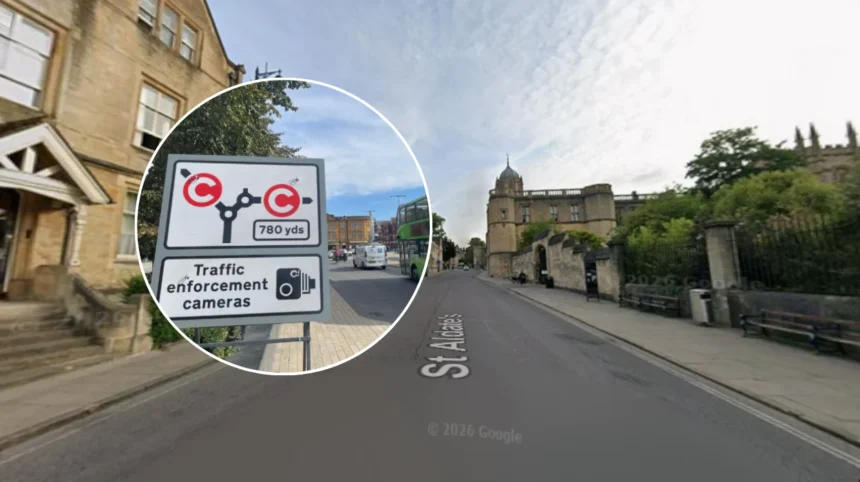
Motorists driving private cars without active day passes or permits must adjust their travel routes by using the Oxford ring road to bypass the camera locations when travelling between different quadrants of the city. Advance directional road signs—comprising blue warning markers situated 80 yards (73 metres) prior to each filter point and yellow boundary signs at the camera locations—have been erected to notify drivers to reroute before crossing the enforcement boundary.
Background Of The Development
The rollout of the traffic filter trial represents the realization of a long-term urban transport restructuring strategy formulated by Oxfordshire County Council under its Central Oxfordshire Travel Plan and Local Transport and Connectivity Plan. Over the past decade, demographic growth across Oxfordshire—highlighted by an 11% population increase between 2011 and 2021 and an estimated additional 15% increase projected through 2031—has placed severe strain on the medieval city’s road infrastructure.
Vehicle ownership metrics indicate that Oxfordshire possesses one of the highest average numbers of cars per household in the United Kingdom, leading to severe highway congestion, extended public transit journey times, and heightened localized carbon emissions.
Initial approvals for the traffic filter initiative were passed by the council cabinet in late 2022 following extensive public consultations; however, full deployment faced administrative and operational delays due to major infrastructure works elsewhere in the city, notably Network Rail’s ongoing works at Botley Road and the temporary implementation of an interim congestion charge scheme.
The filters are formally introduced under an Experimental Traffic Regulation Order (ETRO), a statutory mechanism that allows public authorities to test traffic management schemes in real-time for up to 18 months while simultaneously gathering empirical data and receiving formal public comments before deciding whether to make the changes permanent, amend them, or abandon the initiative entirely.
Prediction: How This Development Will Affect Key Groups
The implementation of the traffic filter trial will alter travel habits, operational logistics, and economic patterns across several distinct stakeholder groups in Oxford and surrounding regions:
1. Local Commuters and Private Car Owners
Out-of-city commuters who previously drove directly through Oxford city centre during peak hours will face longer driving distances and increased journey times as they are forced onto the already busy A40, A34, and ring road networks. Conversely, residents living within the city permit zone using their 100 annual day passes will maintain flexible direct access when necessary, though they will need to plan non-essential trips carefully to avoid exhausting their pass allocations prior to the annual renewal date.
2. Public Transport Users and Bus Operators
Bus passenger services are expected to be the primary beneficiaries of the initiative. By removing thousands of private car journeys per day from major arterial roads like St Clement’s and Hythe Bridge Street, bus operators will experience improved timetable reliability, reduced turnaround times, and lower operational costs. This efficiency gain is anticipated to trigger increased bus patronage and encourage local transport authorities to introduce expanded routes and higher service frequencies across central Oxfordshire.
3. Pedestrians, Cyclists, and Active Travel Advocates
With private car traffic reduced along key corridors such as Marston Ferry Road and Hollow Way, cycling and walking conditions will become safer and more appealing. Lower vehicular volume reduces collision risks for school pupils, micro-mobility users (such as e-scooter riders), and daily cycle commuters, likely leading to a structural shift toward active transport choices.
4. Local Retailers, Traders, and Delivery Logistics
City-centre retail and hospitality businesses may observe shifts in customer footfall patterns. Retailers relying heavily on drive-in trade from surrounding rural villages may see reduced non-local car visits, prompting a greater dependence on Park & Ride usage. Meanwhile, commercial tradespeople, delivery logistics operators, and service fleets—who are exempt from the filter restrictions—will benefit from reduced traffic delays and faster job completion times across the city.