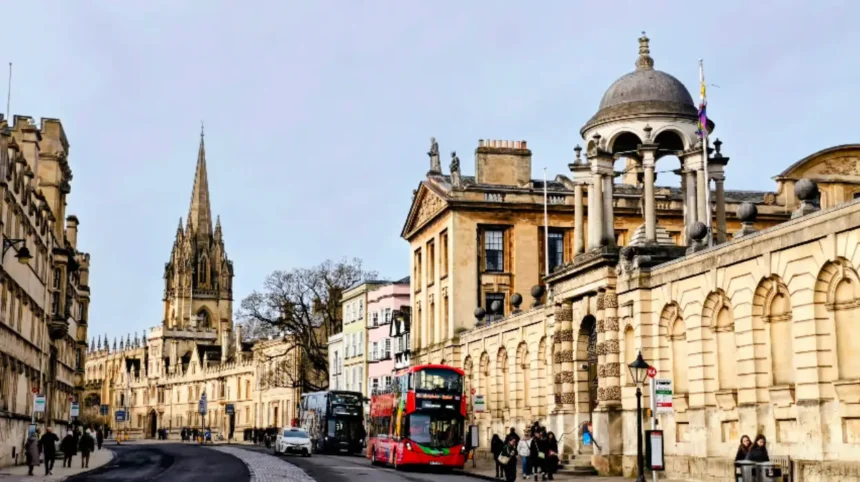
High Street in Oxford serves as the principal historical and architectural thoroughfare connecting Carfax to Magdalen Bridge. It integrates major University of Oxford colleges, historic commercial establishments, and landmark domestic structures within a Saxon street grid.
High Street, locally designated as “The High,” forms the primary east-west arterial spine of central Oxford, England. Spanning roughly 0.6 kilometers, the street features a distinct gentle curve that frames sequential architectural views of medieval, Renaissance, and Neoclassical structures. The thoroughfare originates at the Carfax Tower intersection, where it meets Cornmarket Street, Queen Street, and St Aldate’s, and terminates at the eastern boundary marked by Magdalen Bridge over the River Cherwell.
The street functions simultaneously as a major academic precinct for the University of Oxford and a commercial sector. Monumental college facades line the eastern and central segments, while the western end transitions into active retail frontages. The layout preserves original Anglo-Saxon tenement boundaries alongside later Georgian and Victorian infill. High Street remains a primary focus of urban heritage preservation, academic administration, and local transit within the city core.
Which Historic Colleges Are Located on High Street Oxford?
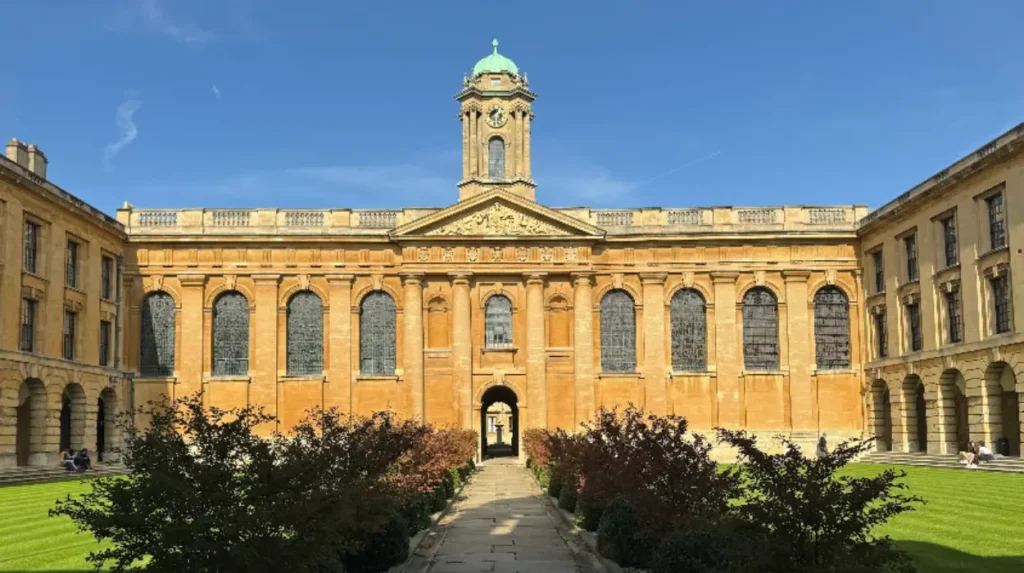
High Street Oxford houses several prominent University of Oxford colleges, including Magdalen College, The Queen’s College, University College, All Souls College, and Lincoln College. These institutions define the street’s architectural continuity from medieval to modern eras.
Magdalen College occupies the far eastern terminal of High Street near Magdalen Bridge. Founded in 1458 by William of Waynflete, the college features the 144-foot Magdalen Tower, constructed between 1492 and 1509. Proceeding west, The Queen’s College presents a prominent 18th-century Hawksmoor-designed Palladian front screen facing the north side of the street. Opposite Queen’s stands University College, which traces its corporate foundations to 1249 and exhibits a 17th-century Gothic Revival frontage.
Further west along the northern side lies All Souls College, founded by Henry VI and Archbishop Henry Chichele in 1438 as a research institution. Adjacent to All Souls is the University Church of St Mary the Virgin, which forms the historic center of university administration. Lincoln College maintains its historic library within the former All Saints Church structure situated at the intersection of High Street and Turl Street. Additional institutional properties include the Examination Schools at the eastern section.
How Did High Street Oxford Develop Historically?
High Street Oxford developed from a 9th-century Saxon burh defensive axis into a medieval commercial hub and academic center. Urban expansions and university acquisitions transformed the timber-framed street into a stone-built architectural showcase.
The origin of High Street dates to the establishment of the Oxford burh under King Alfred or Edward the Elder around 900 AD. Archaeological excavations at 113–119 High Street revealed 10th-century cellar pits and timber structures aligning with the planned Saxon street grid. By the 12th century, a central drainage trench known as the Kennel ran down the street axis. Medieval academic halls, such as Tackley’s Inn at 107 High Street built in 1320, provided early student lodgings before formal collegiate housing expanded.
During the 17th and 18th centuries, extensive re-edification altered the structural character of High Street. Medieval timber-framed structures were largely replaced or fronted with Ashlar limestone and Georgian facades. The expansion of collegiate holdings systematically consolidated multiple narrow domestic burgage plots into wide monumental frontages. The construction of the Oxford Covered Market access points off High Street in 1774 further organized commercial trade away from the main carriageway.
What Architectural Styles Are Present on High Street Oxford?
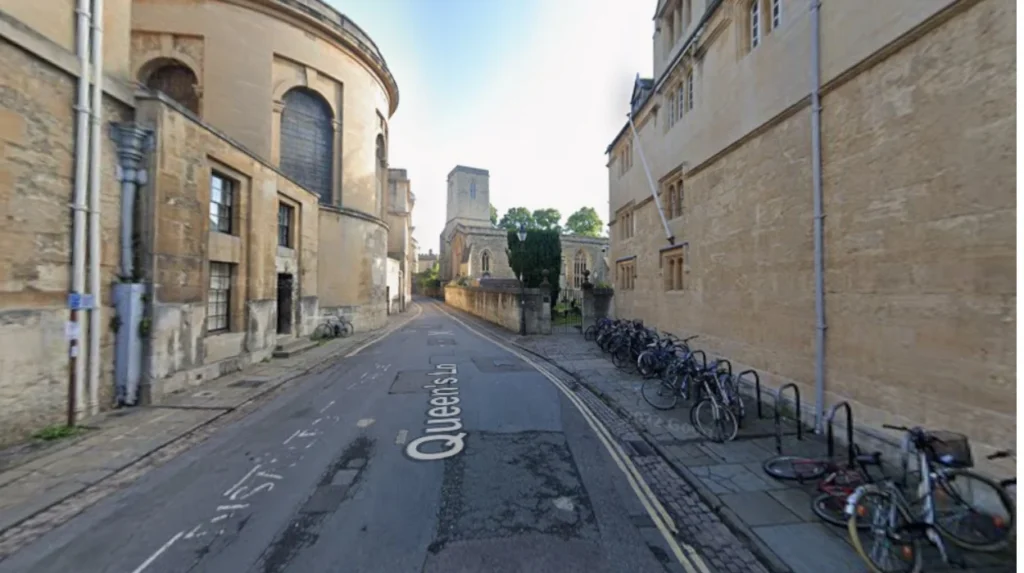
High Street Oxford features a diverse progression of architectural styles, including Saxon street alignment, Medieval timber framing, English Baroque, Neoclassical Palladianism, and Gothic Revival facades. This stylistic combination creates a celebrated urban panorama.
The street demonstrates structural continuity across six centuries of British architecture. Medieval survival is exemplified by No. 126 High Street, a Grade I listed timber-framed townhouse constructed in 1485 featuring overhanging jettied gables. English Baroque architecture is prominently displayed at the University Church of St Mary the Virgin, whose porch was designed by Nicholas Stone in 1637, and All Saints Church, designed by Henry Aldrich in 1701.
Neoclassical and Palladian designs dominate the central northern section through Nicholas Hawksmoor’s rebuilding of The Queen’s College between 1710 and 1738. Gothic Revival elements appear along the frontage of University College and the 19th-century additions to Oriel College. Victorian commercial architecture is represented by the 1901 Neo-Jacobean Lloyds Bank building at the Carfax corner. The stone choices, primarily Cotswold limestone and Headington stone, provide unified coloration across these distinct eras.
What Are the Key Commercial and Historic Businesses on High Street?
High Street Oxford hosts specialized independent retailers, historic hospitality venues, and early commercial sites alongside academic institutions. Notable examples include Queen’s Lane Coffee House, Shepherd & Woodward, and the original Frank Cooper shop.
Commercial trade on High Street maintains deep historical roots alongside university operations. Queen’s Lane Coffee House, established in 1654 at the corner of Queen’s Lane, represents one of the oldest continuously operating coffee houses in Europe. Across the street, The Grand Café operates on the site of an earlier 1650 coffee establishment. Traditional tailors Shepherd & Woodward continue to supply official University of Oxford academic dress from their High Street premises.
At Nos. 83–84 High Street, a official blue plaque marks the former grocery store of Frank Cooper, where “Oxford Marmalade” was produced starting in 1874. The Mitre Hotel site preserves extensive 13th-century vaulting beneath a 17th-century coaching inn frame. Additional long-standing businesses include Payne & Son goldsmiths and Sanders of Oxford print sellers. The street also provides primary pedestrian passages leading into the historic Oxford Covered Market.
What is the length of High Street in Oxford?
High Street in Oxford measures approximately 600 meters (0.37 miles) in length. It runs directly from the Carfax Tower junction at its western end to the foot of Magdalen Bridge at its eastern terminal.
Why is the street curved instead of straight?
The gentle S-curve of High Street reflects the original Anglo-Saxon settlement contour along the gravel terrace between the Thames and Cherwell rivers. This organic bend creates sequential visual framing of college frontages and church spires for pedestrians.
How do visitors access the Oxford Covered Market from High Street?
Visitors access the Covered Market through four historic dedicated passages branching north directly from High Street. These pedestrian arcades are located between shop premises at Nos. 13 through 16.
Are vehicles permitted on High Street Oxford?
Vehicle access on High Street is restricted under Oxford City Council traffic management schemes. Buses, taxis, and bicycles are permitted, but private motorized vehicles face strict access limitations during peak daytime hours.
Which bus routes service High Street in Oxford?
High Street serves as a main transit corridor for Oxford Bus Company and Stagecoach Oxfordshire services. Park & Ride lines and local city routes stop at designated bays near Queen’s College and St Mary’s Church.