Key Points
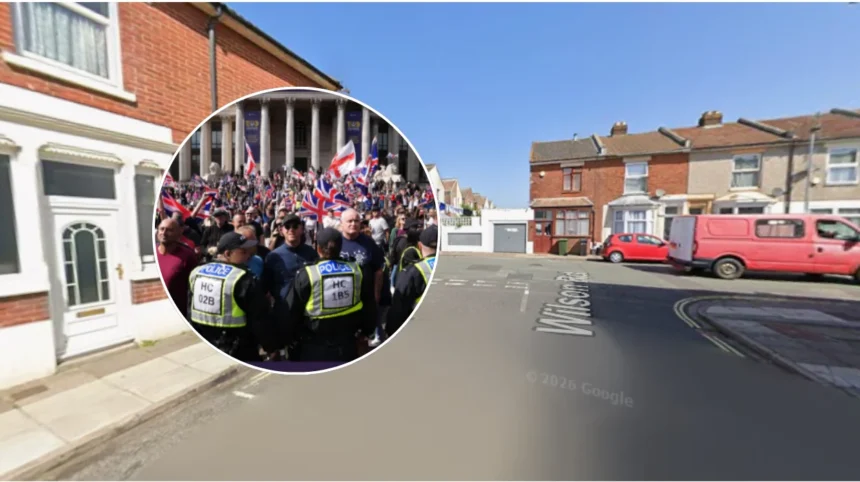
- Hampshire and Isle of Wight Constabulary arrested a 76-year-old man in Portsmouth on suspicion of concealing his identity during a public protest.
- Officers used powers under the Crime and Policing Act 2025, which allows police to enforce the removal of face coverings in designated protest zones.
- The arrest comes after police detained 42-year-old Del Leon Somerville of Paulsgrove, who was charged with violent disorder and assaulting a police officer following clashes at Eastney Marina.
- Home Secretary Shabana Mahmood held emergency meetings with national police chiefs, telling forces to use robust tactics against masked groups exhibiting “malign intent”.
- Detectives are reviewing hundreds of hours of video footage, and senior officers said they expect to make more arrests following recent port disruptions.
Portsmouth (Oxford Daily) September 12, 2026 – Hampshire Police have arrested a 76-year-old man on suspicion of concealing his identity during an anti-immigration demonstration in Portsmouth, marking the first direct application of new statutory powers banning face coverings at designated public assemblies in the city. The suspect was taken into custody on Saturday after officers enforced a designated restriction order designed to prevent violent disorder and eliminate the use of masks by protest factions. The operational enforcement follows days of escalating tensions along the South Coast after demonstrator clashes with law enforcement at maritime sites.
- Key Points
- Why Was the Concealment of Identity Order Enacted by Hampshire Police?
- How Did the Investigation Into Recent Portsmouth Port Disruptions Begin?
- Who Has Been Charged in Connection With the Maritime Public Disorder?
- Background of Public Order Tactics and Legislative Changes
- Prediction: How This Development Will Affect Key Stakeholders
Why Was the Concealment of Identity Order Enacted by Hampshire Police?
As reported by political correspondent Vikram Dodd of The Guardian, Home Secretary Shabana Mahmood met senior law enforcement executives to urge police chiefs to curb anti-immigrant groups acting with “obvious malign intent”. Following directives from the Home Office, Hampshire and Isle of Wight Constabulary established an explicit exclusion zone prohibiting face coverings between 10:00 am on Saturday and 10:00 am on Sunday across specific corridors of Portsmouth.
Writing for Sky News, crime reporter Martin Brunt noted that Assistant Chief Constable Paul Bartolomeo declared the measures necessary after listening to local residents who felt intimidated by masked gatherings descending upon urban neighbourhoods. Assistant Chief Constable Bartolomeo stated: “Where a minority of people try to take advantage of the situation to cause violence and disruption, it is right that we use all our policing powers robustly to protect the local community as well as the right of others to peaceful protest”. The powers, granted under provisions within the Crime and Policing Act 2025, render refusal to remove a face covering a criminal offence subject to immediate arrest, potential fines reaching £1,000, or custodial sentences.
How Did the Investigation Into Recent Portsmouth Port Disruptions Begin?
According to reporting by press officer Ellie Ng for PA Media, police officers launched a high-priority criminal investigation following severe public order breaches at Eastney Marina. Demonstrators gathered overnight when a vessel carrying asylum seekers arrived on the shoreline. During the confrontation, emergency service vehicles sustained criminal damage and several police officers sustained injuries as crowds attempted to block transfer transport.
As detailed by regional correspondent Dan Kerney of PA Media, detectives have been systematically analysing hundreds of hours of body-worn video, closed-circuit television, and mobile footage. Assistant Chief Constable Tony Rowlinson confirmed that investigators have processed more than 75 per cent of available digital media. Addressing the public, Assistant Chief Constable Rowlinson affirmed: “I want to be really clear to all of those involved, this arrest is the first of what we fully anticipate to be a number of arrests as we identify those responsible for any assaults to officers, criminal damage to vehicles, or other criminal offences”.
Who Has Been Charged in Connection With the Maritime Public Disorder?
Writing for The Independent, home affairs correspondent Amy Gibbons reported that 42-year-old Del Leon Somerville, residing in the Paulsgrove area of Portsmouth, was formally charged by Hampshire Constabulary. Somerville faces statutory counts of violent disorder and assaulting a police constable in the execution of their duty.
Somerville was remanded in custody to appear before Portsmouth Magistrates’ Court. Senior officers emphasized that the arrest of Somerville and the subsequent detention of the 76-year-old male serve as a explicit warning to individuals attempting to exploit peaceful assembly to commit criminal acts or evade law enforcement identification through facial coverings.
Background of Public Order Tactics and Legislative Changes
The legal landscape surrounding public protest policing in the United Kingdom underwent structural modifications following legislative updates enacted under the Crime and Policing Act 2025. Historically, section 60AA of the Criminal Justice and Public Order Act 1994 permitted senior police commanders to authorize powers requiring the removal of face coverings, but application required demonstrating reasonable belief that activities involving criminal offences were imminent.
The updated statutory framework streamlined authorization processes, allowing chief officers to issue section-specific notices proactively when assemblies are planned near critical infrastructure, residential zones, or maritime ports. The implementation in Portsmouth follows similar maritime disruptions across Kent, where port entry routes faced blockades. Government ministers and national policing leads have progressively tightened guidance regarding face coverings to prevent individuals from exploiting anonymity to commit criminal damage or evade post-event forensic identification via facial recognition technologies.
Prediction: How This Development Will Affect Key Stakeholders
Impact on Local Communities and Residents
The strict enforcement of face-covering bans and proactive arrests will likely reduce immediate feelings of intimidation among local residents in Portsmouth. With public survey data from YouGov indicating 68 per cent support for police prohibitions on protest face masks, communities near port facilities may experience greater confidence in public safety during weekend assemblies.
Impact on Protesters and Demonstration Organisers
For groups planning future demonstrations, the operational enforcement establishes a definitive legal precedent. Protesters attempting to maintain anonymity through balaclavas or masks face instant detention and prosecution. This operational stance will force organisers to strictly monitor participant conduct or face rapid tactical interventions and dispersion orders by police units.
Impact on Law Enforcement Operations
Police forces across the United Kingdom will likely utilize the Hampshire Constabulary deployment as a standard operational template for managing maritime and port-related public order incidents. The systematic combination of real-time identity enforcement and retrospective facial recognition analysis will streamline criminal processing, increasing charge rates for violent disorder while lowering overall operational risks for front-line officers.