Key Points
- A 50-year-old construction worker from Swartz Creek, Michigan, was trapped from the waist down for over four hours when a trench collapsed.
- The collapse happened around 3:45 p.m. on Tuesday in Oxford Township’s Brabb-Dewey subdivision during residential sewer installation work.
- Officials said a nearby trench box prevented the worker from sustaining fatal or catastrophic injuries.
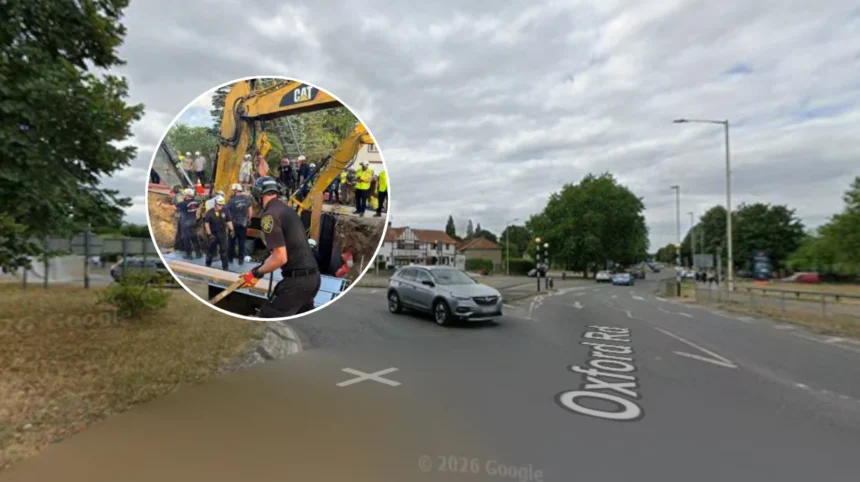
- Between 75 and 100 first responders used shoring panels and a vactor vacuum truck to clear unstable soil and free the man.
- The worker climbed out on a ladder at about 8:05 p.m. and was airlifted to a regional trauma center over concerns of crush syndrome.
- The incident is the second excavation collapse in Oxford Township and the third in Oakland County this summer.
- The Michigan Occupational Safety and Health Administration (MIOSHA) was notified right away and is investigating safety standards at the site.
OXFORD (Oxford Daily) September 3, 2026 – As reported by DeJanay Booth-Singleton of CBS Detroit, emergency response teams were dispatched at approximately 3:45 p.m. to the Brabb-Dewey subdivision in Oxford Township. Crews were engaged in converting local residential properties from septic systems to a new municipal sewer line when the perimeter wall of an excavation gave way.
According to Oxford Fire Department Chief Matt Majestic, as cited by Noelle Friel, Brandon Carr, and Mondrae Murphy of WDIV ClickOnDetroit, the 50-year-old contractor from Swartz Creek was walking alongside the open excavation when the ground beneath him fractured. The slide deposited him directly into the trench, trapping him from the waist down under dense, compacted earth.
Chief Majestic stated, as recorded by CBS Detroit, that “upon my arrival, I was the safety officer and was on the east side of the trench with him and maintaining verbal contact with him, talking to him the whole time, and he was doing really well”.
The excavation ground consisted of heavy, unstable material comprising sandy soil mixed with rocks and gravel. To prevent secondary collapses, the Oxford Fire Department requested mutual aid from the Oakland County Technical Rescue Team, drawing in specialized personnel across Michigan Mutual Aid Box Alarm System (MABAS) Division 3201. Between 75 and 100 first responders secured the structural integrity of the trench wall using protective shoring panels before deploying a vactor vacuum truck to suction away soil from around the trapped worker.
The technical rescue operation concluded at approximately 8:05 p.m. Upon being cleared, the worker insisted on climbing the extraction ladder unassisted.
What Role Did Safety Standards Play and What Medical Risks Remain?
As reported by Hoodline, the presence of a trench box inside the excavation was a pivotal factor during the collapse. Although the worker fell adjacent to the protective system rather than strictly within its shielded core, Chief Majestic confirmed through CBS Detroit that the metal boundary helped absorb the primary impact of the moving earth, preventing complete burial.
Despite remaining conscious and responsive throughout the four-hour procedure, medical protocol dictated immediate air evacuation via helicopter to a regional trauma center. Chief Majestic explained the primary clinical rationale to CBS Detroit: “Our biggest concern is that because he was in soil for so long from the waist down, that we have concern of compression”. Prolonged pressure on soft tissue carries a heightened risk of crush syndrome, a condition where toxins accumulate in restricted limbs and enter the bloodstream rapidly once the physical weight is removed.
As detailed in coverage by WDIV ClickOnDetroit, the Oxford Fire Department notified the Michigan Occupational Safety and Health Administration (MIOSHA) within 20 minutes of establishing a command perimeter. Investigators from MIOSHA and the Oakland County Sheriff’s Office are analyzing site maintenance, soil classification, and whether daily hazard evaluations were recorded accurately prior to the collapse.
Background of Oakland County’s Summer Trench Incidents
Tuesday’s emergency in Oxford Township represents the third significant trench collapse in Oakland County within roughly two months.
The pattern began on June 30 on Barber Road in Oxford Township, where a 35-year-old contractor from Ira Township was buried while installing field tile for a residential septic system. Rescuers extracted him after an extended rescue operation, triggering an ongoing MIOSHA investigation.
Less than 24 hours later, on July 1, a 25-year-old worker from Clarkston became trapped below the waist in neighboring Orion Township during a sanitary sewer excavation. In that instance, an adjacent earth wall failed around a trench box, inflicting lower extremity injuries that required emergency care at McLaren Oakland Hospital. Additionally, surrounding regions encountered severe outcomes during the same period, including a fatal trench failure in neighboring Livingston County that resulted in the death of a 23-year-old worker.
These events occur within a broader statewide context. Data from the Michigan Department of Labor and Economic Opportunity indicates that excavation work remains one of the most hazardous tasks in state construction, accounting for 31 fatalities over the past two decades. MIOSHA guidelines under Construction Safety Standard Part 9 mandate strict protective measures—including sloping, hydraulic shoring, or trench boxes—for any trench reaching or exceeding five feet in depth, alongside keeping excavated soil piles at least two feet away from the trench perimeter.
Prediction: How Will This Development Impact Construction Workers and Regional Infrastructure Projects?
The recurring failure of excavation walls across Oakland County is expected to prompt rigorous regulatory enforcement and operational shifts that will directly affect construction companies, municipal planners, and utility workers across Southeast Michigan.
1. Increased MIOSHA Scrutiny and Mandatory Site Audits
Following three high-profile technical rescues in the same county during a single summer, MIOSHA is likely to increase unannounced inspections across residential and municipal excavation projects. Construction firms operating in Oakland County may face heightened compliance checks focusing on soil stability checks, daily hazard evaluations, and soil displacement distances.
2. Mandatory Retraining on Trench Box Placement and Soil Behavior
Despite the presence of protective equipment like trench boxes at recent collapse scenes, worker positioning outside or along the perimeter of these boxes contributed to workers becoming trapped. Industry associations and labor unions are likely to implement mandatory re-certification programs emphasizing safe movement along trench perimeters, particularly when working in mixed, unstable soils comprising sand and gravel.
3. Delays and Rising Costs for Municipal Conversion Projects
Subdivisions undergoing infrastructure modernizations—such as converting aging septic setups into municipal sewer systems—may experience extended project schedules. Heightened safety protocols, additional shoring requirements, and potential stop-work orders during investigations will increase operational overhead for contractors, potentially leading to higher bid prices for upcoming municipal utility contracts across Oakland County.