Key Points
- Oxford City Council approved planning permission for a two-metre bronze sculpture named Origins.
- Zoologist, artist, and author Jonathan Kingdon designed the artwork.
- The sculpture will stand in the forecourt of the University of Oxford’s new Life and Mind Building, located at South Parks Road and St Cross Road.
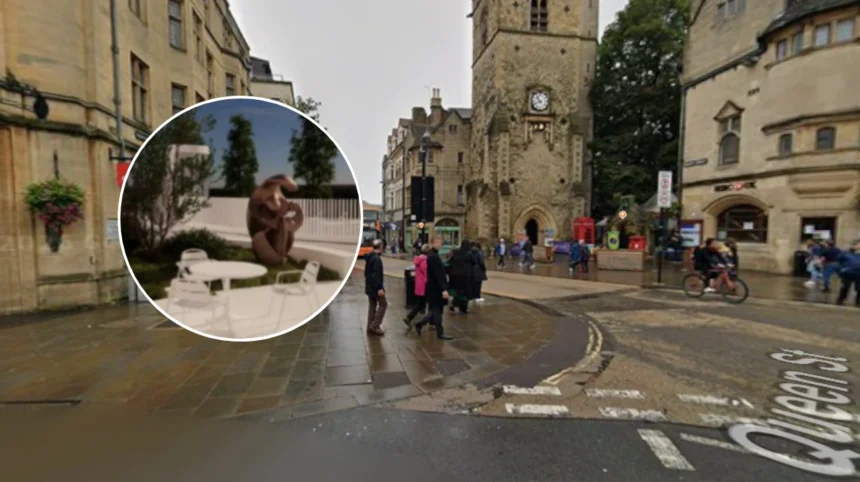
- Planning documents state the work depicts the origin of life, mother-offspring bonds, and evolutionary connections.
- Council planning officers described the sculpture as an “attractive and appropriate piece of public art” that adds visual interest and fits the local conservation area.
OXFORD (Oxford Daily) September 2, 2026 — A new two-metre-tall freestanding bronze sculpture is set to be permanently installed in central Oxford following formal planning approval granted by Oxford City Council. The artwork, titled Origins, has been created by zoologist, artist, and author Jonathan Kingdon and will take up a prominent location in the forecourt outside the University of Oxford’s newly constructed Life and Mind Building. Situated at the busy junction of South Parks Road and St Cross Road, the public art installation has been designed to provide a site-specific visual landmark at the intersection of Oxford’s science precinct and public thoroughfares.
As reported by local news reporting from the Oxford Mail, planning documentation submitted on behalf of the University of Oxford outlines that the two-metre bronze structure is intended to evoke “life’s emergence and to express the mothering principles as a source of existence”. The submission further details that the work examines both biological and emotional bonds connecting mother and offspring prior to and following birth, linking broader themes of evolution, care, and shared lineage directly to the academic research taking place within the adjacent facility.
Why was Jonathan Kingdon selected for the Life and Mind Building commission?
According to details published in the formal planning statement submitted to local planning authorities, the choice of artist directly aligns with the interdisciplinary ethos of the University of Oxford’s Life and Mind Building. Jonathan Kingdon holds a longstanding academic and artistic relationship with the city of Oxford, having built a distinguished career that bridges empirical science and visual arts.
As highlighted in the official planning statement, Kingdon’s background uniquely qualifies him for the site-specific installation: “His academic work has focused on biogeographic and anatomical aspects of evolution in mammals, including humans, while his artistic work has been exhibited internationally”.
The statement further explained the deliberate alignment between the artwork and its physical setting: “This dual contribution to science and art is particularly relevant to the Life and Mind Building, where interdisciplinary exchange and public engagement are central themes. Kingdon’s long-standing relationship with Oxford further reinforces the appropriateness of the proposal as a site-specific contribution to the university environment”.
By translating concepts of mammalian evolution and maternal care into a durable physical form, Origins serves both a scientific and symbolic purpose. The planning statement notes: “The work is therefore both scientific and symbolic in character, linking themes of evolution, kinship, care and shared origin in a manner that is especially resonant for a building dedicated to the life sciences and the study of mind and behaviour”.
How did Oxford City Council evaluate the planning application?
During the formal assessment of the planning application, local authority officers reviewed the spatial, aesthetic, and historical impact of placing a major bronze sculpture within the designated conservation zone.
As officially recorded by an Oxford City Council planning officer in the decision report, municipal authorities found the proposal fully compliant with local urban development and heritage policies. The planning officer stated: “The proposal is considered to be an attractive and appropriate piece of public art which would add visual interest within the forecourt and make a positive contribution to this part of the conservation area”.
The clearance allows contractors and installation teams to proceed with site preparation along the forecourt on South Parks Road. The bronze structure will be anchored into the hard landscaping surrounding the Life and Mind Building, ensuring public accessibility for pedestrian traffic moving between the University of Oxford’s science facilities and the city centre.
Background of Public Art and Academic Infrastructure in Oxford
The approval of Jonathan Kingdon’s Origins sculpture comes amid a broader, multi-year transformation of Oxford’s university infrastructure and public realm. The Life and Mind Building represents one of the largest capital development projects in the University of Oxford’s modern history, designed to bring together the Departments of Biology and Experimental Psychology under a single state-of-the-art facility.
Oxford City Council has consistently maintained planning policies that encourage developer-led and institutional public art contributions, particularly within conservation areas and major new building projects. Prominent public installations across the city—such as Antony Gormley’s Another Time XI figure atop Exeter College on Broad Street—demonstrate a long-established tradition of placing contemporary sculptures within historic academic landscapes.
Furthermore, public art installations in Oxford’s science corridors are routinely leveraged to demystify academic research for passing residents and visitors. By incorporating sculpture, landscape art, and visual installations directly into forecourts and communal pathways, the university and local authorities seek to foster public engagement with complex topics such as evolutionary biology, neurobiology, and environmental conservation.
Prediction: Impact on Local Stakeholders, Students, and the Public Realm
The introduction of Origins at the intersection of South Parks Road and St Cross Road is expected to influence local audiences and stakeholders in several key ways:
- For Students and Academic Researchers: The placement of a biologically inspired sculpture outside the main entrance of the Life and Mind Building creates an immediate visual identity for the facility. It serves as an everyday reminder of interdisciplinary collaboration, encouraging researchers in biology and psychology to consider the broader evolutionary and philosophical dimensions of their work.
- For Local Residents and Pedestrians: The installation adds a distinct cultural landmark along a major pedestrian route linking the city center to Parks Road and the University Parks. It elevates the visual quality of the public realm within the conservation area, offering accessible street-level art that does not require entry into a formal museum or gallery.
- For Visitors and Cultural Tourism: As part of Oxford’s expanding footprint of public art, the two-metre bronze installation will draw interest from art enthusiasts, architectural tours, and academic visitors. It reinforces Oxford’s reputation as a city where contemporary fine art and historical academic heritage continuously inform one another.