Key Points
- Westminster City Council sent a formal letter to the Ministry of Housing, Communities and Local Government demanding a full Environmental Impact Assessment for the Mayor of London’s Oxford Street pedestrianisation project.
- Council leaders said Transport for London and the Mayor’s office are using an environmental screening request to avoid standard safety and environmental reviews.
- Displaced traffic from Oxford Street could raise nitrous oxide pollution past legal limits on nearby roads, including Piccadilly and St James’s Park, according to the council.
- Officials warned that failing to manage traffic, noise, and waste controls could disrupt almost one million daily commuters, residents, emergency services, and local businesses.
- Transport for London submitted an Environmental Impact Assessment Screening Opinion to central government, which will decide if a full assessment is legally required before work begins.
WESTMINSTER — (Oxford Daily) September 1, 2026 — Westminster City Council has formally urged the UK Government to block attempts to bypass standard environmental checks for the Mayor of London’s project to pedestrianise Oxford Street, demanding a mandatory, full Environmental Impact Assessment (EIA) before any physical works begin.
- Key Points
- What Specific Concerns Have Local Leaders Raised Regarding Environmental and Safety Risks?
- How Might the Local and Capital-Wide Economy Be Affected by the Proposal?
- How Have Transport for London and City Hall Responded to the Demands?
- Background of the Particular Development
- Prediction: How This Development Can Affect London Residents, Businesses, and Commuters
According to reporting by Linus Rees of The Fitzrovia News, the local authority has raised serious concerns that proceeding without assessing air quality, traffic movement, noise levels, waste management, and public safety risks will cause significant detriment to central London. The council has argued that the current screening materials submitted by TfL provide an inadequate basis for understanding the scheme’s wider environmental and equality impacts across the capital.
What Specific Concerns Have Local Leaders Raised Regarding Environmental and Safety Risks?
As reported by BBC London, Deputy Leader of Westminster City Council, Cllr Tim Barnes, publicly criticized the current trajectory of the scheme, warning that a rushed implementation will harm residents and surrounding commercial districts. As noted in the broadcast, Cllr Tim Barnes stated that: “Our position on pedestrianisation is simple, if you must do it, get it right. A needlessly rushed scheme will be a disaster for residents and worse for business”.
Filming a video message from Piccadilly to highlight traffic displacement, Cllr Tim Barnes explained that even internal models from the Mayor’s team indicate that redirected vehicles could push nitrous oxide levels past acceptable targets in surrounding areas. As reported by Westminster Conservatives, Cllr Tim Barnes stated:
“It’s pretty well assumed by even the Mayor’s team that nitrous oxide levels will exceed the desired targets on Piccadilly as a result of the traffic displacement that will take place. But we don’t know the full extent of that. We don’t know what the impact will be in so many other areas because the Mayor is once again trying to cut corners”.
Furthermore, as covered by BBC London, Cllr Tim Barnes noted that key public safety bodies faced timing hurdles during the initial consultation stages, highlighting that the London Fire Brigade failed to get its official submission into the Mayor’s consultation in time. The council has urged a delay to ensure that comprehensive planning involves emergency services, proper policing, and robust traffic management models.
How Might the Local and Capital-Wide Economy Be Affected by the Proposal?
The economic stakes extend well beyond retail units located directly along Oxford Street. As reported by BBC London, Cllr Tim Barnes pointed out that the City of Westminster alone generates approximately 4 per cent of the UK’s total Gross Domestic Product (GDP). The surrounding commercial ecosystem—comprising finance, hospitality, and creative industries—could suffer significant fallout if surrounding arterial roads become chronically congested.
As reported by Air Quality News, Cllr Tim Barnes addressed the balance between environmental management and commerce, stating that:
“This scheme will have an impact way beyond Oxford Street affecting bus routes and traffic flow right across the capital. The Mayor has important questions to answer about managing traffic, noise, impact on air quality or how to clean the roads. The consequences of getting this wrong are potentially terrible for central London”.
Cllr Tim Barnes emphasized that requesting a full EIA is not an attempt to kill the pedestrianisation project, but rather to ensure the scheme is optimized. As stated by Cllr Tim Barnes to BBC London: “This isn’t about using the environmental impact assessment to stop the Oxford Street pedestrianisation. It’s about trying to make sure that the scheme that comes forward and what we see at the end of all of this process is as good as it can be”.
How Have Transport for London and City Hall Responded to the Demands?
As reported by The Fitzrovia News, Transport for London (TfL) confirmed that it has officially submitted an Environmental Impact Assessment Screening Opinion to the Ministry of Housing, Communities and Local Government. A representative for Transport for London stated that the central government’s determination on the screening opinion will clarify whether a full EIA is required by law, which will in turn influence the precise timeline for transformation works.
TfL took over as the highway authority for Oxford Street in September 2025, with the creation of the Oxford Street Development Corporation (OSDC) coming into effect in January 2026 to deliver Mayor Sadiq Khan’s vision of a pedestrianised shopping boulevard. City Hall maintains that transforming the thoroughfare will revitalize retail footfall, improve pedestrian safety on overcrowded pavements, and deliver a world-class public realm.
Background of the Particular Development
The ambition to pedestrianise Oxford Street has been a central point of political and logistical debate in London politics for nearly a decade. Mayor Sadiq Khan initially proposed transforming Europe’s busiest shopping street into a pedestrian plaza during his first mayoral term. However, previous iterations of the plan were repeatedly blocked or stalled due to firm opposition from Westminster City Council—under both Conservative and Labour leaderships—over concerns regarding bus rerouting, accessibility for disabled visitors, and severe traffic congestion spilling into residential side streets in Marylebone, Mayfair, and Fitzrovia.
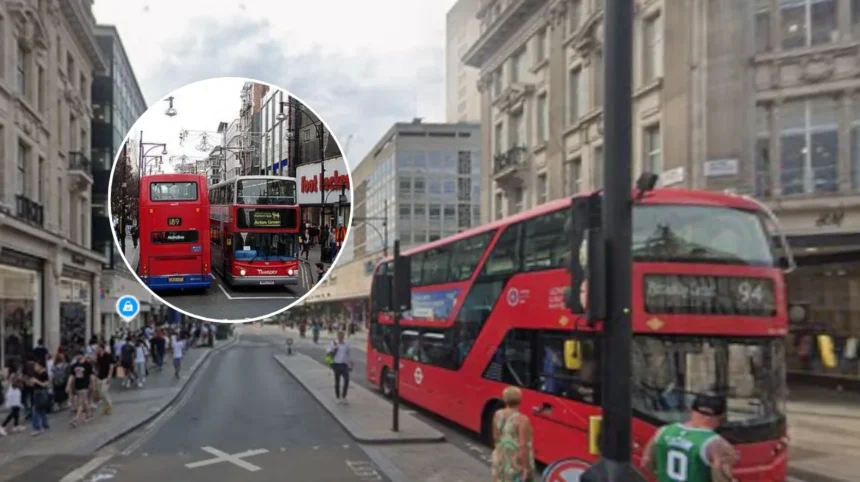
In late 2024 and throughout 2025, the Greater London Authority (GLA) moved to bypass local municipal deadlocks by obtaining direct statutory powers over Oxford Street. By assuming highway authority status and establishing the Oxford Street Development Corporation (OSDC), the Mayor’s office positioned itself to push forward physical changes. Despite statutory restructuring, the fundamental logistical challenge remains: Oxford Street serves as a vital east-west transit route across central London. Diverting hundreds of daily buses, delivery vans, and taxis onto surrounding narrow residential and commercial streets continues to trigger debate among urban planners, local representatives, and transport operators.
Prediction: How This Development Can Affect London Residents, Businesses, and Commuters
If the Ministry of Housing, Communities and Local Government grants TfL’s request to forgo a full Environmental Impact Assessment, initial physical works could proceed rapidly. However, bypassing a full EIA risks triggering formal legal challenges or judicial reviews from resident association groups and commercial landlords, potentially plunging the multi-million-pound regeneration project into costly court delays.
For the primary audiences affected by this development:
- Local Residents (Marylebone, Mayfair, Fitzrovia, and Soho): Residents are likely to experience immediate secondary impacts if traffic is redirected without strict mitigation. Side streets could see elevated noise, increased congestion, and heightened air pollution—particularly higher nitrogen dioxide ($NO_2$) levels. Night-time deliveries and municipal waste collection could also become major pain points if loading access is restricted on Oxford Street.
- Commuters and Transport Users: Approximately one million commuters travelling into Westminster daily face significant route alterations. The removal of bus routes from Oxford Street will force passengers to rely on diverted, potentially slower routes through surrounding streets or walk longer distances to reach key destinations, impacting those with mobility limitations.
- Local Retailers and Businesses: While major retailers directly situated on Oxford Street stand to gain from increased footfall and improved street aesthetic, surrounding businesses in adjacent streets may suffer. Gridlocked delivery access and increased traffic congestion on secondary commercial streets could disrupt supply chains and lower customer accessibility, potentially dampening trade in the broader central London economic zone.